 |
| Reblogged from come correct |
Showing posts with label sexuality. Show all posts
Showing posts with label sexuality. Show all posts
Sunday, December 30, 2012

"The important thing is that we cease treating sex as something shameful, and an aspect of life separate from all the rest. We need to make decisions about sex and evaluate them in the same framework which we use to judge worth of our other capacities, be they our intelligence, intuitions, physical stamina or prowess, or other special talents."
--Lester A. Kirkendall, Premarital Intercourse and Interpersonal Relationships (1961)
(via WYSIWYG)
Wednesday, December 19, 2012
Fascinating mini-doc about (the lack of) open sexuality in Africa
EATEN BY THE HEART (Interview excerpts) by ZINA SARO-WIWA from ZSW Studio on Vimeo.
The man describing learning how to kiss (presumably as an adult) and having to teach himself to find it pleasurable is the critical moment of this short film to me.
The man describing learning how to kiss (presumably as an adult) and having to teach himself to find it pleasurable is the critical moment of this short film to me.
"Of course, not all women of color are sexualized in the same way. For example, while Black women are considered lascivious, always consenting, and out of control, Latina women are considered exotic or overly sensual, and Asian women are considered childish and prude. These particular stereotypes are reinforced through popular culture and pornography...The common thread here is that non-White women's sexuality is seen as outside the norm of White heterosexuality. It's therefore something to be uniquely desired, manipulated, extorted, or controlled. Within this rather toxic climate, being a woman of color who's in touch with her sexuality is an act of resistance. Pushing past the negative media depictions and still finding a healthy, healing, erotic, and functional sexuality is no small feat."
--Samhita Mukhopadhyay
Tuesday, December 18, 2012
This person wins today.
"I hate how the phrase 'have some self-respect' is used to shame women who are comfortable with their sex lives. 'Have some self-respect?' I do respect myself; that's why I wanna have a fucking orgasm tonight, thank you very much."
(via come correct)
Sunday, December 9, 2012
Friday, November 16, 2012
"Fyi, for me, 'ho tapes' are the internal voice that black women hear when they are debating whether or not to engage in a sexual act. Often times, the politics of respectability play a role, and I theorize that often our 'ho tapes' stop us from experiencing pleasure, or they allow us to center the pleasure of another while making our own secondary."
--MDotWrites, of New Model Minority
(via come correct)
Wednesday, August 8, 2012
What I love about being queer is the ability to grow and transform my sexuality. The recognition that our sexualities are complex and ever evolving, just as every other part of us, is a blissfully freeing thing. Regardless of anything else in the entire world, I am not bound by anyone else’s rules beside my own. Queer is freedom, possibility and space.
Friday, June 22, 2012
“Society has a problem with female nudity when it is not… ” —Badu pauses to get her words together; she wants this point to be very clear— “…when it is not packaged for the consumption of male entertainment. Then it becomes confusing.”
--Erykah Badu: June/July Cover Issue|Pg 1|VIBE Magazine
(via Indie Art Nerd)
Saturday, May 26, 2012
I may have coined a term on Twitter the other day.
I tried Googling it and came up with no hits, so maybe I'm the first (in spaces privileged enough to be cataloged on the internet). And now, like any good academic, I am going to define it.
sex subject (n.) a person enthusiastically engaged in the attainment of their own sexual pleasure, with or without the involvement and pleasuring of another person(s). Viewing yourself and others as sex subjects entails the recognition of sexual partners as whole persons with valid sexual desires and the right to choose whether or not to act on them at any particular time rather than just sources of sexual pleasure, as well as an awareness that your partner(s)' body and company are privileges that your partner(s) choose(s) to share with you, not rights or de-personified items to which you are entitled. Ant: sex object
(Now you have something to cite, ChoosingPancakes.)
I welcome commenters with ideas to flesh this term out a little.
sex subject (n.) a person enthusiastically engaged in the attainment of their own sexual pleasure, with or without the involvement and pleasuring of another person(s). Viewing yourself and others as sex subjects entails the recognition of sexual partners as whole persons with valid sexual desires and the right to choose whether or not to act on them at any particular time rather than just sources of sexual pleasure, as well as an awareness that your partner(s)' body and company are privileges that your partner(s) choose(s) to share with you, not rights or de-personified items to which you are entitled. Ant: sex object
(Now you have something to cite, ChoosingPancakes.)
I welcome commenters with ideas to flesh this term out a little.
Thursday, April 19, 2012
“I don’t care how much sex anyone has, how often they do it, or who they do it with. I’m much more interested in the consent, pleasure, and well-being of the participants and the people affected by it. I respect women who are asexual, celibate, monogamous, multi-partnered, or have had more partners than they can recall. I respect women who only have sex after a commitment to monogamy and those who have sex with someone within minutes of meeting them. I respect women who have transactional sex, women who have sex for love, or for any other reason. I know that all of these categories are permeable and that many women move from one to another. And I know that any of these decisions can be made from a place of personal power, choice, and authenticity, as well as from a place of coercion, shame, and disempowerment.”
- Charlie Glickman (If You Don’t Respect Sluts, You Don’t Respect Women)
(via come correct)
Wednesday, April 18, 2012
Foreign Films are really cool.
This one is Norweigan, about a teenage girl coming into and wanting to express her sexuality, and then actually acting on it. WE DON'T HAVE SHIT LIKE THIS IN AMERICA.
From the website:
Turn Me On, Dammit! trailer
Sadness: It's coming to DC at the beginning of June, and I won't move until the middle of June at the earliest. I need to find a way to pirate indie films. XD
From the website:
Trailer:TURN ME ON, DAMMIT! is a whimsical and refreshingly honest coming of age story about the blossoming sexuality of a teenage girl, set to open in theaters on Friday, March 30. The feature debut of Jannicke Systad Jacobsen, the film was awarded “Best Screenplay” at the Tribeca Film Festival, “Best Debut Film” at the Rome Film Festival, and “Best European First Feature” at the Mons International Love Film Festival (Belgium).
15-year-old Alma (Helene Bergsholm) is consumed by her out-of-control hormones and fantasies that range from sweetly romantic images of Artur, the boyfriend she yearns for, to down-and-dirty daydreams about practically everybody she lays eyes on. Alma and her best friend Sara live in an insufferably boring little town in the hinterlands of Norway called Skoddeheimen, a place they loathe so much that every time their school bus passes the sign that names it, they routinely flip it off. After Alma has a stimulating yet awkward encounter with Artur, she makes the mistake of telling her incredulous friends, who ostracize her at school, until Sara can’t even be seen with her. At home, Alma’s single mother is overwhelmed and embarrassed by her daughter’s extravagant phone sex bills and wears earplugs to muffle Alma’s round-the-clock acts of self-gratification.
Laced with warmth and quirky humor, TURN ME ON, DAMMIT! is a light-hearted take on a story that is told so often about boys and so rarely about teenage girls.
Turn Me On, Dammit! trailer
Sadness: It's coming to DC at the beginning of June, and I won't move until the middle of June at the earliest. I need to find a way to pirate indie films. XD
Friday, March 9, 2012
Two things I've read recently on come correct have me thinking about female sexual discovery.
I will quote them for you in full.
1. "Nobody told me I had a clitoris. Nobody told me I was capable of having orgasms. For five years I was given 'sex education.' It mostly consisted of periods and condoms. It didn't talk about consent. It didn't talk about the actual mechanics of sex, about arousal and lubrication and oscillation. It didn't tell me a single thing about relationships and it didn't tell me I had a clitoris. I only know now because of the internet. Nobody entrusted with my care and education has ever told me that the female orgasm exists, or about the parts of my anatomy necessary for it. I didn't find my clitoris until I was eighteen, after six years of active sexuality. That made me angry."
2. "Although most boys figure out how to bring themselves to orgasm by age thirteen, half of girls don’t have their first orgasms until their late teens, twenties, or beyond. Teenage girls widely agree that they get the message loud and clear that masturbation is something boys do, but girls don’t, can’t, or shouldn’t. The cultural focus on intercourse tells young women to expect they’ll begin to experience sexual pleasure once they have sex with a man (whether or not they’re even interested in sex with men). Nearly all teen boys, on the other hand, experience sexual pleasure long before they get their hands—or other body parts—into a partner’s pants. Despite the massive advances in women’s equality, young women’s sexuality is stuck in a surprising paradox. Young women are sold provocative clothes but aren’t taught where to find their own clitoris. Many girls give their boyfriends oral sex, but are too uncomfortable with their own bodies to allow the guys to return the favor. It’s still a radical act to say that women need and deserve access to information about their own sexual pleasure—not just about the risks and negative consequences of sex."
-- Dorian Solot, I Love Female Orgasm: An Extraordinary Orgasm Guide. (via)
Let me begin by stating that I do not, in any way, want to belittle or invalidate the experiences of the first woman, and/or women who can identify with that story, or those of the young women describe in the second passage. Secondly, I am all kinds of entirely in support of revamping the sex education system in this country to like, actually be somewhat useful in people's lives. While it was not really my experience at all, I recognize that we live in a culture that denigrates or, at best, avoids the topic of female masturbation, and if you know anything about me, you know that this pisses me off.
All of that being said, I just...fundamentally don't understand how one can get to adulthood (or near-adulthood) without knowing one's own anatomy. Yeah, okay, maybe you don't know the WORDS for what each body part is called, because sex education sucks in this country, but I guess I'm just struggling with the concept of needing to be "taught" that one has a clitoris. I don't remember when I learned the word clitoris. It was probably in high school. But I've known that touching/rubbing a particular spot down there feels ah-ma-zing since I was about 8 years old. I think I discovered it accidentally when I was taking a bath or going to the bathroom or something, but I had already been exploring my body. I very distinctly remember my stepbrother, who is a few months younger than me, once making the argument when we were small children that girls pee out of their butts, and while I knew that wasn't true and explained that there was another hole. Very soon after this conversation, I decided that I wanted to know more of what it looked like, so that I could better debunk my silly brother's arguments, so at the next opportunity of a full length mirror (in my aunt's room at my grandmother's house), I dropped my pants, bent all the way over, and looked at myself upside down with my head between my legs.
I don't remember my first orgasm, but I know that it was most likely in about the third grade. I hadn't needed anyone to tell me these body parts existed in order for me to explore them, and exploring them led directly to pleasure, so I explored rather often. The first time I was ever even exposed to the concept that some people thought this was a bad thing to do was in a book on puberty that was probably called Your Changing Body or something equivalent that my mother bought for me after I first got my period (at the age of 9). I feel like there was like, one page about masturbation, and somewhere in it it contained the line "Some girls don't like to do it," or something similar. I felt sorry for those girls then, and I still do.
I guess what I take issue with in these passages is the implied idea that one needs to be formally introduced to something to have any conception of it. It gives me the eerie sense that a woman's sexuality is something she needs to be taught or GIVEN by someone else, rather than something inherently part of herself, and that doesn't sit well with me. I never really got the "masturbation is something boys do, but
girls don’t, can’t, or shouldn’t" thing--in fact, I can't really remember it ever being mentioned at all, besides by my female cousin once when we were eleven and twelve, so where does that message come from? I'm not denying its existence--I believe them--I just want to know from whence it stems so I can know what to take issue with and how to fight it. I feel like I discovered my own sexual nature and the ability to pleasure myself organically at a young age like these passages suggest boys do, and I don't understand why so many women didn't have the same experience.
Why do you assume your children are straight?
I think that more kids have 'crushes' on persons of the same gender than would report having done so as children when they're adults, because we're socialized to call those feelings 'friendship.'
This came up in conversation between me, Choosing Pancakes, and JB a while ago. I wrote it down because I really liked what I had said, and figured I would elaborate on it at some point. As I rant about a little in my guest post over at Met Another Frog this week, I hate that we live in a culture that assumes heterosexuality. Even more than that, I hate when people try to justify the assumption of heterosexuality by saying that the vast majority of the population is heterosexual. First off, majority rule should never be used to effectively erase the minority's existence from public discourse or recognition. That's just a fact. But secondly, and more throw-off-your-understanding-of-how-the-world-works-y, that argument ignores the fact that living in a culture that assumes heterosexuality socially encourages people to assume heterosexuality on a personal level too.
Members of the LGBTQ community often respond to others' questioning about their sexuality with denial; I know I did. I honestly don't know how my friend CC even dealt with me, unless she recognized my denial/rejection as the early stages of self-acceptance; I remember having an incredibly problematic conversation with her sometime at the beginning of my sophomore year about how I'd be uncomfortable living with a lesbian (a disgusting blanket statement I no longer endorse in nearly any form, the one remaining form being living with a lesbian who was interested in me but whom I was not interested in, because that would just be awkward). I remember junior year being at a party and her flat out asking me, in front of KS, whether I was bi-curious. I brushed it off, but she could tell I was bluffing.
The ONLY reason we ever feel we have to bluff about our sexualities, sexual practices, and sexual orientations, is because we live in this society that drills into our heads from the earliest days that sex (and thus romantic interest and flirting and love) is something that happens between a man and a woman (insert whatever variations you were raised with regarding constructs like love and marriage here). In all seriousness, I ask you, what is the difference between best-friend-ship and "interest" when you're seven? Little kids know that they like being around certain other little kids, and I'm convinced that we'd have a lot of people who are both more versed in and comfortable with their sexualities if we didn't put a million constraints around that liking from Day One.
Even the most idiotic advise we give to children about dating and relationships and flirting is gendered. I swear, I want to brand anyone who tells a little girl that some little boy is hitting/pinching/pushing/being mean to her "because he likes her" as unfit to be around children. You're actually just priming that child to accept physical and emotional abuse from men for the rest of her life, you asshole. But think about it--when boys fight with each other or bully each other, no one says it's because one of them caught feelings for the other. There is no idiotic insertion of romance in a spat between little girls. There is also no--perhaps fully warranted--insertion of romance into two little girls holding hands while they walk down the street. We raise our children to understand the same actions--the holding of a hand, the giving of a smile, etc.--as insignificant when between persons of the same gender, and as potentially meaning "EVERYTHING" when between persons of different genders. Yes, love and lust and romanticisim are contextual. I'll give you that. But our society demands that children be grounded in one particular context while regarding all others as deviant--if they recognize them at all.
I don't think I knew that romance and love and sex could exist between people of the same gender until I was in middle school. THAT is an act of erasure, no matter how you want to frame it, and it's not fair to anyone. Even if a child is going to grow up to only be romantically interested in persons of the so-called "opposite" gender--which is absolutely 100% perfectly fine--they should understand that interest as it exists along the spectrum of possible interests, not as the way interest works.
This came up in conversation between me, Choosing Pancakes, and JB a while ago. I wrote it down because I really liked what I had said, and figured I would elaborate on it at some point. As I rant about a little in my guest post over at Met Another Frog this week, I hate that we live in a culture that assumes heterosexuality. Even more than that, I hate when people try to justify the assumption of heterosexuality by saying that the vast majority of the population is heterosexual. First off, majority rule should never be used to effectively erase the minority's existence from public discourse or recognition. That's just a fact. But secondly, and more throw-off-your-understanding-of-how-the-world-works-y, that argument ignores the fact that living in a culture that assumes heterosexuality socially encourages people to assume heterosexuality on a personal level too.
Members of the LGBTQ community often respond to others' questioning about their sexuality with denial; I know I did. I honestly don't know how my friend CC even dealt with me, unless she recognized my denial/rejection as the early stages of self-acceptance; I remember having an incredibly problematic conversation with her sometime at the beginning of my sophomore year about how I'd be uncomfortable living with a lesbian (a disgusting blanket statement I no longer endorse in nearly any form, the one remaining form being living with a lesbian who was interested in me but whom I was not interested in, because that would just be awkward). I remember junior year being at a party and her flat out asking me, in front of KS, whether I was bi-curious. I brushed it off, but she could tell I was bluffing.
The ONLY reason we ever feel we have to bluff about our sexualities, sexual practices, and sexual orientations, is because we live in this society that drills into our heads from the earliest days that sex (and thus romantic interest and flirting and love) is something that happens between a man and a woman (insert whatever variations you were raised with regarding constructs like love and marriage here). In all seriousness, I ask you, what is the difference between best-friend-ship and "interest" when you're seven? Little kids know that they like being around certain other little kids, and I'm convinced that we'd have a lot of people who are both more versed in and comfortable with their sexualities if we didn't put a million constraints around that liking from Day One.
Even the most idiotic advise we give to children about dating and relationships and flirting is gendered. I swear, I want to brand anyone who tells a little girl that some little boy is hitting/pinching/pushing/being mean to her "because he likes her" as unfit to be around children. You're actually just priming that child to accept physical and emotional abuse from men for the rest of her life, you asshole. But think about it--when boys fight with each other or bully each other, no one says it's because one of them caught feelings for the other. There is no idiotic insertion of romance in a spat between little girls. There is also no--perhaps fully warranted--insertion of romance into two little girls holding hands while they walk down the street. We raise our children to understand the same actions--the holding of a hand, the giving of a smile, etc.--as insignificant when between persons of the same gender, and as potentially meaning "EVERYTHING" when between persons of different genders. Yes, love and lust and romanticisim are contextual. I'll give you that. But our society demands that children be grounded in one particular context while regarding all others as deviant--if they recognize them at all.
I don't think I knew that romance and love and sex could exist between people of the same gender until I was in middle school. THAT is an act of erasure, no matter how you want to frame it, and it's not fair to anyone. Even if a child is going to grow up to only be romantically interested in persons of the so-called "opposite" gender--which is absolutely 100% perfectly fine--they should understand that interest as it exists along the spectrum of possible interests, not as the way interest works.
Thursday, February 23, 2012
Questions Raised at the Black Solidarity Conference
(by myself and others)
...New Haven also has some great places to shop. I'm not gonna lie.
- What does it mean to be a Black sexual being?
- How are people given the opportunity to be engaged in their sexuality?
- Do people engage in sexuality differently according to access to various resources?
- Why are today's young people, especially young women, being so miseducated about their own bodies?
- Why is abortion what we leap to when talking about sexuality? Why single-motherhood? Why monogamy and marriage? What narratives are being ignored when our conversation centers itself around these topics? How can we refrain from institutionalizing sexuality?
- What is the difference between talking about sexual practices and talking about sexuality?
- What are the everyday ethics of Blackness that determine who can or can not be in the community?
- What is the impact of geographic region on gender presentation?
- How do we work against the sociohistorical pathologization of Black bodies?
- If Black women have never really fit into the definition of womanhood presented by dominant (White) society, what are our goals in the redefining of gender roles? What does that redefinition mean for us?
- Why can't Brothers see themselves in women the way Sisters can see themselves in men?
- How do we disaggregate criticism from "haterism"?
- Why is the "walk of shame" a female-specific term?
- Why are Black communities so obsessed with "presentability"? Why is who we are not enough? What are we overcompensating for?
- How much experimentation with gender presentation is internal, having fun, and expressing ourselves, and how much is in response to our expectations of others' reactions to our presented selves?
- How do we get rid of the idea that to participate in Blackness, we have to debase ourselves?
- How do we reconcile promoting cultural criticism with promoting solidarity and/or the presentation of a unified front?
- How does harkening back to our African past influence, isolate, and/or negate the experiences of people living in Africa today or who came to America from Africa recently?
- What does the phrase "I see you" signify in Black communities?
- When can we, as Black peoples, OWN our sexuality?
...New Haven also has some great places to shop. I'm not gonna lie.
Monday, February 20, 2012
I don't like Nicki Minaj, but I will recognize when she says something awesome:
“When I started making those weird voices, a lot of people told me how whack it was,” she says, “‘What the fuck are you doing?’ they’d say. ‘Why do you sound like that? That doesn’t sound sexy to me.’ And then I started saying, Oh, that’s not sexy to you? Good. I’m going to do it more. Maybe I don’t want to be sexy for you today.”
- Nicki Minaj (BlackBook Magazine)
Sunday, February 19, 2012
The most amazing acting experience of my life.
I really don't even have words for how phenomenal an experience being in The Vagina Monologues was. Seeing it last year was...revolutionary towards my overall lifestyle and most likely played a non-trivial role in my extended deep exploring of my sexuality and sensuality. Fact: I actually went home after that performance last year, took all my clothes off, grabbed a mirror, laid down on my bed, and looked at my vagina, because I hadn't actually seen it since I was a little kid bending over in the full-length mirror in my aunt's room because I was curious. I thought it was beautiful and I understood why people have historically compared it to a flower. And a few weeks later when my ex wanted to turn on the light and look at me, really see my vagina and have a better understanding of its anatomy and the ways in which he could please me, I was a little freaked out, but I wasn't ashamed to let it happen. It wasn't the most comfortable thing ever, but I had learned to resent the idea that my body should embarrass me with people that I'm comfortable enough to be intimate with. The Vagina Monologues started that in me. I have to agree that I didn't actively think of my vagina as "something attached to me," or really think about it at all, before seeing the show last year. And as I laughed, cried, gasped, and smiled during the performance, I knew that I had to be involved this year.
So despite not being where I wanted to be thesis-wise, I auditioned. I wanted to perform "He Liked to Look at It," which is arguably my favorite of the monologues, but I got selected to perform "I Was There In The Room," which is about witnessing someone give birth. Oh, the irony. I wasn't really a fan of this monologue, because birth freaks me the fuck out beyond like, nearly anything else that involves vaginas (
My favorite lines from my monologue:
"We forget the vagina. All of us. What else could explain our lack of awe? Our lack of reverence?"Awe. Reverence. These are feelings I want every woman to have about her body, every person to have about hir own self. But I don't think they're things I've fully internalized about my own body and my own self, and especially not about my "down there."
Being in the show has made me realize that I really don't have a word I feel comfortable referring to my vagina as...which translates into me actually never referring to it at all, which I think makes it easier to not think about it often (or as something that is a part of me, because what other parts of my body do I not give names to? Perhaps my nipples. I'm unsure that I ever directly refer to them either. I should work on that. Or that space behind my knee that doesn't actually have a name because who ever needs to refer to it? I don't want my vagina and my nipples to be in the same category as the useless space behind my knee.) There is a power in naming things. I don't want to sacrifice that power. But "vagina" is so...clinical and just un-sexy. I don't really like "pussy" or "cunt". Things like
"va-jay-jay" are just...no. There are other words, I'm sure, but I am positive that this disinclination towards referencing my vagina is intricately linked to my general disinclination towards talking during sex, which I know I'm not comfortable with. So maybe I need to spend more time figuring out why I don't like particular words for the vagina and discovering one I do like, because I want to be able to employ the ownership enabled by having terms for things.
We have a student-written monologue about...basically when sex doesn't feel good. She talks about not enjoying sex with her ex-boyfriend, and she describes it as "mechanical". That word floored me the first time she used it, because I think it would be inaccurate to say that I've never been bored during sex. I have a distinct memory of being with someone, being on top and just going up and down, up and down and not being particularly into it...but it was just for a little while and then I got out of my head and more into the moment. I didn't regret the experience overall. But her monologue has made me wonder a) whether I should have, and b) if I've been having bad sex, or worse sex than I'd previously thought I've been having. I've turned down sex recently and I doubt that my experiences listening to this monologue and that fact are unrelated. She and her vagina deserve better than mechanical sex, and so do me and mine.
We were supposed to have a transgender woman perform a monologue about what it means to be a vagina-less woman, and though she didn't actually perform with us due to unfortunate circumstances (the details of which I do not know), her story is making me think more about what it means to be a woman. (I'm also interested in whether transgendered individuals do more to fight or support gender normativity, but that's another thought train for another time.)
But even apart from the specifics of various monologues, there was something profound about being in this show, and especially about staging the show the way we did it, with the cast members "hiding" in the audience. The cast members got the audience to participate very heavily, from reading intros for various pieces to grabbing hold of a performer's breasts during an orgasm scene. The energy in that room was palpable, and it was all revolving not only around sex and sexuality, which is not terribly uncommon, but around VAGINAS. We were celebrating them, and helping to create a space in which they could be openly and comfortably celebrated was...transformative.
Moral of this story: If you've never seen The Vagina Monologues, go buy the book. And/or find a local performance to go to next February.
To commemorate this experience, I purchased this necklace on from LipsLikeCherry's etsy store. (You can find ANYTHING on etsy.)
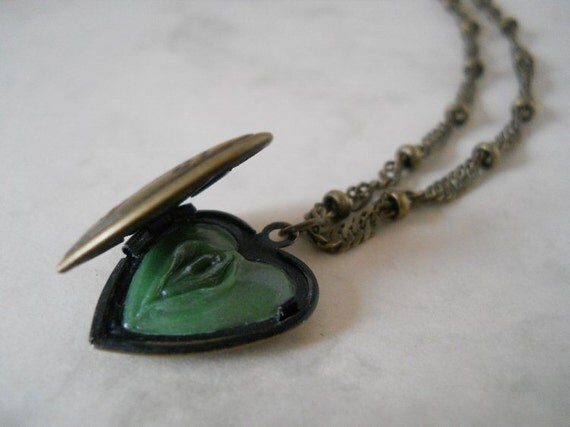 | |
| Yes, that is a vulva. |

Saturday, February 4, 2012
Always always always have sex on your own terms
There’s this notion that you can only be “not ready” to have sex when it’s your first time. You can be indecisive and wishy washy when you’re a virgin because, yes, sex can seem terrifying. But once you take the plunge, it should be a cinch for the rest of your life. Telling someone “I’m not ready” when you’re 23, after you’ve already slept with a handful of people and maybe even had a one-night stand, is met with utter confusion. “What is there to be ready for exactly? You know what’s coming to you. It’s come before.”
It doesn’t matter how much sex you have or haven’t had. You can always not be ready. And it’s usually a good thing. It usually means “I like you. Having sex would be too easy and I don’t want this to ever be easy or expected.”
--
Wednesday, February 1, 2012
I don't like sexuality labels.
On the most recent survey I filled out, I picked Queer over Bisexual because queer has a broader meaning, but I still prefer "heteroflexible" as the best representation of my place along the sexuality spectrum at this particular point in time. I've talked about how checking sexual orientation boxes is difficult for me before (here), and I unsurprisingly really really can't stand it when people try to invalidate other people's sexual identities--or any other identity, because by the simple virtue of not being me, you (hypothetical rando trying to tell me about myself) cannot say who or what I am or am not. Fact of life. Get over it.
Anyway, evidently Cynthia Nixon, the woman who played Miranda on Sex in the City (which has become one of the shows I will watch whenever it is on television), told the New York Times that her identity as gay is a choice, and various factions of LGBTQQIA communities freaked the fuck out. She tried to explain later that she chooses to identify as gay because she doesn't like the way Bisexual sits, and they were like, 'Oh so you're bi and just denying.' Pause. People. Explain to me how persons of various sexual identities who have banded together in order to demand public visibility and acceptance can render her identity choices and preferences invalid? 1) you are perpetuating the very same things you're fighting against. 2) NO MATTER WHO YOU ARE, YOU CAN'T TELL HER WHO SHE IS. You just can't. It doesn't work like that. If she had implied that everyone's sexuality is a choice, which she expressly said she was not doing, you could raise the issue that that viewpoint is problematic for any of 2987904734 reasons. You can't say fuck your opinion of yourself, Cynthia Nixon, this is what you are because we said so. No.
Anyway, evidently Cynthia Nixon, the woman who played Miranda on Sex in the City (which has become one of the shows I will watch whenever it is on television), told the New York Times that her identity as gay is a choice, and various factions of LGBTQQIA communities freaked the fuck out. She tried to explain later that she chooses to identify as gay because she doesn't like the way Bisexual sits, and they were like, 'Oh so you're bi and just denying.' Pause. People. Explain to me how persons of various sexual identities who have banded together in order to demand public visibility and acceptance can render her identity choices and preferences invalid? 1) you are perpetuating the very same things you're fighting against. 2) NO MATTER WHO YOU ARE, YOU CAN'T TELL HER WHO SHE IS. You just can't. It doesn't work like that. If she had implied that everyone's sexuality is a choice, which she expressly said she was not doing, you could raise the issue that that viewpoint is problematic for any of 2987904734 reasons. You can't say fuck your opinion of yourself, Cynthia Nixon, this is what you are because we said so. No.
"Simply slapping a label that says “bisexual” onto Nixon — or me, or anyone else who falls outside a clearly delineated gay/ straight dichotomy — and expecting that to be the end of the conversation is reductive, simplistic, and insulting to everyone whose sexuality is somewhere in the gray area." --Lindsay Miller, Thought CatalogIn fact, I think that trying to do this is absolutely antithetical to the recognition of sexuality as a spectrum. Anyone who is working towards that goal should celebrate sexual identity as an individual process of self-acceptance and definition, rather than a forced matching to societal standards (even as those standards become more "progressive"). Let her identify how she wants and me identify how I want and everyone identify however they want because they are who they are and that's just how it is.
Subscribe to:
Posts (Atom)