Showing posts with label black people. Show all posts

Thursday, December 27, 2012

"People of color have to learn White culture for survival. White people learn Brown and Black culture for 'ghetto' jokes."
--Sara David

(via Free Bird)

It may surprise much of my readership, but I actually pretty vehemently disagree with this quote as a blanket statement. 

First, I would like to henceforth officially dismiss the term "[race/ethnicity] culture" from any and all popular discourse. Every group of people, no matter how specific you get to narrow them down, has cultures, plural. Urban Northern Black culture is very different from rural Southern Black culture, which is very different from Afro-Caribbean culture, which is very different from the cultures of recent African immigrants. The same goes for the cultures of various places in Latin America--Mexican culture is not Cuban culture is not Dominican culture is not Brazilian culture, etc. Even White culture is not a monolith--think about Midwestern US culture v. Californian surfer culture v. preppy New England culture. This is just an improper standpoint from which to discuss anything.

Secondly, I feel like this quote assumes that people of color grow up in environments mainly or entirely composed of other people of color, and have to venture out into the White world and fight and learn on their feet to make it because everything is so different. Bitch, please. My first best friend was White (as were the overwhelming majority of my closest friends until college), the first boy I couples skated with at our local skating rink was White, my first kiss was with a White boy, all of my teachers were White until high school. I could go on. Things typically described as "Black culture" involved much more active trying to learn on my part, as they were not part of my everyday lived experiences. What are you calling White culture here, anyway? Are you equating it with mainstream culture? Like, pop music and sitcoms? Because NSYNC was the first concert I had tickets to and Boy Meets World and Sabrina the Teenage Witch were as much a part of my childhood as The Cosby Show and Sister, Sister. You're arrogant as fuck if you assume that all Black and Brown people grew up outside of the mainstream. 

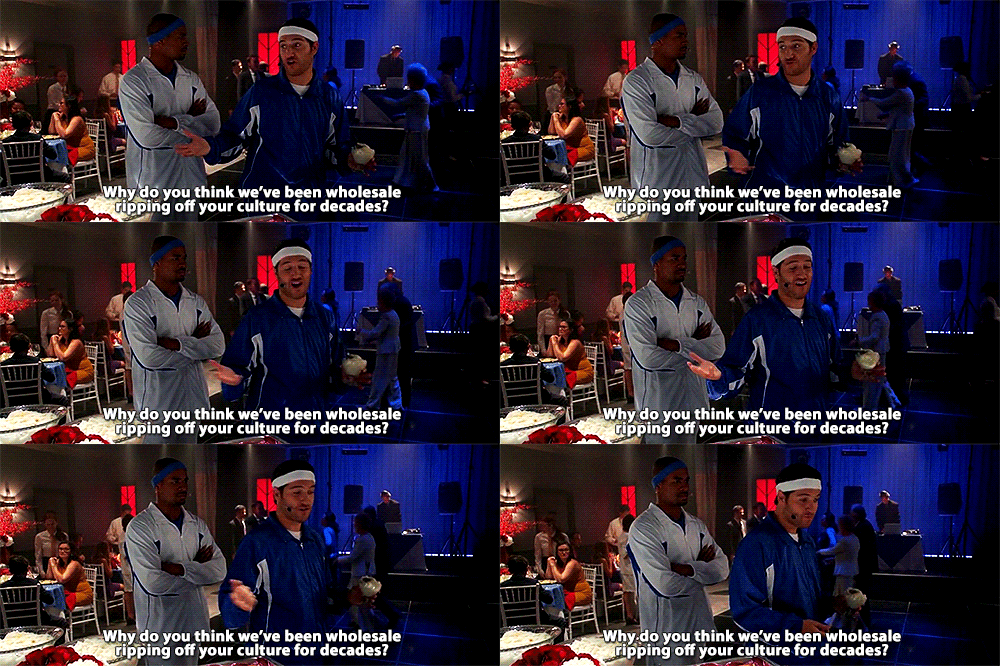
Thirdly, and this is related to my first point, I don't think that every time a White person, or a person of any race, for that matter, adopts things that are generally associated with persons of another race, they do so with malice in their hearts. Also, I don't agree with the idea that people of a certain race somehow have a more authentic claim to certain elements generally assumed under "[that race]'s culture"--for example, during a conversation with WYSIWYG a few weeks ago, I shocked her by saying 
"I don't really see why teen white boy asshat who thinks he's legit because he listens to rap is really that much different than teen black boy asshat who thinks he's legit because he listens to rap. Sure, we started it, but why does that give us some universal claim of authentically owning [rap music] or something? It's a culture you can play into or not play into."
And that's a viewpoint I stand by. If you try to tell me there are no Black and Brown people in the world making ghetto jokes, you're a damned liar. I don't see why the offensiveness of a 'ghetto' joke should vary depending upon the color of the skin of the person who makes the joke, just like I don't see why we assume that Black and Brown people are somehow more significantly linked to "the ghetto" than are White people. You're either of that kind of a background/situation or you're not. End of story. 

Sincerely,

A Black Girl who Grew Up in Suburbia

Wednesday, December 19, 2012

"In North America, the Black immigrant is used to downgrade the North-American-born Black population; in Europe, the North American Black is used to downgrade the Black European and African and Caribbean permanent residents there. Each instance allows the dominating populations to conceal their racism by appealing to a worse racism elsewhere and by castigating the resident population for failing to excel under the status quo. How often have I heard American Blacks speak of how wonderfully they were treated in Europe! My experience--perhaps from looking too African in Brussels or too Black in Prague--is that European Whites are not particularly different than U.S. Whites when they think the Black is one of their "own," which ironically includes the type of immigrants they are used to."
--Lewis Gordon

Sunday, December 16, 2012

All of this.

"I want to talk about intimacy. I want to talk about desire. I want to talk about fucking. I want to talk about touch.
I want to talk about how Black and Brown bodies are denied these things. I want to talk about how Black and Brown bodies thirst for these things. I want to talk about how Whiteness constructs Black and Brown bodies in opposition to these things.
I want to talk about how Black and Brown bodies are rejected by other Black and Brown bodies. I want to talk about how we can't always find comfort in each other because we're so busy finding comfort in Whiteness.
I want to talk about how Black and Brown bodies tear themselves apart for these things. I want to talk about how Black and Brown bodies struggle for these things. I want to talk about how it's never enough.
I want to talk about intimacy. I want to talk about desire. I want to talk about fucking. I want to talk about touch."

Thursday, November 22, 2012

If it remains a mark of our oppression that as black people we cannot be dedicated to truth in our lives without putting ourselves at risk, then it is a mark of our resistance, our commitment to liberation, when we claim the right to speak the truth of our reality anyway.
--bell hooks

Monday, November 12, 2012

Every time I go to the National Portrait Gallery

I am captivated by this bronze bust of Booker T Washington.

Photo taken by me!
For dramatic effect (at least, dramatic for those of us who get more caught up in drama from a century ago than in today's celebrity gossip), the museum places this bust and a portrait of Frederick Douglass on opposite sides of a small wall, spatially articulating their radically divergent viewpoints and envisioned directions. As much as I prefer Douglass's philosophy (though I've learned to at least see where Washington was coming from), I have to say that his portrait is little match for this bust. Sitting on a pedestal that makes him over 6 feet tall, the bust is as imposing as I imagine the man must have been. His eyes are too high to look back at me, and I can't help but feel slighted. Given the sad state of urban and rural public education these days, I am of the firm belief that you could bring Douglass and Washington into the present day and their arguments would change significantly. Bearing that in mind, I can't help but stand firmly rooted there for a number of minutes, measuring myself up to this man, wondering what he might think of me.  


Thursday, October 4, 2012

I want to spend more time at/around Howard.

I went to this cool kind of snazzy event with some coworkers after work today, Phillips after 5. (Link for DC-based readers.) It's an event The Phillips Gallery holds on the first Thursday of every month, with live music, art, refreshments, and live performances. The kid's dance company that performed the dance to MJ's "Thriller" was pretty great, and I really liked the jazz band that performed tonight.

What does any of this have to do with Howard, you might be wondering. Well after a subset of us museum-goers ventured to Shake Shack for dinner, I decided to ride the trusty old G2 bus home while they all got on the metro. The bus took foooorever to show up, and I contemplated giving up and walking the 15 blocks home instead. But my mother convinced me to stay and wait, and like a good daughter, I listened.

My little sister called me while I was on the bus, and I was only half-listening to her while I eavesdropped on the conversation of three young Black people across the aisle from me. I was drawn to them because one of the girls was absolutely gorgeous, and I could have been content to spend that twenty minute bus ride alternating between appreciating her beauty and ogling the ass of the guy she was talking to.

They were talking about religion. The other girl (3rd person in the 3-person party) was saying that she's a combination Christian and Buddhist. She's "trying to be a Buddhist but it's just so hard!" I didn't hear why--I went back to listening to my sister. But a minute or two later, the beautiful girl made a comment about how the church is always preaching humility, but have you SEEN some of those churches?! Talk about ego! I laughed outright, but was disguised by the fact that I was on the phone. 

I got off of the phone with my sister and began pointedly looking the other way so that I might better pretend I wasn't listening to their every word  when the beautiful girl said something else hilarious. Talking to the second girl, she said, "But you're okay because you go to Howard. Black people looooooove Howard!" I laughed outright again, and this time they noticed me. She said, "It's true!" I agreed, and the guy asked me if I go to Howard. I'm never sure when the HBCU v. Ivy thing is going to be an issue or not, so I tried to get away with just saying that no, I don't go to Howard. Where do you go, he asked. I went to Princeton--I graduated in June. They all but fell out on the ground congratulating me, and the guy turned to face me too, officially including me in the conversation.  The guy and the second girl both go to Howard, while the beautiful girl just graduated from UCBerkeley.

The second girl was trying to get the beautiful girl and the guy to go to a Kendrick Lamar concert with her on the 22nd at the Howard Theater. I mentioned that I love that theater, and how disappointed I was that the Emeli Sande tour has been postponed because I was pumped to see her on Monday. The beautiful girl was surprised that I knew Emeli Sande, and the second girl said that she had recently been on an all-neo-soul-all-the-time groove. The beautiful girl asked her if she knew any of Bilal's music, and the second girl put a look on her face like, Who? I told her she should remedy that. The beautiful girl laughed. The second girl said she was really into a lot of instrumental things recently as well, and I told her she should look up The Robert Glasper Experiment, because their recent album Black Radio is a beautiful combination of neo-soul and instrumentals. The beautiful girl looked impressed, and said I knew what I was talking about. The second girl told me she loved my hair and my earrings, and asked me where I got them from. I introduced her to etsy. [Second girl's wallet, I make my apologies to you now.] Somehow the conversation turned to Wawa and the guy joked that he'd been lost for like 10 minutes by this point. 

And then, just as suddenly as it had begun, our conversation had to come to an end because I'd reached my stop. I will likely never see any of them again, but that was the best bus ride I've had in a very long time. Perhaps ever. And it has reminded me that there are, in fact, lots of indie Black people I can relate to in this city--I just have to find them. And evidently Howard is the place to start--as if I didn't know that already. Can I just go make myself a permanent fixture in their bookstore? Take up permanent residence in a nearby coffee shop? I need an in...    

Wednesday, September 26, 2012

So last night/this morning, I finally caught up on a webseries I've had bookmarked for ages.

It's called The Unwritten Rules (that's a link to the first episode), and it's about this Black female Brown graduate who starts at a new job where she's the only Black girl. In fact, only Black person. In fact, only person of (visible) color. 

I don't know if I've made it clear on here that, while I'm far from the only one, I'm one of few in my workplace of 300+. That becomes one of very few if you discount the secretarial staff, Copy Room and Mail Room employees, security staff, etc. I'm both the only Black person under age 30 and the only Black female in my division. 

And I mean, those of you who have a good understanding of my history know that being a rarity is far from unusual for me, which is probably why I haven't really mentioned it. I've made fast fantastic friends at work--the young people in my division and recent hires in other divisions are seriously awesome people, and they're just one part of what makes my job le awesomest.

I get compliments on my various hairstyles, but no one has ever asked to touch my hair. I've never eaten Black ethnic food at work (when RG's mom gave me leftover fried chicken, plantains, and chilli, I decided to bring the chilli to work and eat the chicken and plantains at home, lol), so all of my "Mmm that smells good" instances aren't particularly egregious for any reason. I'm sure that once it gets colder and I start making mac and cheese, that's gonna get some attention, though. And my Nana's pies? PLEASE. The episode that really got me, though, is number 5, in which Racey (yes her name is Racey, which I just adore) tries and fails to bond with the other Black people who work in her building (in security and at the front desk, while she's some sort of manager). Their playing of dominoes (which I didn't learn were a Black thing until recently, actually) and her eating of asparagus don't really mix well...   

I'd be lying if I said I hadn't noticed that I haven't really become close to any other Black people at work (though that's starting to change with the guy closest to my age in my division). Granted, most of them are considerably older than me, but still something seems...off. When I see a Black person I don't recognize at work, I will go out of my way to introduce myself to her. Like on campus, I don't pass a Black person in the office without acknowledging him or her in some way. But it occurred to me that I only know the name of about four Black people outside of my division. I know the others by face, know them enough to wave and ask how their weekends were, but I do not substantively know them in any way. There are small clusters of Black employees who regularly eat lunch together, and I don't eat with them. Granted, I've never been invited. But on the other hand, I've never asked either. 

I want to make more legitimate attempts at forming friendly acquaintanceships with other Black people in my office. Like, the next time I see a cluster eating or chatting, instead of just waving as I walk by, I'm going to wander over and chat for a little while. #babystepstonotfeelingliketheonlypocinmydailyworld  

Tuesday, August 28, 2012

I went to an African Diaspora International Film Festival on Friday night

kind of on a whim. It was a meetup for my Black Film and Media Meetup group, but it didn't seem like very many people were going to the showing on Friday night, but Friday's showing was the only one I could make, so I decided to make EY proud and go by myself.  

I knew the general area that the festival was being held in, so I figured I'd just get off the metro and walk up the street until I found the address. It was definitely on the Chinatown side of the Chinatown/Gallery Place area (not that our Chinatown is *remotely* authentically Asian, by anyone's standards), but imagine my surprise when I realized that it was at the Goethe Institute, better known as the German Cultural Center.

...So that's how Diasporic we're talking, huh?

There were these delicious African meat pastry things that I had at an AKWAABA meeting once but don't know the name of, and the people standing around eating it at the pre-film reception were mostly Black, some white, some in African or African-inspired clotihng/jewelry, some in general office attire and/or jeans. There were like only two women with straightened hair, though, which I thought was an interesting commonality between the otherwise quite diverse-looking crowd.

I saw another girl sitting by herself, so I crossed the room to introduce myself to her and she became my buddy for the night. We talked about being new to DC, her job hunt, our blogs, and other getting-to-know-you stuff. She was pretty cool.

The film was called Lover's Rock. I was expecting some sort of romance story, I suppose, so was more than a little surprised when it turned out to be a documentary about a softer form of reggae music that was popular among Black Brits in the late 70s through early 90s. To be honest, when I realized this, I was expecting to be disappointed. To the contrary, I was pleasantly surprised by the film as a whole, but altogether intrigued by some specifics...

1) The Sus Laws: a series of litigation in England and Wales similar to many "stop-and-frisk" practices in the US, whereby the police had the power t"o stop, search and potentially arrest people on suspicion of them being in breach of section 4 of the Vagrancy Act 1824." (source) I couldn't listen to the musicians and producers talk about the fear Black men carried in them walking down the street in the late 70s without  seeing Trayvon Martin's face, without thinking about the fact that there have been more stop-and-frisks of Black men in NYC than the entire population of Black men in NYC in 2011. I don't know why this similarity surprised me--institutionalized racism is everywhere, duh--but perhaps due to the particularly police-brutality-rife time we're in, seeing these connections hit me deep. George Zimmerman is not the only man to automatically equate Blackness with suspiciousness. The US isn't the only place where "neutral" laws promote this kind of behavior among those supposedly protecting and serving.

2) The bombing of a sixteen year old Black girl's birthday party, which resulted in 9 deaths and upwards of 30 injuries. I couldn't set up a clearer parallel to the four little girls who lost their lives in the 16th Street church bombing in Birmingham, Alabama, during the Civil Rights Movement. Watching footage of the riots that began when the entire city of London protested police inaction on this case, I felt a surge of pride. Pride for a people and a place that are in no way my own...or are they? I felt pride, and at the same time a hint of dread, as I wondered if it would take another such tragedy to move us to action.

3) A major theme of the film was the expression and, in some ways, even creation of a Black British identity through this genre of music that was distinctly originally British and Black in the same way jazz is distinctly originally American and Black. And this is the part where I shocked myself with my US tunnel-vision. Black British identity isn't really a concept that I'd ever explored, perhaps that I'd ever even recognized as being a thing. One of the musicians talked about feeling like there were social spaces for either Black or British, as if the two were mutually exclusive, and all I heard was Du Bois writing "and one ever feels his twoness, an American, a Negro; two souls, two thoughts, two unreconciled strivings; two warring ideals in one dark body, whose dogged strength alone keeps it from being torn asunder" (The Souls of Black Folk, 3). I was instantly taken back to the first pages of the first book that I read in my first African-American studies class with my first Black teacher (the honorable Dr. Cornel West) and was surprised to find myself hearing myself in this man, just with different words. Double consciousness is diasporic.

4) The concept of dance as symbiotic, creating a tiny space of figure-8 hip movements wherein the rest of the room falls away, leaving the dancers in a world composed of nothing more than beat and bodies. The way you feel when you fit with the person you're dancing with. ...Brought back memories that made me catch my breath.

5) The first reggae song to break number 1 on the popular music charts in the US was British. It wasn't Bob Marley. It wasn't any Jamaican artist at all, despite the fact that generally our entire concept of reggae is as a Jamaican art. I've actively participated in the perpetuation of a single story I didn't even know I was oversimplifying. I think that the amount of times this happens in a life, in a week, in a day, would astound me.

6) This quote. "Whether you know about it or not, it's part of your memory." I saw myself in these young Black Brits. If they saw a documentary about my life and our times, I think they would see themselves in me. We are part of each other's memories. I think that's what the Diaspora means.  

Thursday, April 19, 2012

I finally saw Pariah!

I didn't tell you all about it earlier because I saw it the weekend before my thesis was due and then I kind of forgot all about wanting to write this post until right now.

I really, really liked it. First off, it was kind of amazing to see it on campus with a large group of LGBT and ally-identified students. It created this alternative sort of social space within this quaint little theater right off campus where it was totally normal for me to be snuggled up with and lightly fondling CC throughout the show. It felt "normal" to hold her hand or run my fingers up and down her thigh as we watched (not that heterosexuality is any more "normal" than any other form of human sexuality--it's just more common). I'm not sure I had ever before been in a space where I was surrounded by more non-straight-identified people than straight-identified people, at least consciously, and it made me want to seek out such spaces more often.

I was drawn in to the movie from the beginning. The characters felt refreshingly real. They seemed like actual people I could know in the world, which has happened so rarely for me with "Black movies" recently. Alike was the perfect combination of vulnerable and determined, cautious and exploratory--watching her come into her own sexuality and style and identity reminded me of my own struggles, even though they're not the same in the slightest. I don't think it was hard for viewers to identify with her, above simply sympathizing with her. I saw the relationships as realistic, if painful. I laughed, I cried, I wanted to punch bitches in the face, I wanted to give the characters hugs. 

...But my friend MH compared it to Precious, an independent Black film which I absolutely detest. (More on that here if you're interested.) And this has made me step back and critically examine my interpretation of the film, because the comparison is not unwarranted. From an objective standpoint, this is a film about a specific marginalized Black female experience directed towards a largely outsider audience which conforms to various stereotypes of the African experience (homophobia, strict parenting, domestic violence, infidelity among men) and ends with the main character rejecting normative structures in favor of a brand of radical independence which she may or may not survive. It may not feature as many horrible life experiences or as thorough subjugation on the part of the main character, but the film is structurally quite similar to that of Precious. So how could I interpret them so differently?

Perhaps I need to check my privilege. I'm both closer to and farther removed from the specifics of this story in some interesting ways. Wrestling with my own sexuality, check. Putting all of myself into a first romantic encounter only to be told my supposed partner "isn't ready," check. Little sister coming to sleep in my bed when the parents are screaming at each other in the middle of the night, check. But my heart broke when this teenage girl came out to her very unaccepting parents, and part of that heartbreak was thinking that I will never go through what she's going through in that scene. I'm about 95% sure that my attraction to women is something my parents will never know about, unless I find myself in a serious long-term relationship with a woman, which doesn't seem likely at this point in my life. For right now, at least, that aspect of my life isn't such a large aspect of my life that they need to know about it. In fact, as I didn't come into this aspect of myself until semi-adulthood, I could feasibly never tell them, even if I do get into a relationship with a woman, because they're not overseeing my life like that anymore. They don't get to question/control me like that anymore. 

And then on an entirely other level, the stereotypes in this film aren't stereotypes that people would put on me. In fact, I didn't really even recognize them as stereotypes to begin with. They aligned so well with my interpretation of African cultures and intolerances that I didn't question...and that worries me. So I guess I'm wondering how that in-group received this movie, and whether I should be less quick to love it. Which then makes me wonder if I should be less quick to judge all the people who loved Precious. Also, the juxtaposition of the terms "Precious" and "Pariah," which have basically opposite meanings, to represent these characters with similar lives fascinates me. There's some critical commentary there that someone should unpack...

Wednesday, April 4, 2012

#angryblackgirl

This is the hashtag that best describes my life and attitudes with regards to what is going on in America right now and for the forseeable future. 

A fellow Black Princetonian (DD) asked me last Monday night how I was feeling. I responded, "I feel..like I wanna blow something up. Like I wanna fight somebody." He put down his soda and gave me a fist bump, saying "Yesssss. If someone punches you in the face, you don't go and run to the administration saying, 'Excuse me, can you do something about this?' You punch them right back." 

Another hashtag that I have used recently and will likely continue to use in the near future is #Ishouldabeenablackpanther. My hashtags are not unrelated. It has taken me so long to write this post because earlier in the week, I was tense and shouting and shaking with anger. Anything I wrote would have boiled down to FUCK ALL OF THE PEOPLE, EVERYONE, I CAN'T EVEN FUCK WITH THE WORLD RIGHT NOW, and that's not what I want to say. 

This conversation with DD happened minutes after leaving a Black Student Union meeting at which we discussed (1) the racist comments left on a Daily Princetonian article my friend MJ, a Black sophomore, wrote about the application process for Creative Writing courses (a commenter called her a "whiny black girl" and from there all hell broke loose), (2) the small-scale protest we as the Black Princetonian community launched against the Sanford PD's failure to prosecute George Zimmerman:

What looks like a Black Power fist is actually me fixing my glasses, but I kind of wish it were an intentional Black Power fist, because that would be pretty baller. I'ma call it a subconscious act of resistance.
and (3), the unfair arrest of fellow Black Princetonian Mandela Sheaffer, '13, who while home on Spring Break was thrown into county jail for "obstruction of justice" when visiting a White friend at home in Ohio over Spring Break. I'm not going to post about the details, because it's an open case, but nothing in the vibe that I get from him as a person suggests that anything in the police report is factual. We all collectively smell something fishy, even if you don't want to toss around terms like "racial profiling" all willy-nilly. 


In the time since that meeting, my friend MH discovered this lovely message scrawled across the map in an elevator in our student center:
Let's let this serve as the fourth piece of evidence in the claims I will make in this post.


I'm sick and tired of fronting like progress is being made and everything is gonna be okay. It's fucking pouring outside, and I'm not expecting to see a rainbow after the storm.

I feel like no matter which way I turn, I see my people under attack in this country. In this particular post, I'm talking about my people as (young) Black people, but similar things could be said about women as my people, or people who don't identify as straight as my people, or the [lower sections of the] 99% as my people. 

Granted, I was 11, but I don't think I actually feared as much for the state of my life as I know it after the September 11th attacks as I do now. I'm actually afraid that I'm coming of age in a country where my views, opinions, and rights simply don't matter to anyone in charge AND it's uncouth to even suggest that that might be the case. I'm so over this post-everything era. I want to be able to talk about racism and sexism and classism and homophobia and cissism, etc. in public spaces. I want to be able to say that I. don't. feel. safe. and not be looked at like I'm paranoid or insane. 

Hold on. Let me not just put that into the atmosphere with no context. One of the things that has stuck out the most to me with everything that's going on with #TrayvonMartin and the conversations I've had with friends about the case is the degree to which racism operates in sexist and classist ways. I have never had an unfairly negative encounter with a police officer, though I was raised to try to handle things without their interference. I can walk around campus at 4 am and never feel like one of the campus safety officers is going to stop me and ask to see my ID, which I know has happened to various Black male students on this campus. Trayvon's hoodie had nothing to do with his death, but it honestly felt weird to wear my hood up on my hoodie, and it took me quite some time to figure out what to do with my hair on Monday to even make wearing the hood up feasible--if the "hoodie" (which Trayvon wasn't actually wearing when Zimmerman began following him, let us remember) is part of what makes young Black men suspicious, then I'll never be that. I have been told that my ... self can be intimidating, which hurts, but that's a rarity in my experience, rather than a frequent occurrence in the lives of Black men I have spoken to about this. Similarly, I can count on one hand finger the number of times I've been made to feel like I don't belong in an integrated academic space, like I have to prove that myself and my ideas are worthy of my professor, preceptor, and/or classmates' time, and while that is undoubtedly related to the fact that I'm a Sociology major with a certificate in African-American studies and a bunch of Gender and Sexuality Studies classes under my belt, and while I hate trying to map systems of oppression onto any sort of hierarchical scale, I just don't feel as directly persecuted as young Black men are in today's society. 

And I know that it's not only cases of young Black men meeting unjust ends that get ignored by the mass media. I know about Rekia Boyd, and that cases like hers aren't rarities. And so maybe this is where class (or the fact that generally speaking, I've never hung out with large numbers of Black people publicly outside of this campus) comes in, but I've just never ever been made to feel like my life is in danger in a racialized situation. The closest I've ever come to this is probably this little gas station my family stopped at in this little town with giant crosses on the sides of the buildings when we were on our way to Ithaca, NY when I was college visiting. I was oblivious to anything going on at the time, but my mother and grandmother told me that three muscular White men were staring at our car the entire time we were there, and that the cashier refused to take my mother's money out of her hand, but rather made her put it down on the counter and pick her own change up off the counter.


Regardless of all of that, I feel like we've regressed into a system where talking about "Black" issues means talking about the issues pertaining to Black men, and talking about "women's" issues means talking about the issues of liberal White women of at least some financial and/or educational means. (Did we ever actually grow out of this system? I'm finding it hard these days to reconcile my conceptualization of the world as shaped through the literature I'm exposed to in my classes and the blogs/news sources I read and the actual reality of the situation to people who aren't sociologists and/or race/gender scholars.) The only "big" stories about Black women I can remember existing in the past few years are all OMG BLACK WOMEN AREN'T GETTING MARRIED WTF IS WRONG WITH THEM WHAT SHOULD THEY DO?! and we're going to table that discussion for the purposes of this post. 


Trayvon Martin's death hurts me. It is my issue. It is the issue of decent human beings everywhere. And I don't use hormonal birth control, but it and abortion are my issues, not even as a woman, but as a sexual being. I don't see stories in the media about people like me, but at the same time, I see these stories and can't help but see myself or my brother or someone in my heart. Humanity is in my heart. 


I'm getting off subject. The point I want to make here is that I'm hurt and upset by...basically everything that's going on in our country right now. I'm hurt by action, by inaction, and by responses to both. I'm outraged, and I'm even further outraged that people are outraged about my outrage, and I don't give a fuck if that makes me sound like an #angryblackgirl, because that's what I am right now.

But I want to harness that anger. I can write a blog post and wear a hoodie and help to write an open letter, but none of these things feel like active resistance. I'm sick of low-level resistance. It's not working for me anymore. 

One of the things that came up at the BSU meeting last week was that more Princetonians would have participated in Martin Monday if they'd known about it. So I'm toying with the idea of creating a like, Social Justice at Princeton Facebook page. It would be one place for every person or group with a cause to find other people who care, even if that issue isn't particular to their defined community. The first step to resistance must be the creation of an army, yes?   

Monday, March 19, 2012

"In the White racist imagination, “a nigger is a nigger is a nigger.” White supremacy took different types of Africans and reduced them to “the nigger.” I’m not chasing that kind of thinking. We are diverse!  I refuse to embrace that sameness. I know my people are diverse. Black rigidity, and not Black diversity, is the real threat to Black people. When we buy into notions of Black sameness, we begin to lose. I don’t want, nor do I need, all Black people to be the same. Some of us are straight, some are gay, some are masculine, some are feminine, some of us are rich, some of us are poor, some of us are college educated, some of us are trade educated, some of us outspoken, some of us are quiet. Respect our diversity. How can you claim to love Blackness, want to fight for it, when you see us the same way White supremacist do? We are not a pool of sameness."

Tuesday, February 28, 2012

Black people are limited in time travel options.

Choosing Pancakes, JB, and I were discussing this last night. Whenever I get asked what time period I wish I'd been born in or whatever, I consistently say my own. And while I don't think that's incorrect, I will admit that if I could go back in time, it would probably be to be among this man's contemporaries:
“Who taught you to hate the texture of your hair? Who taught you to hate the color of your skin to such extent that you bleach to get like the white man? Who taught you to hate the shape of your nose and the shape of your lips? Who taught you to hate yourself from the top of your head to the soles of your feet? Who taught you to hate your own kind? Who taught you to hate the race you belong to so much so that you don’t want to be around each other? Before you come asking Mr. Mohammed does he teach hate, you should ask to yourself who taught you to hate being what God gave you?”

 --Malcom X

reblogged from orange&black in brazil

Replace "God" with "your mama" and I'm right there with him.

Thursday, February 23, 2012

Questions Raised at the Black Solidarity Conference

(by myself and others)

  1. What does it mean to be a Black sexual being? 
  2. How are people given the opportunity to be engaged in their sexuality?
  3. Do people engage in sexuality differently according to access to various resources?
  4. Why are today's young people, especially young women, being so miseducated about their own bodies?
  5. Why is abortion what we leap to when talking about sexuality? Why single-motherhood? Why monogamy and marriage? What narratives are being ignored when our conversation centers itself around these topics? How can we refrain from institutionalizing sexuality?  
  6. What is the difference between talking about sexual practices and talking about sexuality?
  7. What are the everyday ethics of Blackness that determine who can or can not be in the community?
  8. What is the impact of geographic region on gender presentation?
  9. How do we work against the sociohistorical pathologization of Black bodies?
  10. If Black women have never really fit into the definition of womanhood presented by dominant (White) society, what are our goals in the redefining of gender roles? What does that redefinition mean for us?
  11. Why can't Brothers see themselves in women the way Sisters can see themselves in men?
  12. How do we disaggregate criticism from "haterism"?
  13. Why is the "walk of shame" a female-specific term?
  14. Why are Black communities so obsessed with "presentability"? Why is who we are not enough? What are we overcompensating for?
  15. How much experimentation with gender presentation is internal, having fun, and expressing ourselves, and how much is in response to our expectations of others' reactions to our presented selves?
  16. How do we get rid of the idea that to participate in Blackness, we have to debase ourselves?
  17. How do we reconcile promoting cultural criticism with promoting solidarity and/or the presentation of a unified front?
  18. How does harkening back to our African past influence, isolate, and/or negate the experiences of people living in Africa today or who came to America from Africa recently? 
  19. What does the phrase "I see you" signify in Black communities?
  20. When can we, as Black peoples, OWN our sexuality?
 Despite all the "rachetness" and the existence of Travis Porter in my personal space and the heteronormativity I had to deal with and the freshwomen crashing in my room and not letting an old person like me sleep and all the other minor annoyances, this is why I go to the Black Solidarity Conference every year. Questions like this. The conference makes me think. The things I don't like about the conference make me think even harder. 

...New Haven also has some great places to shop. I'm not gonna lie. 

Monday, January 30, 2012

I do research for quotes like this:

"...the people of the African Diaspora are a biogenetically diverse category of people who have an identity derived from common experiences of exploitation and racism. It is far more accurate and more fruitful to scholarship, and possibly to the future of humankind, to define African American people by their sense of community, consciousness, and commitment than by some mystical 'racial' essence. It is the Community into which they were born and reared, a Consciousness of the historical realities and shared experiences of their ancestors, and a Commitment to the perspectives of their 'blackness' and to the diminishing of racism that is critical to the identities of the Thurgood Marshalls and Hazel O'Learys of our society."
--Audrey Smedley, "'Race' and the Construction of Human Identity"

Wednesday, January 11, 2012

I wish I could have been a part of this all the time.

We're fighting the same fight, but it seems so...diluted. My opponents are invisible, as is my army. My artillery is made of scholarship, of words, numbers, and history, whereas theirs was physical, involving bodies, marches, and when the occasion called for it, guns. I want the feeling that my militancy is part of something larger.

But I digress. 

Kathleen Cleaver of the Black Panter Party answers the ubiquitous question of "why" Black people wear their hair naturally:

Monday, December 26, 2011

Today is the first day of Kwanzaa

and while I don't officially celebrate Kwanzaa, I respect it as an entity, and feel the need to defend it from haters like my bestie K. Hence, this post. 

A little background: Kwanzaa is a week-long holiday created by Dr. Maulana Karenga, a major figure in the Black Power Movement of the 60s and 70s, to "give Blacks an alternative to the existing holiday and give Blacks an opportunity to celebrate themselves and history, rather than simply imitate the practice of the dominant society." There are seven principles, each with a day devoted to it and represented by a red, green, or black candle that goes into a specific place in the kinara, a special candleholder. You're supposed to spend each day reflecting and talking about the principle with your family and friends, and each night feasting and exchanging gifts (which may or may not be supposed to be handmade as a rebellion against American consumer culture.) And that's a little much even for a self-righteous Black woman like myself, because I have no problems with Santa (who was Black in my house anyway, but that's another story for another time), and I hit up the after-Christmas sales LIKE A BOSS today, but I like the spirit of the celebration nonetheless. I like that it's something created by and for our peoples as a way of celebrating whatever it is that connects all of us Diasporic individuals.
Growing up, my family usually lit the candles, and my dad usually mailed me a Kwanzaa card, but I wouldn’t go so far as to say we legitimately celebrated Kwanzaa. As I’ve gotten older and have to start thinking about which traditions from my childhood to keep and which to let go of, I’ve decided that I want to start taking Kwanzaa more seriously. I don’t know if I’ll go so far as to make and exchange gifts for each of the days, but I want to get a kinara, light the candles on each day, and spend some time at the very least seriously reflecting on each of the principles, hopefully engaging in discussion with friends and family about them.
I don’t understand people who criticize it for being “made up;” how is it any more made up than the secular version of Christmas or Easter or any other (even non-religious) holiday? All holidays are social constructions, and I like the principles and values this particular holiday tries to construct us around. Maybe people who dress in “traditional African clothing” or go around speaking languages that originated in Africa or cooking foods from various African countries for this week ONLY every year might be “faking it” or “making it up,” but I think that just by being a socially conscious person of African descent in this world, I am living my culture every single day–on these particular days, I’m just reflecting on specific principles that may add strength and depth to my own understanding of that very culture. And I see no problems with that.


That being said, today's principle is Umoja, which means "unity" in Swahili. It is a day for reuniting with friends and family, and more broadly, for thinking about ties that bind. I spent this whole semester taking "Diversity in Black America," and after 12 weeks I say "Black peoples" and "Black cultures" and "Black identities," yet I don't believe it's possible to walk away from this concept of "out of many, one." Sure we may come from as many different backgrounds as you can possibly imagine and go through quite a range of experiences and have diverse interests and have been raised in cultures that are nothing like one another's and have different languages, vocabularies, styles, and tastes...but there is something that keeps "the Black head nod" and the either gravitation towards or strict avoidance of the other Black person in the room when you're few and far between in some social setting. Maybe that something is nothing more than the legacy of racism in this country, which has molded us all within a racialized understanding of the world, and maybe it's something more, but whatever it is, it is, and that is fine as long as we can still come together in our difference.
Unity is not casting out members of our communities for being different. It's accepting those who are Black and Women, who are Black and LGBTQQIA, who are Black and nerdy/awkward, and even who are Black and Republican. It's recognizing the "Black card" and terms like "oreo" and "sell-out" as ridiculous entities that no one has the authority to project onto anyone else. I think the truest form of solidarity to which we can strive as Black peoples, or even as human beings on this great green earth, is just to accept each other for that which we are without trying to quantify the authenticity or validity of anyone's sense of self. Recognizing that I am what I am, you are what you are, and we are what we are...that is being united.