Showing posts with label media. Show all posts

Sunday, December 30, 2012

"Somebody told a real life woman that her skin was too brown to play an imaginary creature. That basically in the whole fictional world of Lord of the Rings and The Hobbit, where you have dragons and trolls and talking trees, where you draw the line, where imagination is capped out, no more room, is for a brown hobbit.
"Like, fiery eyeball thing, no problem, but don't even try to imagine a Samoan elf. That shit will blow your mind."
--Wyatt Cenac

Thursday, December 27, 2012

THIS.

"The thing that sucks about Girls and Seinfeld and Sex and the City and every other TV show like them isn’t that they don’t include strong characters focusing on the problems facing blacks and Latinos in America today. The thing that sucks about those shows is that millions of black people look at them and can relate on so many levels to Hannah Horvath and Charlotte York and George Costanza, and yet those characters never look like us. The guys begging for money look like us. The mad black chicks telling white ladies to stay away from their families look like us. Always a gangster, never a rich kid whose parents are both college professors. After a while, the disparity between our affinity for these shows and their lack of affinity towards us puts reality into stark relief: When we look at Lena Dunham and Jerry Seinfeld, we see people with whom we have a lot in common. When they look at us, they see strangers."


...This might actually sum up most of my problem with pop culture. Wow. 

Tuesday, September 11, 2012

So I've been throwing around the idea of watching HBO's "Girls"

when I finish The L Word, even though I've been reading that there's some controversy because there aren't any Black people, but there's no Black people on Sex and the City ever either and I didn't let that stop me from being entertained by it while I'm waiting for Without a Trace on weeknights when I'm in a place with cable. I have been places where I am the only Black person in a crowded room, and so it is not inconceivable to me that the group of friends that the show follows could all be White, or that I could enjoy such a show. 

What IS inconceivable to me, however, are the beliefs of the show's writer. I cannot, in good faith, or even under any form of irony or curiosity I could drum up, under any circumstances, watch this show (even if finding it online does little if anything to support the writer).

 
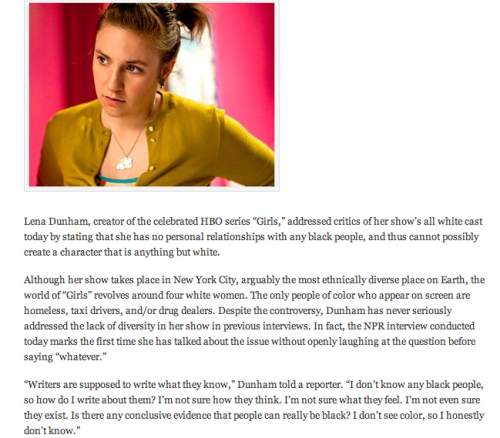
I'm not sure you can read that. I wasn't turned off yet in the beginning. She was reported to have said that she doesn't have any personal relationships with black people, and thus can't create a black character. I hoped that this would go off into her saying that she didn't want her own ignorance to contribute to harmful stereotypes, or to go the opposite route and so totally whitewash a character of color that she loses any cultural authenticity. I would have accepted reasonings of that sort, even if I'd rather see people of color on the show. I would have seen that she was coming from a place of...understanding of her lack of understanding, and that kind of a place is honest enough that I could probably have still watched the show.

But then, she continued. The bottom paragraph reads, 
"Writers are supposed to write what they know," Dunham told a reporter. "I don't know any black people, so how do I write about them? I'm not sure how they think. I'm not sure what they feel. I'm not even sure they exist. Is there any conclusive evidence that people can really be black? I don't see color, so I honestly don't know."
YEAH, RIGHT, BECAUSE OBVIOUSLY YOU, WHITE PEOPLE, ARE A HUGE MONOLITHIC GROUP THAT THINKS AND FEELS THE EXACT SAME WAY ABOUT EVERYTHING AND WE, BLACK PEOPLE, ARE A SMALLER  MONOLITHIC GROUP THAT THINKS AND FEELS THE EXACT SAME WAY ABOUT EVERYTHING BUT OUR EXACT SAME WAY IS WHOLLY AND FUNDAMENTALLY DIFFERENT FROM YOUR EXACT SAME WAY EVEN THOUGH EVIDENTLY, WE MAY VERY WELL NOT EXIST IN THE WORLD BECAUSE YOUR PRIVILEGED PORCELAIN-COLORED FACE HAS NEVER HAD TO "SEE" COLOR. #ICANT #IMDONE

Wednesday, April 18, 2012

"The Unwritten Rules"

A new webseries about being Black and female in the American workplace, featuring one of the stars of Pariah, set to premiere next Wednesday! Check out the trailer below:

Sunday, February 19, 2012

“I swear to god I will lose my mind if I hear the “sex sells” fallacy one more time. Sex does not sell. If sex sold, we would see penises where we see boobs. Naked men would be on everything that naked women are on. Sex isn’t what they’re selling you. They’re selling you an impossible, pornographically fueled misogynistic idea of the perfect woman.”
--Tumblr won't tell me. Sadface.

Wednesday, January 11, 2012

Lies my Commercials Told Me:

Check out this lovely short satirical piece on impossible standards of beauty and the rampant use of Photoshop in the media/advertising industry:


Fotoshop by Adobé from Jesse Rosten on Vimeo.

Sunday, October 16, 2011

Hmm...

I've bemoaned Disney's presentation of femininity and relationships in the past, but this is something I've never considered: Disney's teachings of masculinity to little boys are just as problematic.

Sunday, September 18, 2011

Smh

So when I was checking FOX's website to see when Bones comes back (NOT TIL NOVEMBER WHAT THE ACTUAL FUCK?!), I noticed that they have a new show coming out called I Hate My Teenage Daughter. And then I saw today that MTV is producing a new show called Dumb Girls which for all intents and purposes seems to be about a group of normal 20-somethings. I'm pretty sure I'm disgusted with the image of femininity being marketed by production companies right now; not that that should surprise me in any way.

Tuesday, September 6, 2011

What do I think it means to be beautiful?

Miss Jenkins of Rewriting Herstory has posed this question, and I think it sounds like a good thing to talk about, but before I share my thoughts, I want to share hers with you, because they're inspiring:
"Eventually, I realized that my outward appearance was a reflection of how I felt about myself.
Beauty is a combination of attitude and appearance.
Sure, physical beauty is a noticeable attribute based on appearance alone. But when I think about the people I consider “beautiful,” he or she usually carries him or herself in a way that makes you feel good when you are around them. Even if their outward appearance isn’t billboard worthy, so to speak, people usually enjoy their presence because of something that you can’t usually put into words. They look good partly because they exude a positive attitude and confidence.
It’s about how you feel about yourself.
I used to be kinda miserable. Complaining wasn’t hard for me to do. I could find a reason to criticize even positive experiences. I still have my moments, but I’m working on it. When I look at back it, I was mostly reflecting how I felt about myself. I would constantly criticize myself. I didn’t enjoy simple things, like going shopping with my friends because I hated to try on clothes (and because I was usually broke). I didn’t like shopping because I didn’t think anything could make me look good. I didn’t think anything could make me look good because I wasn’t as pretty as they were. I wasn’t as pretty as they were because something was wrong with me.
I’m learning to do away with those self-damaging thoughts about myself. I’m not weighed down by as many of them anymore. And people have noticed. I have gotten compliments about how much better I look. But it’s not because my wardrobe has significantly changed. I haven’t gained or lost a significant amount of weight. I haven’t had any physical work done. I’ve only done work on and for myself. I’m starting to appreciate what makes me beautiful on the inside and I’m learning to let it show." --Miss Jenkins
*a round of applause for her accepting her own fly-ness* 

I know that this struggle to see your own reflection as beautiful or to accept other people's suggestion that you are beautiful runs rampant amongst women who don't fit the media's image of beauty MOST WOMEN. Maybe you're a woman of color. Maybe your size isn't a single digit (double zeros, you are not included in this sympathy group). Maybe you don't have long silky wavy hair. Maybe your skin tone isn't even or you're prone to breakouts or you're just "plain". Maybe you are a human walking around in the real world rather than an airbrushed/Photoshopped image in a magazine. And whatever one or combination of these you are, you subsequently grew up thinking there was something "wrong" with you. You started brushing it off or being embarrassed when someone called you "beautiful," because they had to be just taking pity on you or trying to make you feel better. I think the thing most women (most people, I'm sure, but "beauty" is generally female territory) are raised to have in common is insecurities that could eat us alive. 

And the cold hard truth is that insecurity is not beautiful. When your insecurities are ruling you, you don't walk in beauty. You hide your smile behind your hands. You try to dress how you think you're supposed to dress, rather than adhering to your own personal style. You use make-up to hide rather than to accentuate. Generally, you are afraid to own the things that make you unique. A guy once told me that confidence makes a woman sexy, and I think something similar can be said about what makes women beautiful. I think it's hard, if not impossible, for a woman who does not love herself to feel beautiful. Maybe she can feel hot, or sexy, or desirable, or cute, but so much of beauty dwells in self-acceptance.

That's not to say there's no room for self-improvement in the quest to find your own beauty. Quite the opposite, in fact--I think people who love themselves must always want to better themselves; when you love someone, don't you want to encourage them to be the person they can be?  If you're overweight, wanting to lose weight doesn't mean you hate yourself, or that you think your current body is anything but beautiful. It just means you recognize that healthy is beautiful too. Even more of a sidenote: I can't stand people who criticize women who "go natural" but still wear makeup or perfume or eat things that aren't organic--I didn't say I was purifying my entire existence.

Society tries to say beauty is a physical thing, but I say beauty manifests itself in physical ways. Anyone can look put together. People are randomly born with perfectly symmetrical faces. Lots of people work really hard to have tiny waists, and some don't have to work hard at all. But I think the people who focus on biological/physical/external beauty like that are focused on something that is ephemeral and will inevitably fade as you get older (even if by the time we're 80, anti-aging everythings have made 80 the new 30). Beauty like that is...vapid. It's 2-D. It's...pretty. I think beauty is the antithesis of pretty. "Pretty" is a qualifier. If your teacher says the class average on an exam was "pretty good," you are less relieved than if he said the average was "good." "You did __insert thing here__ pretty well, but..." is a common phrase. "Pretty" might as well be regarded as a euphemism for "not quite good enough," "close, but no cigar", or "can be settled for but isn't the best it could be." "Pretty" is an insult.

 Coming back to what I'm supposed to be talking about here, I think beauty is walking with your head held high. It's letting your hips sway however they sway, not trying to put more into it or tone it down. Beauty is smiling wide enough to show the gap in your teeth, or not being embarrassed about having a loud laugh. Beauty is having style, with regards to your clothing, your mannerisms, your words, the whole package. Beauty is individuality rather than conformity. Beauty is being true to yourself, because truth is beautiful. Beauty is showing the world that you love and care about your whole self, rather than just your appearance. That once-over you give yourself in the mirror before leaving the house in the morning to make sure everything is in place is such a minor aspect of beauty, especially because you won't ever think everything is alright on the outside unless you have all those inner issues worked out.  I think beauty is a state of mind that your physical appearance adapts to represent, not the other way around.

Thursday, September 1, 2011

So Nightline just had a special on transgender teens

And when I heard it come on on my mother's television upstairs, I groaned a little and half-listened to the first minute or two. And then I remembered what happened with "The Help" and decided that if I'm going to hem and haw about something, I should probably at least watch it. They started off interviewing a female psychologist who was talking about how women have been allowed to get more masculine--"look at us, we're wearing pants"--but men haven't really been allowed to get more feminine. Society still freaks the fuck out when the president of J.Crew paints her sons toenails. And I sigh at social conservativeness. I rally against it wherever it exists! 

People were like OMG SHE'S RAISING HER SON TO BE GAY (a lot of them used more offensive terms that I wouldn't dare repeat). People were like I'D NEVER LET MY CHILD DO THAT. I was like, *wishes she could slap ignorant people everywhere* 

So what if a little boy wants to paint his nails like his mom? WHY IS THIS A MATTER OF NATIONAL CONCERN?! If I'm allowed to not paint my nails for the first 21 years of my life, then he should be allowed to experiment with painting his if he wants. Society said nail polish is for girls, society can un-say it. Simple as that.

"But what if your little boy goes a step further and actually tells you he's a little girl?" the Nightline special asked. Evidently all hell breaks loose. 

Okay. Now let me start off by saying that I can understand why this might be traumatizing for parents. Oh you had such high dreams of teaching your son to play baseball and watching sports together and buying him his first condoms and other touching father-son moments. Moms, you wanted to watch your little boy develop into a handsome man and feel proud of your accomplishments. I get it. But hey look, there's softball, and some girls like sports, and everyone should be protected, and I think the biggest accomplishment any parent can have is knowing they did what's best for their child. And trying to mold your child to fit your dreams IS NOT A GOOD LOOK. 

It has come to my attention that transsexuals and transvestites really freak people out. I first learned this one day when I was in Atlantic City with my mother and we saw some men dressed as pretty fly ladies, and my mom mentioned something about how it made her uncomfortable. [Disclaimer: my mother is offensive sometimes. She's also a bit homophobic. It shames me.] And I just said I thought they looked good. Then in high school I had a friend, Joe, who revealed to us after a while that he was about to embark on the process of becoming Cassie. A lot of people were weirded out by it, but I was just happy that she was finally going to be happy. At Princeton, people treat the Drag Ball like it's such a big deal and I know guys who always crack jokes about dressing up and going but never actually do. Before you call me a hypocrite because I've never been either, I've never been because I don't know what I would wear. Jeans and a t-shirt and sneakers is an entirely appropriate outfit for a woman. They even make female boxers. So what am I supposed to wear that is entirely inappropriate for a woman? [And how do I make the 38Ds disappear?] 

Anyway, back to this primetime special. So it started off really well. The first story was about a woman of color whose four-year-old son loves to wear dresses and calls himself a "Princess Boy". Though she tried to fight it at first, her older son encouraged her to let his brother "be happy" and she wrote a book about their family and has become an accidental activist. Some students at his preschool don't like to play with him, and some parents are mean, but he has friends and, most importantly, seems genuinely happy. Because he still identifies as a boy, this child is most accurately labelled a transvestite.

The second story features a family in rural bumblefuck whose son eschewed things like fire trucks and action figures from infancy, preferring barbie dolls and pink tutus. When he's ten, he finally has a mini breakdown and tells his mother he's a girl and can't do this anymore. Hir parents decide to let hir start dressing as a girl at home, but that isn't enough for hir and eventually they decide to let him to to school as a girl. Jack changes hir name to Jackie, and hir older sister comes to hir 4th grade class to talk to hir classmates before she comes in. None of the kids laughed or said anything ignorant, and even their crotchety grandparents don't disown Jackie. Jackie's parents decide to put hir on drugs that will suppress male puberty. Everyone is happy. Success story number two. 

Then we get our first actual teen, and our first look at the not-so-rainbows-and-butterflies side of this story. Vanessa was supposedly a normal boy until high school, at which point he started getting teased and having things thrown at him because he was different. Vanessa has been selling hir body as an "escort" to fund her "habit" of black-market hormone therapy and to raise enough money for top surgery (remodeling of the face to appear more feminine, reduction of the size of the adam's apple, and breast implants) in Mexico. Against the wishes of hir mother, Vanessa goes to Mexico and undergoes a somewhat shady (but thankfully complication-free) surgery. Hir mother is supportive and welcoming she she returns, saying she is going to love her, because "that's what she needs". 

And up until this point, I am okay with this special. They've shown the good and the bad, and both are needed to make an expose even halfway legit. But then, they found this fool. I don't remember his name. He went through a normal functional male--no, I'm sorry, he called himself an alpha male--life, getting married and having kids and never having the slightest thought he might be a woman on the inside until he got divorced at age 33. Then he started hanging out around some transsexuals and decided hmm this might be cool or something. He went to a doctor, got put on female hormones, and decided to spend $100,000 undergoing fancy surgeries that turned him into a female supermodel basically. She was fucking hot. But after 7 years of life as Samantha, he realized he had never really wanted to be a woman in the first place, and spent another $50,000 to turn back into a man. And now he's on national television saying that he doesn't think anyone is born thinking they were born the wrong sex, and blaming transsexuality on doctors and their hormone therapy. 

[This is where my respect for Nightline got up and walked out the door.] You just got finished showing us the stories of children who have, since birth, exhibited signs and symptoms of believing they were born into a body of the wrong sex and have been fighting since the earliest of ages for the right to be who they ARE, and then you're going to let this FOOL who dropped 100 Gs on a WHIM tell us transsexuality doesn't exist?! STFU. In fact, GTFO. I wanted to turn the TV off, but I'd committed to the idea of this post already, and I wasn't going to punk out. But YOU JUST FINISHED SHOWING US YOURSELVES that this isn't a whimsical desire, something someone just wakes up one day and decides to do. This is these people's lives! But you undermined all of that by letting this fool open his mouth. [Confession: I have difficulty supporting the right to freedom of speech on the part of people whose messages spread hatred and -isms of any variety.] 

They then turned to some foreign musical artist who became the youngest person in the world to fully physically make the M-to-F transition at sixteen, having to undergo all sorts of tests and becoming a big media scandal in her home country before they allowed her to make an exception to the rule that one has to be 18 to undergo the surgery. She talked about how she knew it was what she wanted, and all the support and love she's gotten from fans around the world. I suppose her story was meant to show the social acceptability that M-to-F transsexuals can garner, but what struck me was the sort of throwaway line of hers that she doesn't want to be known as "just that transsexual artist." She wants to just be herself.

And that's the take home point of this very long post, people. Transsexuals, be they M-to-F or F-to-M, are just trying to be normal people. They just want to own their bodies the way the rest of us own ours. They just want to be comfortable with themselves, and it's ridiculous that close-mindedness on the rest of our parts might keep them from doing so. Why? Because it's something we're unfamiliar with? Oh-hey-look-something-new-and-different-let's-shun-it is a mentality we as a society should have outgrown a hell of a long time ago. It's 20-fucking-11 people--now that the technology exists that these people don't have to suffer in a body that doesn't feel theirs, why should we try to make them? No one would balk at someone who has been in a horrible accident getting plastic surgery. I think being born into a sex category that doesn't match your gender is one of the worst accidents I can imagine. So get the fuck over it, okay?  

Thursday, August 18, 2011

I Co-Sign this with the biggest pen I can find:

"I am past the point where I have any patience for people telling me how I should feel about how black women are presented in the media. Especially people who have never walked a moment, much less a mile in the shoes of black women in America. And before someone decides to break out the face paint & do a documentary? Let me tell you right now that a day or a week or even a month in makeup won’t touch what it’s like to hear from birth that you are worth less than every body else because of you hair, your skin, your culture, your history, & your gender. You know, all those things that make you human? Yeah, the message we get is that we’re not really human. We’re beasts, we’re Mammy, we’re bedwarmers, we’re everything under the Sun but people who are valued & valuable. Well, we’re valuable when we can be exploited by someone else, but pearl clutching ensues when we want to profit from our own labor.
Black women have a reputation for being strong that is sometimes helpful & sometimes harmful. We do our best to survive everything that gets thrown at us. We fight the messages, we teach our kids to fight the messages, but it is 2011 & I am still seeing books, movies, TV shows, & articles lauded for explaining exactly how much less we are worth than everyone else. We can’t even tell our own stories without having to argue over whether or not we’re qualified to speak. If we’re silent others speak at top volume until we are rendered down to Mammy, Jezebel, or Sapphire with no room for reality. When we do speak up suddenly we are too loud, too angry, too confrontational, simply too much. Even when we whisper, we are doing it wrong, but trust & believe we will be heard whether anyone else likes it or not. We are women. We are black. We will not stop speaking for ourselves. Get used to it or get the fuck out of our way."
A PSA From A Loud Angry Black Woman -- Originally posted at The Angry Black Woman

Thursday, August 11, 2011

I'm so conflicted about whether or not to see 'The Help'

On the one hand, sisterhood! friendship! standing up for what you believe in! stories that haven't been told! a movie about Black women! 
On the other hand, though, yet another tired old film about Black people whose lives really are interesting and meaningful, but made so only through the intervention of a benevolent White woman! (The Blind Side, anybody?) celebration of Black women's stories as long as they're told from a White woman's perspective! making people feel like the conditions of 
oppressed minorities weren't (aren't) so bad!


Some people are telling me I'm making too big a deal about this. That there are [much less successful] movies and books about Black persons who stand up and tell their own stories. That I shouldn't look at these things as Black v. White, but in terms of other divisions, like religion or class. That I should see the patronizing White female savior as really just a friend like any other friend, and not pay attention at all to all the privileges she has over her Black female domestics "friends". That I should validate her for working against societal expectations by caring about these Black women. Or, my fucking favorite, that Hollywood isn't about historical accuracy or truth-telling, but rather is for entertainment purposes only, and presumably has absolutely no societal responsibility to speak of. That it somehow shouldn't bother me that, with few exceptions, the most widely popular films that feature or are about Black people offer those characters little more than belittlement and backhanded compliments. Self-sufficiency and positive narratives are few and far between.


I'm terrified that this will someday get shown/read in history classes in high school, and be taken as an accurate representation of what life was like for these women. NOTHING GOOD can come of members of a dominant group writing the history of members of a marginalized group. Nothing. So when someone asks me what I expected from a White woman's telling of the story, I say this: that I expect White people to finally learn that maybe they shouldn't be trying to tell the narratives of Black experiences. But alas, they will never learn this, because this book was wildly successful, and the film most likely will be too, because unlike when a Black person tries to talk about a Black experience, this appeals to White audiences [sugar-coating history has a tendency to do that]. 


The friend I'm arguing with on Facebook [I hate Facebook arguments] raises the incredibly valid point that the representations of Blackness coming from within our community are arguably worse. I agree 100%, a la the post immediately prior to this one, but that just means I'm not going to stand for either one.


My friend says the only way to change this is to go out and do something about it, instead of just bitching about what's wrong with the images we're being presented with. Again, I agree 100%, but we have to recognize that if a Black woman had written a novel about Black women's experiences as maids in the South, it would be relegated to the huge pile of "African-American literature to be ignored by the general public unless one has a very progressive high school English teacher" and the idea of a movie deal would be laughable. So, as I am not a filmmaker or a screenwriter, but an academic, all I can do is talk about why I don't think these images are acceptable, why I don't think these movies will do anything good for anyone (except put money in the hands of the people who made them, and making wealthy White people feel less guilty--which I'm pretty sure is only beneficial to them, not to the people of color and/or in poverty who could use a program or two that might be created [or, at the very least, not ripped to shreds] by people who have stopped recognizing that guilt is entirely appropriate). Maybe wanting to hold Hollywood to some level of social responsibility is naive of me, but how can we change the dominant cultural perceptions of a community if only narratives that perpetuate those perceptions are allowed to be seen/heard?


I suppose I have to see it now that I've talked so much shit about it though, huh? Damn.

SOMEBODY PLEASE TELL ME WHY

Tyler Perry is getting his own television station. WHO THINKS THIS IS A GOOD IDEA?! WHO?!?! I would like to know so I can go personally slap them, on behalf of advocates of social change everywhere. Because tell me, please, I beg you, tell me one good thing Tyler Perry has done for a Black person anywhere (his-worth-$350-million-self not included)?

Some of you are going to say he's funny. Some of you are going to say he's funny because he exaggerates the truth. Some of you are going to say he's funny because he tells the truth. I say he tells stories that he wants y'all to think are funny because y'all think they're true. Because okay, sure, I'm sure people like pistol-in-one-hand-Bible-in-the-other Madea exist out there in the world somewhere. I know that there are cracked out mothers and histories of abuse and family members who will tell you to sit there and take it. I have experienced black churches like the ones he depicts. Scenes that have taken place in the living room on House of Payne have taken place in real people's living rooms, I know. I KNOW.

But what I know more than any of those things is that there are MILLIONS of Black peoples who are nothing like this, and I am SICK AND FUCKING TIRED of this same monolithic image of the Black community being shoved down our throats and the community responding by placing the shover on a pedestal! He's like the new millenium's version of shucking and jiving, and I'll be damned if I sit back while we let him portray this slice of Blackness as THE truth rather than A truth. I'm going to try to list all the vicious stereotypes that I think he's perpetrating and, even worse, getting Black folks to identify with and internalize.
  1. The class war between African-Americans is real, and middle/upper-class Blacks should be demonized. 
  2. Relatedly, all middle/upper-class Black women should realize that men of their own social/educational status aren't "real men", and should fall in love with/marry blue-collar men.
  3. A Black woman cannot be strong without being angry/violent. 
  4. Relatedly, Black women are consistently in trouble with the law. 
  5. Light-skinned Black women represent all that is good and right with the world, and dark-skinned Black women are inherently problematic. 
  6. Dark-skinned Black women are inherently unattractive and sexually undesirable.
  7. Thin, White, blonde womanhood is the ideal standard of beauty/femininity/desirability that all women must imagine themselves as exemplifying to have any sort of self-respect.
  8. Womanhood is a role that can be appropriated, belittled, and dramatically over-emphasized by men for the enjoyment of the masses.
  9. There is no such thing as a traditional family amongst Black peoples.
  10. African-Americans who are not practicing Christians should be ostracized.
  11. Known history of a criminal past or past dependence on drug abuse should have zero effect on whether you choose to let someone [back] into your or your children's lives.
  12. Dark-skinned Black men are liars, while light-skinned Black men are saviors. 
  13. Gay Black men are "on the down low," having unprotected sex, and spreading HIV to Black females.
  14. Physical, psychological, emotional, and sexual abuse are normal, standard elements of life as a Black woman. 
  15. Black men are the greatest threat to Black women's health/lives, but also our only possible saviors.
  16. Black peoples should leave all their problems to divine intervention.
That's what I came up with off the top of my head. I could probably keep going, but I have more posts to write. 

I will admit that there is most likely a grain of truth to each of these statements, but only in so far as you add "some" to every mention of Black peoples or any subset of Black peoples, and that you recognize that those same such "some _____" statements can be filled in by members of ANY SOCIAL GROUP IMAGINABLE. But no. We are presented with these ideas solely in terms of Blackness, and very specific "types" of Blackness at that, types which are marketed as being the end-all-be-alls of Blackness. There is no counter-narrative here. Awkward Black Girl ain't got a TV show. 

So let's go back to the question, what good has come out of this for Black peoples? Maybe a few more Black women got tested for HIV. Maybe someone somewhere got the courage to leave her abusive relationship. Those are good things, yes, but do they have to come at the expense of demonizing and even-further-marginalizing subsets of an already marginalized people, widening gaps and strengthening tensions that already existed within the Black community, and silencing the voices of other sections of Blackness? I think not. Are any of the SIXTEEN DAMAGING IDEAS I just listed doing any good for anybody? I think not. IS. HE. FUNNY? I think not. I think he one of the most problematic Black men in the country, and at a time when I was just bemoaning the death of the Black sitcom/Black family show...this is THE OPPOSITE of what we need. I am thoroughly unconvinced any good will come from this endeavor. Someone stop the madness, please! 

Monday, August 8, 2011

I just don't understand

how major media corporation after major media corporation can release THE SAME GODDAMN STORY ABOUT BLACK WOMEN'S (AND PARTICULARLY, BLACK PROFESSIONAL WOMEN'S) ABYSMALLY LOW MARRIAGE RATES YEAR AFTER FUCKING YEAR and this is somehow still considered was somehow EVER considered news-worthy. You all publish the same UNCITED statistics about how 70% of black women have never been married, and 30% of professional black women aren't married by the time they're thirty, compared to less than 15% of similarly-occupationed White women, and how this many black men are in jail and this many don't go to/finish college/graduate school. 

Here's the thing: WE FUCKING KNOW ALREADY. The LAST thing anyone needs is you people bringing it up OVER AND OVER AGAIN.

Actually, that's not true: the last thing we need is what you always manage to do--suggest some cure-all that we should all employ immediately to remedy this issue. Lower your standards. Stop looking for someone who is your equal. Look for older men. GET YOURSELF A WHITE MAN (in caps because I keep hearing it over and over again).

I'm sure I don't speak for black women everywhere, but even if it's on behalf of me and me alone, I want to tell you all to SHUT THE FUCK UP. Actually, that's not loud enough:
SHUT. THE. FUCK. UP.
Seriously. Take your fingers off the keyboard. Close your mouth. Stop bringing this idea to your editors. (Editors, stop somehow thinking it's news or you're putting any sort of a new spin on it.) Because, guess what...
YOU'RE NOT HELPING ANYTHING.
Not one iota of productivity or social welfare is going to come out of you TELLING THE SAME DAMN STORY again and again. If I'm being honest with you, not much came out of it the first time, except a whole slew of conversations in the black blogosphere and between black friends and community members about what we're doing wrong/what's wrong with us/why we can't get our shit together/what we need to do to fix this.  Just spoon another helping of fear/dread/reasons-to-self-loathe on our plates, why don't you?
I have a secret for you, people who write these articles: THERE'S NOTHING WRONG WITH US. Sure, every individual has their own shit going on, obviously, but there is no one thing wrong with us as a people that you can write some magic recipe to fix. 
Actually, I have some more secrets for you. Secret one: THERE ARE QUEER BLACK WOMEN. YES, WOMEN OF AFRICAN DESCENT WHO ARE NOT, IN FACT, LOOKING FOR A MAN. I would like for you to stop ignoring them, because even if they do not fit the dominant cultural narrative of blackness that YOU, MEDIA INSTITUTIONS, are shoving down OUR throats, they are my sisters and deserve recognition. Secret two: NOT EVERY HETEROSEXUAL BLACK WOMAN WANTS TO GET MARRIED. I'm not sure I do. Outside of religion (because yes, as another black woman who doesn't fit your narrative, I am not religious), I don't really see a point. And with half of marriages ending in divorce these days anyway, it seems like the institution is on its way out, to me. Secret three: INTERRACIAL RELATIONSHIPS ARE NOT SOME NOVEL IDEA THAT YOU HAVE TO OPEN OUR EYES TO. I'm pretty sure interracial relations were forced upon black women for centuries under slavery, and I'm also pretty sure that COUNTLESS LEGAL BATTLES WERE WAGED to lift the ban on miscegenation after we were emancipated, because even then we could recognize that love does not know color.
So, in conclusion, GET THE FUCK OUT OF MY FACE WITH THAT SHIT.      

Thursday, August 4, 2011

HOLD THE MOTHAFUCKIN PHONE

So in recent weeks I'd heard a lot of buzz about this miniseries called "The Misadventures of Awkward Black Girl". Occasionally some of the blogs I read would post about it, and I would wonder whether this few minutes of my time was worth craning my neck awkwardly at work so that my headphones could reach the computer tower which is far as fuck from the monitor for no identifiable reason. The answer was always, "Eh, I'll go back to it when I get home." But then I would get caught up in other unread posts and other unwritten posts and Scrabble on Facebook and talking to my mom and forget all about Awkward Black Girl. 

I decided to remedy that this morning. BEST DECISION OF MY WEEK. This shit is FANTASTIC. The episodes keep getting longer and her life keeps getting more and more awkward and I LOVE IT. I don't always agree with her (for instance I love spoken word...but not that wack shit they were forced to sit through) and have no qualms about actually eating on a date, but I see a lot of myself in her. 

And I know from all the blogs that I've been reading that the creator of the show is having some funding issues, so I'm thinking about donating ten bucks or so. Every little bit helps, right? On the funding page she has a little description about why she created ABG, which starts off like this: 
"Why ABG exists:
Television today has a very limited scope and range in its depictions of people of color. As a black woman, I don’t identify with and relate to most of the non-black characters I see on TV, much less characters of my own race. When I flip through the channels, it's disheartening. I don’t see myself or women like me being represented. I’m not a smooth, sexy, long-haired vixen; I’m not a large, sassy black woman; an angry Post Office employee. I’m an awkward black girl.
And I’m not alone."
I had two very clear and very interesting reactions to this little introductory snippet to the reason for the show. Reaction number one: I, Maya Reid, of sound mind and body, must confess to you all right now that I have NO PROBLEM identifying with and relating to non-black characters I see on TV. Characters of my own race can be a little more touchy, because I don't see very many black characters--I see "real" black people on reality shows I refuse to watch, but as far as characters...as a kid, Sister Sister was my SHIT, I wanted to be the girl the Famous Jett Jackson liked, and it is still my dream to one day be as bougie as the Huxtables (without any of Bill Cosby's egregious classism in real life). As an adult, I was ALL OVER Girlfriends (like a black Sex in the City, for those who don't know) and still watch reruns regularly, and I can see bits of myself in The Game's Melanie and Nurse Hawthorne and her daughter. I liked the ambition and double-life led by the main characters in last fall's quickly-canceled Undercovers. Huh, that actually seems like a decent number of black characters I can relate to/identify with. But that wasn't my point here.
My point was that I see just as many bits of myself in some White women on television (Bones, Annie from Community) and even in men (House, Reid on Criminal Minds ). Until I came to Princeton, I spent my whole life relating more to White people than to other Black people, and I was okay with that. But the second biggest gift Princeton has given me (the first being a free $200,000 education) is the knowledge of and camaraderie with Black people who are LIKE ME. Because honestly, I'm pretty sure I didn't think that was possible growing up. I had stopped looking for it. 
But they're out there. I've found them at Princeton, and I've found them hailing from all over the country at Yale's Black Solidarity Conference, and I have to say, it is comforting, I suppose. Reaction number two: Based solely upon the legions of women responding to the series, and the fact that it was all over my blogosphere and even my friend C was talking about how much she loves it, THERE'S AN ARMY OF US. And that...seems like it would feel validating if I was still looking for validation. And it is refreshing to have another character to add to the people-who-look-and-think-like-me category. I think my favorite thing about this webseries, though, is the fact that race is often confronted openly in a way that doesn't ever happen on television. And THAT is something I can identify with.   

Wednesday, August 3, 2011

Marvel must have been as upset as I was

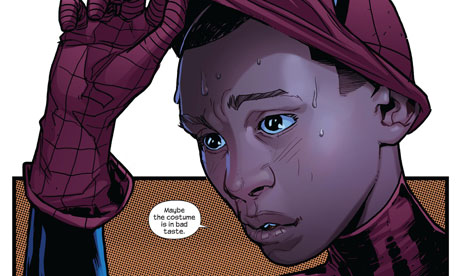
about Disney fucking up and not recognizing the black struggle in Captain America, because some CRAZY-ASS SHIT was announced yesterday: The new Spiderman in the Ultimate Spiderman comic book series IS HALF-BLACK AND HALF-LATINO, with an incredibly appropriate name for such a background: Miles Morales. You heard me, a BLACK AND HISPANIC MAN IS SAVING THE WORLD. Say whaaaaaaaa?

But evidently this is not as uncommon as I had previously imagined. I casually mentioned this to a friend and how I was trying to figure out how I felt about it, and he informed me that Marvel is actually hella diverse in its superhero portrayals. One of the incarnations of The Green Lantern was black, and there was a Black Panther before the Party (though the "Jungle Action" and "savage" themes are a bit problematic, don'tcha think?). A little more digging showed me that various incarnations of Spiderman and Co. have been getting more and more diverse for a while: in 1992 the company released a miniseries entitled Spiderman 2099, in which Spidey was half-White and half-Latino, and the Spider Girl that was introduced in 2005 is a Latina by the name of Anya Corazon. And sure, while my main superhero experiences in life have been admiring Whites superheroes on the silver screen, I certainly remember Halle Berry as the Black Catwoman (damn that woman is sex on a stick, but again with the animalistic thing. Larger questions: why are so many superheroes based on animals? What is this weird fascination with invincible half-man-half-beast creations, especially when those creations are also supposed to be sex objects? Bestiality isn't cool...), and some lesser appearances on the small screen: the Power Rangers usually had at least one token member, Captain Planet's Planeteers were pretty diverse, and the gritty urban qualities of the Ninja Turtles always made them seem kind of Black in my mind.

So the question is, in light of all these cultural representations to the contrary, why do I think "White" when I think "superhero?" Why did I see Racialicious's article about this and think, "Hmm...that's interesting," rather than "Damn, it's about time?" like I did when Disney finally announced its plans for a Princess of African descent? Why was I not bothered by the dearth of mainstream superheroes of color? One of the Ultimate artists was quoted as saying 
"Maybe sooner or later a black or gay — or both — hero will be considered something absolutely normal,”
and while this is obviously something I'm in very strong support of, I just think it's crazy that I didn't recognize a need for it. The nerd-by-day, hero-by-night trope familiars like Peter Parker, Clark Kent (omg I lusted SO HARD after Tom Wellings on Smallville when I was in high school; I'm not even gonna front--oh hey, and the hottie from the Famous Jett Jackson grew up to be Cyborg on Smallville for a hot minute), and even the kids from Kick Ass was something I could buy into and identify with regardless of race. And don't get me wrong, I think that's fantastic...but not when it stands in the way of me seeing larger problems in popular culture. Anyway, I applaud Marvel for their [evidently consistent] efforts to diversify and dig themselves out from under the mountain of white privilege their characters have simply by having been created in a time when that shit was PC. 
Sigh, except some people evidently still think that shit is PC, because this is already an internet meme:
Evidently some people are still scared of men of color in masks...
PS It should be noted that DC is working hard to integrate the field of superhero-dom too, with characters like Vixen (another hypersexualized black woman being compared to an animal, greattttt), The Amazing Man, Cyborg (though the only part human thing worries me a bit), and Kid Quantum, among others. I didn't want to not give props where props were deserved. If you want to see a list of all the black superheroes to ever exist in the history of the university under any comic company, check out Wiki's list. There are a lot of them, yeah, but the fact that I've never heard of most of them goes to show that there's still a balance issue.
PPS: THE BEST THING I'VE SEEN ON THE INTERNET REGARDING THIS ENTIRE TOPIC: 
"And really, there’s nothing new about people of color receiving disproportionately exposure to environmental radiation and medical experiments. A few good superpowers is the least they deserve." --Channing Kennedy for Colorlines
More truth is in that statement than I can possibly get into right now, so I'm gonna...uh...*drops mike, walks away*