Reblogged from WYSIWYG
Inside the mind of a kind of quirky, pretty stubborn, way too opinionated, twenty-something, heteroflexible Black female newly employed up-and-moved-to-DC Princeton GRADUATE who's just trying to sort out her life. An uninhibited celebration of all that is me, this blog is an exercise in self-discovery and live-with-your-heart-wide-open-ness. Though I make respect a habit, I will not always be politically correct, and I believe in the power of making audiences uncomfortable to inspire change.
Showing posts with label race. Show all posts
Monday, December 31, 2012
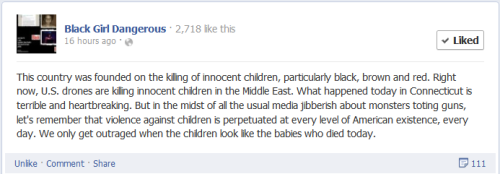
"White American children in this country who become victims of gun violence are a sign of shattered innocence, an anomaly that must be analyzed and dissected to ensure that it doesn’t happen again. Black and Brown American children who become victims serve as an indictment of our communities, our homes and our parenting."
--Kirsten West Savali
(via RiotsnotDiets)
Sunday, December 30, 2012
"Somebody told a real life woman that her skin was too brown to play an imaginary creature. That basically in the whole fictional world of Lord of the Rings and The Hobbit, where you have dragons and trolls and talking trees, where you draw the line, where imagination is capped out, no more room, is for a brown hobbit.
"Like, fiery eyeball thing, no problem, but don't even try to imagine a Samoan elf. That shit will blow your mind."
--Wyatt Cenac
(via Lavender Labia)
"We all have a blind spot around our privileges shaped exactly like us.
And I’m telling you guys, we’re never fucking going to get anywhere as long as our economies of attraction continue to resemble more or less the economies of attraction of white supremacy. Finding people who practice decolonial love is as hard inside of a vast movement as it is outside. The actual standard of decolonial love, how little discussed, how little understood, and yet in many ways is the great test of who we are and of our praxis and of our communal praxis."
--Junot Díaz, Keynote Speech at Facing Race 2012
(via Tudo Bom(b))
I have as many speeches from this conference as are available on YouTube queued on my Watch Later list. Expect way more quotes at some future point.
Saturday, December 29, 2012
Photo
| Reblogged from Lavender Labia |
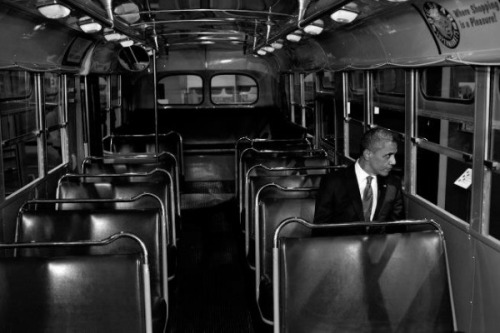
That's within my father's lifetime. I hope he sees this photo and remembers taking me to sit in that seat when he lived in Detroit. That was 2005, and I was overwhelmed by our progress. Now it's 2012 and I'm so torn between wanting to cry in celebration of how far we've come and wanting to cry in desperation at how far we have left to go.
No one has ever said this to me, but I would GO. OFF.
| Reblogged from Tudo Bom(b) |
I don't understand why Bill Clinton is a political figure I'm supposed to like as a Black person.
I'm not even going to touch on the RAGE that overtakes me whenever anyone refers to him as the first Black president (or when someone refers to Obama as the first LGBT president). I'm just going to put a few paragraphs from Michelle Alexander's The New Jim Crow: Mass Incarceration in the Age of Colorblindness (pg. 57-58) here for you to ponder.
"...in 1992, presidential candidate Bill Clinton vowed that he would never permit any Republican to be perceived as tougher on crime than he. True to his word, just weeks before the critical New Hampshire primary, Clinton chose to fly home to Arkansas to oversee the execution of Ricky Ray Rector, a mentally impaired Black man who had so little conception of what was about to happen to him that he asked for the dessert from his last meal to be saved for him until the morning. After the execution, Clinton remarked, 'I can be nicked a lot, but no one can say I'm soft on crime.
"Once elected, Clinton endorsed the idea of a federal 'three strikes and you're out' law, which he advocated in his 1994 State of the Union address to enthusiastic applause on both sides of the aisle. The $30 billion crime bill sent to President Clinton in August 1994 was hailed as a victory for the Democrats, who 'were able to wrest the crime issue from the Republicans and make it their own.' The bill created dozens of new federal capital crimes, mandated life sentences for some three-time offenders, and authorized for than $16 billion for state prison grants and expansion of state and local police forces. Far from resisting the emergence of the new caste system, Clinton escalated the drug war beyond what conservatives had imagined possible a decade earlier. As the Justice Policy Institute has observed, 'the Clinton Administration's 'tough on crime' policies resulted in the largest increases in federal and state prison inmates of any president in American history.
"Clinton eventually moved beyond crime and capitulated to the conservative racial agenda on welfare. This move, like his 'get touch' rhetoric and policies, were part of a grand strategy articulated by the 'new Democrats' to appeal to the elusive White swing voters. In so doing, Clinton--more than any other president--created the current racial undercaste. He signed the Personal Responsibility and Work Opportunity Reconciliation Act, which 'ended welfare as we know it,' replacing Aid to Families with Dependent Children (AFDC) with a block grant to states called Temporary Assistance for Needy Families (TANF). TANF imposed a five-year lifetime limit on welfare assistance, as well as a permanent, lifetime ban on eligibility for welfare and food stamps for anyone convicted of a felony drug offense--including simple possession of marijuana.
"Despite claims that these radical policy changes were driven by fiscal conservatism--i.e., the desire to end big government and slash budget deficits--the reality is that government was not reducing the amount of money devoted to the management of the urban poor. It was radically altering what the funds would be used for. The dramatic shift toward punitiveness resulted in a massive reallocation of public resources. By 1996, the penal budget doubled the amount that had been allocated to AFDC or food stamps. Similarly, funding that had once been used for public housing was being redirected to prison construction. During Clinton's tenure, Washington slashed funding for public housing by $17 billion (a reduction of 61 percent) and boosted corrections by $19 billion (an increase of 171 percent), 'effectively making the construction of prisons the nation's main housing program for the poor.'
"Clinton did not stop there. Determined to prove how 'tough' he could be on 'them,' Clinton also made it easier for federally assisted public housing projects to exclude anyone with a criminal history--an extraordinarily harsh step in the midst of a drug war aimed at racial and ethnic minorities. In his announcement of the 'One Strike and You're Out' Initiative, Clinton explained: 'From now on, the rules for residents who commit crime and peddle drugs should be one strike and you're out.' The new rule promised to be 'the toughest admission and eviction policy that HUD has implemented.' Thus, for countless poor people, particularly racial minorities targeted by the drug war, public housing was no longer available, leaving many of them homeless--locked out not only of mainstream society, but their own homes."
"Some problems we share as women, some we do not. You [white women] fear your children will grow up to join the patriarchy and testify against you; we fear our children will be dragged from a car and shot down in the street, and you will turn your backs on the reasons they are dying."
--Audre Lorde, “Age, Race, Class, and Sex: Women Redefining Difference”
(via WYSIWYG)
(via WYSIWYG)
Wednesday, December 19, 2012
"In North America, the Black immigrant is used to downgrade the North-American-born Black population; in Europe, the North American Black is used to downgrade the Black European and African and Caribbean permanent residents there. Each instance allows the dominating populations to conceal their racism by appealing to a worse racism elsewhere and by castigating the resident population for failing to excel under the status quo. How often have I heard American Blacks speak of how wonderfully they were treated in Europe! My experience--perhaps from looking too African in Brussels or too Black in Prague--is that European Whites are not particularly different than U.S. Whites when they think the Black is one of their "own," which ironically includes the type of immigrants they are used to."
--Lewis Gordon
Wednesday, December 5, 2012
"The problematic terms 'Asian-Pacific American" (APA) and 'Asian-Pacific Islander" (API) not only offer no recognition that Pacific Islanders already constitute a pan-ethnic group that is distinct from Asian-Americans, they also efface Pacific political claims based on indigeneity. For example, indigeneous Pacific Islanders who have ties to islands that were forcibly incorporated into the United States (Hawaii, Guam, American Samoa) have outstanding sovereignty and land claims, based on international principles of self-determination, which get erased by the categorization with Asians. Hence the frameworks for understanding the ills affecting Pacific peoples and their political claims are shaped by imperialism and settler colonialism, not simply civil rights.
"We need to uncouple 'Asian' and 'Pacific' in order to examine these concerns, especially in higher education, where the socio-economic profiles of native Hawaiians and other Pacific Islanders are severely distorted due to the continued problematic lumping with Asian-Americans."
--Dr. J. Kehaulani Kauanui
"Where are Native Hawaiians and Other Pacific Islanders in Higher Education?"
(via come correct)
Tuesday, November 27, 2012
"When feminists can see the problem with all-male panels but can't see the problem with all-White television programmes, then it's worth questioning who they're really fighting for."
--Reni Eddo-Lodge
(via Lavender Labia)
Friday, November 16, 2012
"Students of color are allowed to enter the classroom but never on an equal footing. When they walk in, they are subject to the same racial stereotypes and expectations that exist in the larger society. Students of color do not have the advantage of walking into a classroom as individuals; they walk in as black, brown, or red persons with all the connotations such racialization raises in the classroom. They do not walk into a classroom where the curriculum embraces their histories. They walk into a classroom where their histories and cultures are distorted, where they feel confused about their own identities, vulnerabilities, and oppressions. There is no level of liberal reforms that can alter these experiences for students of color without directly challenging the larger systems in society."
--Margaret Zamudio, Caskey Russell, Francisco Rios & Jacquelyn Bridgeman,
Critical Race Theory Matters: Education and Ideology
(via Tudo Bom(b))
Never not reblog
| (reblogged from La Bella Vita) |
Labels:
race
Tuesday, October 30, 2012
Monday, July 16, 2012
On "Good" and "Bad" Neighborhoods
EY got to Colorado the night before last. Yesterday, she drove to the school that she's going to be teaching at and checked out the surrounding neighborhood, looking to see why people have suggested that she not live in that area. Her report back to me was, and I quote, "I could not [live there]. I mean, I could...but I would not be comfortable. I didn't see a single white person, and the kids walking around on the street were dressed like hoodlums."
I couldn't have predicted word for word, but I knew what was coming after she said the word comfortable. I was dreading the rest of her statement. And once it was there, staring back at me in little black letters in our Skype window, I wanted so badly to get angry. To rant and chastise, to want to smack her. I wanted to ask how she could think and say things like this...but I already knew how.
I'd thought them, too. I'd thought them when I was room-hunting. I thought them when I was on the bus going to see my very first place and I looked around and saw that all the non-Black people who had been on the bus with me got off before I did. When I got off the bus at the corner by a gas station and there were (Black) men standing around in three-sizes-too-big white t-shirts and basketball shorts and sneakers just talking, and I seriously entertained the idea of crossing the street before I got to them (but they were on the side of the street I needed to be on, so I didn't). I remember later that night, being in a different neighborhood where I saw people on dates holding hands and brothas in button ups and felt safe. I recall chuckling at the way the Pakistani girl at the first place said that the neighborhood was incredibly safe, even if it looked a little rough around the edges, and that she'd never had any problems in the 4 years she'd lived there, while the 5 white girls at the second place all seemed more than a little uncomfortable with the ethnic mix of their neighborhood ("It's not the beeeest neighborhood..."). I recall thinking that the relativity of neighborhood quality was a fascinating concept, and that I should explore it more in a post.
Oh, how much more complicated it became. See, I didn't get anything but a crushed dream out of my solo place-hunting adventure, so later came back with my mother and grandmother. As they drove me from place to place, my Nana kept saying, "Oh, this is a Puerto Rican neighborhood." "Oh, this is a Chinese neighborhood." And the way she said it, it was clear that these were not places that she would like for me to live. My grandmother's favorite place, by far, was a basement apartment I looked at in Friendship Heights, which was as suburby as the city gets and where I saw exactly one person of color. I did not like it there--the apartment was stuffy and it was too far away from everything, much to my grandmother's disappointment.
The neighborhood I moved to is mostly Black, which my grandmother also had some commentary about (despite the fact that both she and my mother live in predominantly Black and Hispanic neighborhoods), but it is in the process of being gentrified. I am as likely to be hit on by a Black man in an oversized tee who has lived in my neighborhood for the entirety of his 27 years as I am to be smiled back at by a gay couple walking their dog. I don't live far from Howard, so when I'm lucky, I see a fine-ass brotha in a button up and he asks me how I'm doin. I get catcalled. I also get my "Good morning"s ignored by White women also on their way to work. We have a bodega-like store on my corner, a housing project down the street, a hipster cafe further down the street, and a farmer's market on Sundays. We have a baseball field and a basketball court. We have a rent-a-bike station. We have a public school and a charter school. We have a strong police presence.
Getting catcalled doesn't scare me. This literally has happened every time I'm walking alone in an even somewhat urban environment--remember my posts from New Brunswick? But I am extra-vigilant when I'm walking home at night. And I have crossed the street--to the side of the street my house was on, but still--to avoid walking past a group of Black men when it's dark. And yet, it slightly offends me when my parents suggest I take a cab home, or RG doesn't want me to walk home alone. I hate the question, "Is it safe?" I want to respond that the color of my neighbors' skin does not make them inherently dangerous, nor does their style of dress or the comparative amount of money we make. I walk home, but I walk quickly, purposefully, and with my eyes and ears wide open.
Sometimes while I'm walking to or from work, or on my way anywhere else, I wonder whether I belong here, in the neighborhood where I live. I am a Black woman living in a historically Black neighborhood, but that doesn't preclude me from being a gentrifier. I am a sociologist living in a city, which means I know that Blackness isn't dangerous, but concentrated poverty is. My personal history includes both free lunch and an Ivy League degree, so I'm a little confused about my class status. And even as a social scientist, I can't tell you what does more to mark me "us" or "them," only that it depends who I'm asking.
I can't tell whether I belong here, but like E, I knew that I couldn't live in that other neighborhood in NE with the Pakistani girl. It was too...all the things I am not with respect to who/what I am. I felt like I was in the hood, and it scared me. I was uncomfortable in broad daylight, and didn't want to be around after dark. I was uncomfortable there, even being me. I just don't know where to draw the line between things I want to call "comfort" and "caution" and things better called "racism" and "classism". It's like this essay, by Taigi Smith, that ChoosingPancakes and I read in a feminism class last semester, called "What "Happens When Your Hood is the Last Stop on the White Flight Express?" Taigi writes:
I beat myself up about it every time I cross the street to avoid a person/group that I'm approaching. Every time I smile at a non-poor-looking person on the sidewalk without hesitation. Every time I approach my corner and hope that "these fools" aren't hanging out across the street, and become painfully aware of how easy it would be to replace "fools" with a word with one more letter. I come into my renovated house with its electric fireplace and exposed brick and cook dinner and chitchat with my White housemates and watch The L Word and feel bad about the way I behaved. And that just makes it even worse.
I couldn't have predicted word for word, but I knew what was coming after she said the word comfortable. I was dreading the rest of her statement. And once it was there, staring back at me in little black letters in our Skype window, I wanted so badly to get angry. To rant and chastise, to want to smack her. I wanted to ask how she could think and say things like this...but I already knew how.
I'd thought them, too. I'd thought them when I was room-hunting. I thought them when I was on the bus going to see my very first place and I looked around and saw that all the non-Black people who had been on the bus with me got off before I did. When I got off the bus at the corner by a gas station and there were (Black) men standing around in three-sizes-too-big white t-shirts and basketball shorts and sneakers just talking, and I seriously entertained the idea of crossing the street before I got to them (but they were on the side of the street I needed to be on, so I didn't). I remember later that night, being in a different neighborhood where I saw people on dates holding hands and brothas in button ups and felt safe. I recall chuckling at the way the Pakistani girl at the first place said that the neighborhood was incredibly safe, even if it looked a little rough around the edges, and that she'd never had any problems in the 4 years she'd lived there, while the 5 white girls at the second place all seemed more than a little uncomfortable with the ethnic mix of their neighborhood ("It's not the beeeest neighborhood..."). I recall thinking that the relativity of neighborhood quality was a fascinating concept, and that I should explore it more in a post.
Oh, how much more complicated it became. See, I didn't get anything but a crushed dream out of my solo place-hunting adventure, so later came back with my mother and grandmother. As they drove me from place to place, my Nana kept saying, "Oh, this is a Puerto Rican neighborhood." "Oh, this is a Chinese neighborhood." And the way she said it, it was clear that these were not places that she would like for me to live. My grandmother's favorite place, by far, was a basement apartment I looked at in Friendship Heights, which was as suburby as the city gets and where I saw exactly one person of color. I did not like it there--the apartment was stuffy and it was too far away from everything, much to my grandmother's disappointment.
The neighborhood I moved to is mostly Black, which my grandmother also had some commentary about (despite the fact that both she and my mother live in predominantly Black and Hispanic neighborhoods), but it is in the process of being gentrified. I am as likely to be hit on by a Black man in an oversized tee who has lived in my neighborhood for the entirety of his 27 years as I am to be smiled back at by a gay couple walking their dog. I don't live far from Howard, so when I'm lucky, I see a fine-ass brotha in a button up and he asks me how I'm doin. I get catcalled. I also get my "Good morning"s ignored by White women also on their way to work. We have a bodega-like store on my corner, a housing project down the street, a hipster cafe further down the street, and a farmer's market on Sundays. We have a baseball field and a basketball court. We have a rent-a-bike station. We have a public school and a charter school. We have a strong police presence.
Getting catcalled doesn't scare me. This literally has happened every time I'm walking alone in an even somewhat urban environment--remember my posts from New Brunswick? But I am extra-vigilant when I'm walking home at night. And I have crossed the street--to the side of the street my house was on, but still--to avoid walking past a group of Black men when it's dark. And yet, it slightly offends me when my parents suggest I take a cab home, or RG doesn't want me to walk home alone. I hate the question, "Is it safe?" I want to respond that the color of my neighbors' skin does not make them inherently dangerous, nor does their style of dress or the comparative amount of money we make. I walk home, but I walk quickly, purposefully, and with my eyes and ears wide open.
Sometimes while I'm walking to or from work, or on my way anywhere else, I wonder whether I belong here, in the neighborhood where I live. I am a Black woman living in a historically Black neighborhood, but that doesn't preclude me from being a gentrifier. I am a sociologist living in a city, which means I know that Blackness isn't dangerous, but concentrated poverty is. My personal history includes both free lunch and an Ivy League degree, so I'm a little confused about my class status. And even as a social scientist, I can't tell you what does more to mark me "us" or "them," only that it depends who I'm asking.
I can't tell whether I belong here, but like E, I knew that I couldn't live in that other neighborhood in NE with the Pakistani girl. It was too...all the things I am not with respect to who/what I am. I felt like I was in the hood, and it scared me. I was uncomfortable in broad daylight, and didn't want to be around after dark. I was uncomfortable there, even being me. I just don't know where to draw the line between things I want to call "comfort" and "caution" and things better called "racism" and "classism". It's like this essay, by Taigi Smith, that ChoosingPancakes and I read in a feminism class last semester, called "What "Happens When Your Hood is the Last Stop on the White Flight Express?" Taigi writes:
Do my low-income neighbors realize that the new buildings being put up like wildfire are not for people like them but for people like me, who can afford to pay inflated rents for renovated apartments in the hood? I am keenly aware of exactly what is happening, and I realize that neighborhoods don't have to be financially rich to be culturally vibrant, and that white people moving into poor neighborhoods do little good for the people that already live there. When white people move into black neighborhoods, the police presence increases, cafes pop up and neighborhood bodegas start ordering the Wall Street Journal and the New York Times...When I think about this, I am caught somewhere in the middle, because although I have the money to live in a neighborhood that is being gentrified, I still hear the words my black real estate agent whispered to me: "Just think of this as your own little castle in the hood."
[...]
When I come home at night and see the crackheads loitering in front of the building next door, I realize I may have switched sides in this fight. When I dodge cracked glass and litter when walking my dog, I realize that this neighborhood really could use a facelift and that the yoga center that just opened up on the corner is a welcome change from the abandoned building it used to be.
[...]
Walking the streets, I realize my neighbors and I are alike in many ways. We like the same foods, the same music, and most important, we are a group of African-American people living together in a neighborhood that is on the verge of change. But in the end we are also very different. If the rents go up, I will have options and they may not. They may have to move and I will get to stay. Although we look the same, we are different. We are connected by race but remain separated by a slip of paper called a college degree.
Smith, Taigi. "What Happens When Your Hood is the Last Stop on the White Flight Express?"
Colonize This! Young Women of Color on Today's Feminism, 67-9
I beat myself up about it every time I cross the street to avoid a person/group that I'm approaching. Every time I smile at a non-poor-looking person on the sidewalk without hesitation. Every time I approach my corner and hope that "these fools" aren't hanging out across the street, and become painfully aware of how easy it would be to replace "fools" with a word with one more letter. I come into my renovated house with its electric fireplace and exposed brick and cook dinner and chitchat with my White housemates and watch The L Word and feel bad about the way I behaved. And that just makes it even worse.
Friday, June 15, 2012
#projectsIwantoseebecomemovies
My fingers started snapping of their own accord at "Can we get a movie with characters in it, rather than stereotypes wrapped up in Christian dogma?" By "There's no need for a 'Dear Black People.' Cops, reality tv, and Fox News already let us know what you think of us," I was metaphorically on. the. floor. I love this. I love everything about it.
Is it problematic? Maybe a little. Sure. But life as a Black student at a PWI is pretty damn problematic sometimes, and that's something I want to see addressed in things other than scholarly journals and weird corners of the internet like this. This film, if it goes to full production, will address issues like tokenism, hair, Greek life, "being Black enough," "ways to be Black," and whether Black people can be racist (answer: for damn sure), among others. And it'll piss off some
One of the white frat guys calls Sam, the main character, "Spike Lee and Angela Davis's pissed off baby." First off, I muthafuckin wish Spike Lee and Angela Davis had a kid, because that kid would run shit. That kid would be the Blue Ivy of and for the people. That kid would come out of the womb with its fist raised high and a full fro. But more importantly, we need Spike Lee and Angela Davis again. (Yes I'm fully aware they're both still alive and kicking, but go with me here.) We need the era when Do the Right Thing and Bamboozled were blockbusters, not just Black cult classics. (Confession: I've still never seen Bamboozled or She's Gotta Have It. They're on my to-do list.) Yes we are living in a time when Blackness is being re-examined (a la Toure, Baratunde Thurston, Issa Rae, and others), and I LOVE IT, but when my 21 year old cousin who's a student at Rutgers has never heard of Awkward Black Girl, we need to be doing more.
Dear White People could be it, if it has the chance to come to fruition.
Tuesday, May 29, 2012
Monday, May 28, 2012
W.E.B. Du Bois called it "double consciousness." Some current scholars say "epistemic privilege."
What I see is that the struggle for recognition as whole entities is the struggle for recognition as whole entities, no matter what particular version of wholeness you're fighting for. Not that individual and group differences don't matter--that's a statement that would never ever come out of my mouth and y'all know it--but that we should be able to recognize our strivings in the strivings of other people(s). Maybe not equate them, but support them as we support ourselves. For how can you ask to be seen if you refuse to see?
"I don’t think it’s terribly controversial to note that women, from a young age, are required to consider the reality of the opposite gender’s consciousness in a way that men aren’t. This isn’t to say that women don’t often misunderstand, mistreat, and stereotype men, both in literature and in life. But on a basic level, functioning in society requires that women register that men are fully conscious; it is not really possible for a woman to throw up her hands and write men off as eternally unknowable space aliens — and even if she says she has, she cannot really behave as though she has. Every element of her life — from reading books about boys and men to writing papers about the motivations of male characters to being attentive to her own safety to navigating most any institutional or professional or economic sphere — demands an ironclad familiarity with, and belief in, the idea that men really are fully human entities. And no matter how many men come to the same conclusions about women, the structure of society simply does not demand so strenuously that they do so. If you didn’t really deep down believe that women were, in general, exactly as conscious as you, you could probably still get by in life. You could probably still get a book deal. You could probably still get elected to office."—Jennifer duBois, Writing Across Gender (via florida-uterati)To apply a bit of intersectionality to this…women of color and the many marginalized communities we belong to—especially communities of color—have been saying this for a minute.(via strugglingtobeheard)
Subscribe to:
Posts (Atom)