Showing posts with label black female-dom. Show all posts

Tuesday, December 18, 2012

To illustrate why Jada is winning all the points with me:

"They question why I would LET Willow cut her hair. First the LET must be challenged. This is a world where women, girls, are constantly reminded that they do not belong to themselves; that their bodies are not their own, nor their power of self-determination. I made a promise to endow my little girl with the power to know that her body, spirit, and mind are HER domain. Willow cut her hair because her beauty, her value, her worth is not measured by the length of her hair. It's also a statement that says that even little girls have the RIGHT to own themselves and should not be a slave to even their mother's deepest insecurities, hopes, and desires. Even little girls should not be a slave to the preconceived ideas of what a culture believes a little girl should be."
--Jada Pinkett-Smith

Sunday, December 16, 2012

"Jada (Pinkett-Smith) unchained her daughter. Our mothers, grandmas, and aunties taught us to draw as little attention to ourselves as possible as we make our way through the world--or if we should be noticed, make it only for our exceptional achievements. Too many of us were taught that Willow's style and demeanor are for White people; 'we' don't behave that way. But personal freedom isn't just for White girls. Every little colored girl deserves a chance to grow into the woman she longs to be. I could not be happier that preteens today who look like me now have Willow."

Monday, November 26, 2012

“Those of us who stand outside the circle of this society’s definition of acceptable women; those of us who have been forged in the crucibles of difference; those of us who are poor, who are lesbians, who are black, who are older, know that survival is not an academic skill. It is learning how to stand alone, unpopular and sometimes reviled, and how to make common cause with those other identified as outside the structures, in order to define and seek a world in which we can call all flourish. It is learning how to take our differences and make them strengths. For the master’s tools will never dismantle the master’s house. They may allow us  temporarily to beat him at his own game, but they will never enable us to bring about genuine change.  And this fact is only threatening to those women who still define the master’s house as their only source of support.”
--Audre Lorde

(via Sister Outsider

Friday, November 16, 2012

"Fyi, for me, 'ho tapes' are the internal voice that black women hear when they are debating whether or not to engage in a sexual act. Often times, the politics of respectability play a role, and I theorize that often our 'ho tapes' stop us from experiencing pleasure, or they allow us to center the pleasure of another while making our own secondary."
 --MDotWrites, of New Model Minority

(via come correct

Wednesday, October 31, 2012

"We have to consciously study how to be tender with each other until it becomes a habit because what was native has been stolen from us, the love of black women for each other."
--Audre Lorde

(via come correct

Tuesday, August 28, 2012

Often, being a black woman often means either:
  1. Spending an inordinate amount of your life exhibiting an insane degree of self-control and emotional-detachment so that you can chase an ever-moving narrow target that there is no guarantee you will ever hit. Or …
  2. Screw this. I’m grown. I do what I want.

--Danielle Belton, Clutch

Wednesday, August 8, 2012

I don't like "meant to be"s...

...but I can't help feeling like I was meant to be where I was on Saturday evening. I went to a natural hair meetup cohosted by my girl @HGKWW and saw a young-ish Black woman rocking a low fade. I made a note of her and how she pulled the style off with elegance--since my mom called me crying after she cut all her hair off after it began falling out in clumps, I've been making a mental note of bald/near bald Black women that I see out and about, so I can say with honesty that that look is in right now when I talk with her about it.

About an hour later, before a giveaway, this woman starts speaking and handing out flyers. Her name is Andrene Taylor. She is thirty three years old and has beaten lymphoma three times already. She's currently preparing for a triathlon and serving as the President of an amazing Foundation called ZuriWorks, whose purpose is to raise cancer awareness in Black female communities. And even more, she is hosting an event this coming weekend called It'll Grow Back! Loving your Hair with Natural Care, which along with dealing out knowledge and tips for naturals generally, will feature discussion about the pros and cons of wearing wigs post-chemo, when hair starts growing back, how the hair that grows back differs from the hair you had before, and how hair and healing are connected mentally, emotionally, psychologically, and spiritually. 

Here, in a place hundreds of miles from home, at an event co-hosted by a friend I made at a school I had a 9% chance of getting into, which I learned about via a website that I stumbled upon when lamenting the fact that I didn't know how to make friends in the real world, I found just what my mother needs. My eyes started welling up just as I was listening to her talk, and I waited patiently while she had another conversation later in the evening just so that I could speak with her, shake her hand, and tell her that she is an inspiration. 

I want so badly for my mom to come down to go to the event on Sunday, but she has decided against it because it's a lot of travelling for her to do by herself. My Nana offered to drive her, but she's already driving her to Philly for her appointment with her oncologist on Friday and to Dover and back twice the following Thursday to move my sister in to school, so she didn't want to put that on her too. I understand all of that, but I'm still disappointed. This would be so good for her. I might go anyway just so I can pass on the knowledge. 

Though I am never anything but the picture of optimism to my mother, I feel safe enough here to say that meeting someone who has been through this again and again and is THRIVING did wonders for me. I want her to know that her very existence is helping. I want to help her help other people. I very nearly want to *thank* someone for the peculiar series of events that led to us meeting on Saturday, because few other introductions have every felt so wholly right. 

Wednesday, April 25, 2012

The Politics of Sex Blogging

"I might seem to be a 'straight no chaser' blogger, but if you look back, you don’t see a lot of discussion on sex and dating.
That’s because every time I tried to write those posts, I was afraid someone would know too much about me. That I might be a bad girl. And bad girls are always punished, at least in the Black community. There’s very little room for a respectable Black woman to be erotic and talk openly about it. But I’d like to do that."
--B.C. Flippin aka Honoree Fanonne Jeffers aka PhyllisRemastered

"The erotic offers a well of replenishing and provocative force to the woman who does not fear its revelation, nor succumb to the belief that sensation is enough... The erotic is a measure between the beginnings of our sense of self and the chaos and power of our strongest feelings. It is an internal sense of satisfaction to which, once we have experienced it, we know we can aspire. For once having experienced the fullness of this depth of feeling and recognizing its power, in honor and self-respect we can require no less of ourselves... The function of the erotic is to encourage excellence and to give us the strength to pursue it... When I speak of the erotic, then, I speak of it as an assertion of the life-force of women; of that creative energy empowered, the knowledge and use of which we are now reclaiming in our language, our history, our dancing, our loving, our work, our lives...
The erotic is the nurturer or nursemaid of our deepest knowledge... Another important way in which the erotic connection functions is the open and fearless underlining of my capacity for joy... Our erotic knowledge empowers us, becomes a lens through which we scrutinize all aspects of our existence, forcing ourselves to evaluate those aspects honestly in terms of their relative meaning within our lives. And this is a grave responsibility, projected from within each of us, not to settle for the convenient, the shoddy, the conventionally expected, nor merely the safe... We have been raised to fear the yes within ourselves, our deepest cravings...but when we begin to live from within outward, in touch with the power of the erotic within ourselves, and allowing that power to inform and illuminate our actions upon the world around us, then we begin to be responsible to ourselves in the deepest sense. For as we begin to recognize our deepest feelings, we begin to give up, of necessity, being satisfied with suffering, and self-negation, and with the numbness that so often seems like their only alternative in our society. Our acts against oppression become integral with self, motivated and empowered from within...
When we look away from the importance of the erotic in the development and sustenance of our power, or when we look away from ourselves as we satisfy our erotic needs in concert with others, we use each other as objects of satisfaction rather than share our joy in the satisfying, rather than make connection with our similarities and our differences. To refuse to be conscious of what we are feeling at any time, however comfortable that might seem, is to deny a large part of the experience, and to allow ourselves to be reduced to the pornographic, the abused, and the asburd."
--Audre Lord, "The Uses of the Erotic"

A couple of weeks ago in my Black Women and Popular Music Culture class, we raised the question of whether Black female musicians can manifest images of their own sexuality that don't contribute to their own objectification. That question resonated pretty deeply with me when Professor Brooks asked it in class, and it wasn't until I started reading that post on PhyllisRemastered (which is a great blog, btw, and you should all check it out) that I realized how applicable it was to Black female bloggers as well.

My less-safe-for-work posts are generally the ones that get the most attention on this blog. And though nobody really has the gall to say it to my face, I feel like a lot of the reaction I garner from people (especially the people with whom I interact on a regular or semi-regular basis) is something to the effect of I'm "doing too much". Some individuals commend me for talking about things there are unwritten rules about not mentioning (shoutouts to BD and SM who are coming to mind), but sometimes I wonder whether people think I focus too much on sex and sexuality. I think about what would result from my being Googled by my boss (do they do that even once you're employed?) or by grad schools in the future or by my father again (though the disillusionment this would engender is on him this time; I told him not to) or some other member of my family. I wonder whether I should put my website or my Twitter account on my LinkedIn profile--are they "professional"? Well, this blog is about my passions and my passions inform my scholarship and interests...yet they remain unlinked. 

Can I, as a Black woman, be open about my sexuality (in ideology and in practice) without seeming hypersexual(ized)? Am I contributing to the Jezebel stereotype by openly being a Black woman with an interest in intimacy, a preoccupation with passion, an enthusiasm for the erotic? Am I hurting myself in some social aspect by getting to know myself [and others] intimately? Am I hurting some larger "us" of Black women?

...These are the kinds of questions I could let keep me up at night. But I value my sleep. And even more than my sleep, I value myself and my right to express all that I am in my own space. A non-trivial and growing part of myself is a sexual being. I am also a social being, political being, an intellectual being, an activist being, an ever-questioning being, a poetic being, a musical being, a creative being, a womanly being, a Black being, a fun-loving being, etc. etc. etc. And I won't be limited in any the expression of any of those selfhoods by pressures for "respectability" or "not airing my dirty laundry" or any such similar bullshit. I want my whole self to be a being centered in the erotic as defined by Audre Lorde. I won't see parts of that self diminished, disfigured, or dis-empowered by so-called strategies for avoiding or delegitimizing stereotypes that are just as restrictive as the stereotypes themselves. I will not be a "lady". Nor will I be a whore. I am neither and both and a million stops along the way. I contain multitudes.              

Thursday, February 23, 2012

Questions Raised at the Black Solidarity Conference

(by myself and others)

  1. What does it mean to be a Black sexual being? 
  2. How are people given the opportunity to be engaged in their sexuality?
  3. Do people engage in sexuality differently according to access to various resources?
  4. Why are today's young people, especially young women, being so miseducated about their own bodies?
  5. Why is abortion what we leap to when talking about sexuality? Why single-motherhood? Why monogamy and marriage? What narratives are being ignored when our conversation centers itself around these topics? How can we refrain from institutionalizing sexuality?  
  6. What is the difference between talking about sexual practices and talking about sexuality?
  7. What are the everyday ethics of Blackness that determine who can or can not be in the community?
  8. What is the impact of geographic region on gender presentation?
  9. How do we work against the sociohistorical pathologization of Black bodies?
  10. If Black women have never really fit into the definition of womanhood presented by dominant (White) society, what are our goals in the redefining of gender roles? What does that redefinition mean for us?
  11. Why can't Brothers see themselves in women the way Sisters can see themselves in men?
  12. How do we disaggregate criticism from "haterism"?
  13. Why is the "walk of shame" a female-specific term?
  14. Why are Black communities so obsessed with "presentability"? Why is who we are not enough? What are we overcompensating for?
  15. How much experimentation with gender presentation is internal, having fun, and expressing ourselves, and how much is in response to our expectations of others' reactions to our presented selves?
  16. How do we get rid of the idea that to participate in Blackness, we have to debase ourselves?
  17. How do we reconcile promoting cultural criticism with promoting solidarity and/or the presentation of a unified front?
  18. How does harkening back to our African past influence, isolate, and/or negate the experiences of people living in Africa today or who came to America from Africa recently? 
  19. What does the phrase "I see you" signify in Black communities?
  20. When can we, as Black peoples, OWN our sexuality?
 Despite all the "rachetness" and the existence of Travis Porter in my personal space and the heteronormativity I had to deal with and the freshwomen crashing in my room and not letting an old person like me sleep and all the other minor annoyances, this is why I go to the Black Solidarity Conference every year. Questions like this. The conference makes me think. The things I don't like about the conference make me think even harder. 

...New Haven also has some great places to shop. I'm not gonna lie. 

Wednesday, January 25, 2012

On Nicki Minaj.

I listened to/saw the video for the first half-ish of Nicki Minaj's "Stupid Hoe" last night. I say the first half because I actually couldn't bring myself to sit through the entire thing. It was like torture; I love myself too much to subject myself to such foolishness. Some things can't be unseen/heard. 

It's like, okay, from an academic perspective, I would really like to like Nicki Minaj. Or at the very least, to be able to appreciate her and what she's trying to do. I want to embrace her like I embrace Rihanna, for owning her sexuality and putting herself out there with an agency not often afforded to women, and particularly not to women of color, even in 2012. I want to applaud her for being the only female member of Young Money, and on an even greater scale for like, reintroducing the female rapper, whom we haven't really seen since Eve and Lil' Kim disappeared a while back. I want to commend her for being unashamedly and unabashedly herself in the face of an entertainment system that tries its damndest to mass produce creativity.

I want to have all this respect and maybe even some love for Nicki Minaj. I really do. But I just...find it hard to. I have three songs by the Black Barbie in my music library, "Fly," "Your Love," and "Super Bass". She is featured in three other songs in my library: Gyptian's "Hold Yuh," Sean Kingston's "Letting Go," and Trey Songz's "Bottoms Up." I have few major issues with any of these songs, but they're but a fraction of Minaj's work overall.

It's like, okay, first off she just kind of freaks me out, with her ridiculously colored wigs/makeup and her incessant tics in her music videos. But, as my blog description proclaims, I believe in the power of making audiences uncomfortable to inspire change, so I'm not going to knock her for freaking me out. And as a full-figured woman, I definitely appreciate a nice rack, but...she's just got too much artificiality going on there for me. But that's just a personal preference and I'm not gonna come out and say I'm like, against cosmetic surgery entirely, because it really does change some people's lives for the better. I just kind of wish she embraced her natural body, but hey, this isn't enough to write her off entirely. 

It's songs like "A$$" and "Stupid Hoe" and "Did It On 'Em" that get me. It's not that "A$$" is "too sexual" or that any of these songs are "too aggressive" or "too aggressively _______," it's that they're just too damn vulgar for my tastes. (And the fact that "Stupid Hoe"'s entire chorus is "You're a stupid hoe, you're a, you're a stupid hoe" is just problematic on all sorts of levels.) It might not even matter what your message is if it's so buried in seemingly unnecessary vulgarity that people can't find it. I am dubious of the idea that intent matters more than consequence. 

And then, okay, can we talk about this Barbie thing? Sure, people should be allowed to create their own identities and embrace them and yada yada. That's all well and good and I generally support it, but can we take a moment to analyze the identity she's putting forward? She's the "Black Barbie." Pause. Barbies, by definition, aren't real. They're toys, children's playthings to be used in whatever way the play-er wants and then tossed into some dark box, only to see the light of day again when the play-er decides. They have no will, no volition. They make no choices. They are only used and thrown away, used and left to collect dust. I wasn't really upset if Barbie's head came off because I combed her hair too hard or if my teething little brother chewed on her feet, because Barbie was a thing. By aligning herself with that image, Nicki's objectifying herself, and I can't really see any reason why doing it to herself should be any better than a man (or a patriarchal society) doing it for her. And to add another level, Barbie dolls represent anatomical impossibilities and are one of the first ways in which society indoctrinates young girls with standards of beauty they'll never be able to meet, which it could be argued that Nicki is also playing into by modifying her body with implants. 

So many women have so much love for Nicki Minaj, but it's not really clear to me that she has love for us, or even for herself.

And rather than sharing any of Nicki's music here, because I'm not sure how comfortable I am with it on my page even in a critical sense, I'm going to share this poem by Jasmine Mans, whom Josh Bennet told me to check out way back when I met him at the Mellon Mays mixer in December:

Thursday, January 19, 2012

"Black women don’t need to be taught how to love. Despite what the common narrative may tell you, we are loving beings–no more or less so than any other group." -- Tami Winfrey Harris, who is currently working on a project on Black women and marriage

Monday, January 9, 2012

I wanted to tweet this, but it's too long,

and editing it in any way would be doing VIOLENCE.

"I'm so SICK of being made invisible by people. Can't be black and queer. Can't be black and female. Can't be black and non-religious. Like, what the fuck? I need some of y'all to have a fucking seat." 
--A commenter on this post

Reblogged from  Quirky Black Girls  

I would like to find the person who wrote this and hug them. Repeatedly. (But only with their consent, of course.) 

Sunday, January 8, 2012

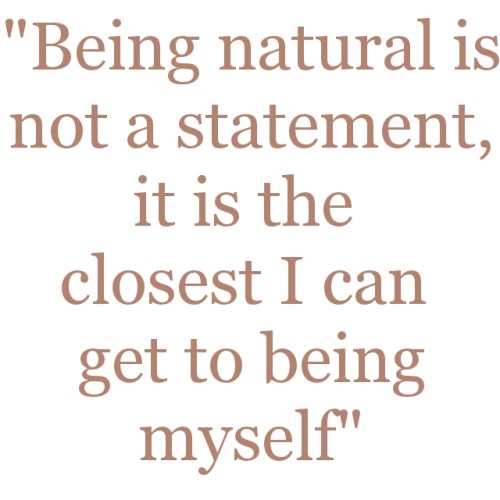
Natural Hair as a Statement

Lyrna, Vogue.It contributor and Editor of Lurve Magazine, in an interview with Natural Belle
One of the questions I get asked most often about my hair (after how do I get it to curl like that, to which I always have to answer, sorry, honey, that's just my curl pattern) is whether I feel like I'm making some kind of statement by wearing my hair in its natural state. At first this question used to offend me. Like, damn, can't a sista do something for her damn self without everyone trying to attach some larger meaning to it? (Side note: I now understand why my friends with tattoos sometimes get mad when people ask what the tats "mean," which I myself am guilty of. Oops. #gottadobetter) 


So once upon a time, I would have cosigned Lyrna's statement. I still appreciate the sentiment, but in the time between when I first embraced my natural texture and now, I've come to realize that every. little. fucking. thing. in our lives is political. Feminism said it first, but there's absolutely no separating the personal from the political. In my humble opinion, there is very little (if anything) I can do as a Black woman that isn't making some sort of statement in the face of a larger society that still actively tries to stereotype us in every imaginable way. No matter who we are, what social categories we fall in, or what exact boxes other people try to shove us in, choosing to be fully and openly ourselves rather than bending and squishing and silencing ourselves to fit whatever is "in" in the moment is making a statement. We pick our clothes, accessories, and hairstyles for a reason, even if that reason is just I like this/think I look good with this; as Facebook has taught us, "liking" something can be an incredibly powerful social tool. 

But I like imagining a world in which we don't have to see our choices as political, a world where style is just style for everyone, regardless of race, gender, sexuality, etc. That would mean that we as members of the human race have come to see all social categories as capable of all the variation imaginable, and that choosing to do things that run counter to dominant society would no longer be stigmatized. Being free to understand our choices simply as choices would require the end of marginalization, fetishization, and the questioning of authenticity. And what a beautiful world that would be. 

But until then, yes, my hair is a statement. So is my style, the music I like, the way I carry myself, my vocabulary, and basically every other stylized choice I make. The statement I'm making? Bitch, who gon check me?! Here I am fucking up your schemas. Deal with it.    

Wednesday, January 4, 2012

Yo, but actually


I have heard these things in real life, I swear. And not just from White girls, but people of various non-Black-woman race/gender combinations. "It's almost like you're not Black" is actually too close to home; I'm writing about times that has been said to me in my personal memoir on Blackness for my Comparative Literature class. Fuck other people feeling like they have some sort of authority to tell me what I'm supposed to be as a Black woman. Hell, even as a person. 

But to go along with the theme of the video, I shall reveal what I believe is the most ridiculous thing a white girl has ever said to me:
"It's like I'm a big Black woman trapped inside a skinny white girl's body!"
She later became a dear friend of mine, but saying this like the second time we'd ever met? The opposite of cool. 


Thursday, December 29, 2011

Major cosign-age:


We, not just as black women, but as women, and as human beings, should have BEEN DONE with this narrative quite some time ago. But by discussing it, even when we're talking about how stupid/inaccurate/detrimental it is, we're giving it credibility and encouraging the media to keep bringing it up. We need to let this DIE and come up with better, more productive narratives to talk about.

And my shout out to someone who is telling the truth about us will go to The Crunk Feminists, with honorable mentions to playwright Lydia Diamond, who wrote Stick Fly, and Issa Rae and her whole team over at The Misadventures of Awkward Black Girl.


Wednesday, December 7, 2011

"Whenever a conscious Black woman raises her voice on issues central to her existence, somebody is going to call her strident, because they don’t want to hear about it, nor us. I refuse to be silenced and I refuse to be trivialized, even if I do not say what I have to say perfectly." -- Audre Lorde

Tuesday, October 11, 2011

We've come a long way.

I don't have a wealth of memories of my ex-stepfather that could be construed as positive, but one of those few happened in the toy section of a department store. It wasn't one of the stores we regularly shopped at, and it wasn't a toy store...if I remember correctly, it was my cousin's birthday the next day, and we were wherever we were trying to find a cheap-ish gift to bring to her birthday party. There weren't very many Black dolls at the store, and while they were choosing between a few dolls, I pointed at another to ask why she wasn't being brought into consideration. 


This doll was a fabric doll, rather than one made of plastic. She had a very wide, very round face, with a pretty flat head. Her nose was puggish and also quite wide. Her hair was some knotty short thing that, to the best of my current understanding, was meant to represent what happens when you let your fro try to form locs naturally. She was wearing some kind of dowdy dress. In short, she was just not cute. But I was an inquisitive child like I am an inquisitive adult, and thus I asked, "What about this one?" 

My ex-stepfather stopped the conversation he was having with my mother. He looked from me to the doll and back again, and in a rare moment of actual parenting, decided to use this as a teaching moment rather than an excuse to beat my ass. He asked my mother if she had a mirror in her purse. She produced one, and he told me to look at myself. I did. He then said to look at the doll. I did. 


"Does that doll look anything like you?" he asked.
I hesitated. "...Not really?" 
"No. It doesn't look anything like you. But that's what They think you look like, and it's what They want you to think you look like. So no, we're not buying that doll."

I didn't really know who They were at the time, but I had the distinct understanding that They were bad people and I wanted nothing to do with Them, and that maybe They didn't like me (or my cousin) very much. We bought a different doll and went on home. 


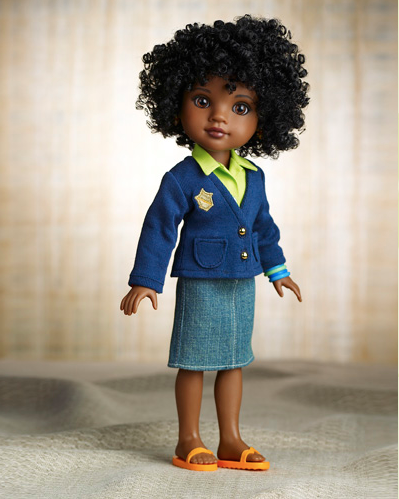
I thought about that day when Mattel announced it was introducing new dolls in the Barbie line, who were varying shades of Black and had ethnic features, hair, and names. I bought one for my young cousin, to give her the cultural representations we struggled to find when I was her age. I thought about that day again last night, when I stumbled across this image on one of the blogs I read:
Meet Hearts for Hearts Girls' newest addition: Rahel from Ethiopia
My first thought was, 'Now there's a doll that looks like me.' Seriously, that's my hair on a good day sitting on her head right now. [There's this new trend amongst naturalistas to give their daughters' straight-haired dolls straw sets with pipe cleaners and hot water to induce the natural look, which is sooo creative and innovative and awesome, and I applaud it, but hers comes like this!] Her nose and lips are just slightly fuller than your average doll, and she comes with the outfit seen above and a more vibrant yellow top and red sarong. I think dollmakers are really starting to understand the versatility of the African diasporic experience and have started to produce representations that highlight the beauty and just accurately reflect those experiences. 

It just might be exciting when people I know start having kids and I won't have to fret about what buying a certain doll might make a certain little girl I care about think about herself.  

Tuesday, September 6, 2011

Pi Nappa Kappa: A Sorority I'll Pledge

So I've been watching very quietly over the past few weeks as basically every single Black female blogger I read has talked about whether or not people should feel some kinda way about the new Pi Nappa Kappa, a Greek organization for Black women and men with natural hair. I've heard that it's pointless. I've heard that it makes a mockery of the extant Black sororities and fraternities. I've heard that it might be setting naturals up for exploitation or trying to scam people. I've heard people rail against the "Natural Hair Nazis" that obviously must be behind this group. I've heard women who "went natural before it was cool to go natural" talk about why we don't need groups like this. I've heard people talk about how we don't need more things to divide our people. I've heard people crack jokes about what their pledging process must be like. 

To make a long story short, I thought I'd heard it all. And as a person who generally supports Greek organizations (as long as they have their shit together), but had never really considered joining one, I thought I was perfectly content to read what lots of other people had to say about the organization without really weighing in. 

But today, Thank God I'm Natural did something none of the other blogs I'd read about the subject did: explained the sorority in its own words, rather than making assumptions, and posted the organization's pledge. 

"Anifowoshe’s sorority is different from traditional Pan-Hellenic sororities of fraternities in the sense, there isn’t a pledge process, a probate, and members won’t be performing at any step shows. All one has to do if they’re interested in becoming a member of the sorority is place their electronic signature on the organization’s pledge document, which reads:
As a member of the Pi Nappa Kappa Natural Hair Sorority, I pledge that:
1. I am a smart, special, valuable person!
2. I respect myself and I respect others.
3. My words and actions are kind and honest.
4. I will respect the dignity and essential worth of all individuals.
5.I will promote the diversity of opinions, ideas, hairstyles and backgrounds which is the lifeblood of the sorority.
6. I will promote a culture of respect throughout the natural hair community.
7. I will not tolerate bigotry, discrimination, violence, or intimidation of any kind.
8. I will practice personal integrity and expect it from others.
9. I will always be proud of my natural-born hair.
10. I accept only my best in all I do.
I am Proud to be ME!"
I'm pretty sure that pledge basically embodies my unwritten manifesto. Okay, maybe I wouldn't have put the virtues of naturalista-dom so highly if I was writing my own manifesto, but promoting diversity and respect for all things would have been there. There is nothing on this list that I don't try to already do in my daily life. 

So, to recap: they're not trying to be like traditional Greek organizations, there is no pledging process, they're promoting really good goals... The only strong counterarguments I see are the dividing-our-people/Natural Nazis arguments, and honestly, those things aren't new, people.  They certainly shouldn't be exacerbated, and I'd hate to see this become another #teamlightskin v. #teamdarkskin, because that shit is just the hottest of messes. But numbers 7 and 8 on the pledge lead me to hope it won't be, and I think there has to be a way for people who have something in common to celebrate that commonality without necessarily putting down people who don't have that in common. This is really just a subset of Black culture, when you think about it, and a lot of us can't go to our mommas to talk about ACV washes or the benefits of henna (don't worry if you don't know what I'm talking about); I don't think creating another space where we can do that is necessarily an affront to the rest of you. 

I'm going to sign the pledge.  

Sunday, September 4, 2011

I'm not particularly dark, and my hair is more curly than kinky, but I still want to rep/lay claim to/own/support this:

Reblogged from 18° 15' N, 77° 30' W
 

Monday, August 22, 2011

I can only handle so much race-related bullshit in short periods of time

I've had problems with Vogue for a while. In response to criticism about their lack of diverse models, Vogue launched the spinoff "Vogue Black" which is cool and all, and I'm glad to see us celebrated, but Vogue, in case you haven't heard, separate is inherently unequal. I wanna see women that look like me in the pages of your worth-gazillions-of-dollars magazine, not relegated to an interesting corner of the interwebs. 
But this makes that look like a stroll in the fucking park: Vogue evidently thinks large hoop earrings are a throwback to the fashion statements made my my enslaved foremothers. That's right, while we all thought they were out there just trying to work hard enough to possibly not get whipped by their overseers and struggling to keep their families together and avoid legally sanctioned rape, and dealing with the psychological trauma of being an object rather than a human being, they were also evidently totally concerned with the image of beauty they portrayed. I mean, I know they didn't get paid or even get enough food to support their families, but they totally rocked gold earrings. And who cares about the food situation anyway?--the emaciated look is still en vogue. //end sarcasm

Vogue says about gold hoop earrings:
"If the name brings to the mind the decorative traditions of the women of colour who were brought to the southern Unites States during the slave trade, the latest interpretation is pure freedom." 
I'm pretty sure my latest interpretation is pure ignorance and a complete trivialization of history and its lasting effects on your part, Vogue. 

*disgust*