Inside the mind of a kind of quirky, pretty stubborn, way too opinionated, twenty-something, heteroflexible Black female newly employed up-and-moved-to-DC Princeton GRADUATE who's just trying to sort out her life. An uninhibited celebration of all that is me, this blog is an exercise in self-discovery and live-with-your-heart-wide-open-ness. Though I make respect a habit, I will not always be politically correct, and I believe in the power of making audiences uncomfortable to inspire change.
Showing posts with label identity politics. Show all posts
Showing posts with label identity politics. Show all posts
Saturday, December 29, 2012
"I will have an undergraduate class, let’s say a young white male student, politically-correct, who will say: “I am only a bourgeois white male, I can’t speak.” … I say to them: “Why not develop a certain degree of rage against the history that has written such an abject script for you that you are silenced?” Then you begin to investigate what it is that silences you, rather than take this very determinist position-since my skin colour is this, since my sex is this, I cannot speak… From this position, then, I say you will of course not speak in the same way about the Third World material, but if you make it your task not only to learn what is going on there through language, through specific programmes of study, but also at the same time through a historical critique of your position as the investigating person, then you will have earned the right to criticize, you be heard. When you take the position of not doing your homework- “I will not criticize because of my accident of birth, the historical accident” - that is the much more pernicious position."
"Well, he's not a Muslim. He's a Christian. He's always been a Christian. But the right answer is, 'Well, what if he is?'. Is there something wrong with being a Muslim in America? ... Is there something wrong with some seven-year-old Muslim-American kid believing that he could be president?"
"Queerness, to me, is about far more than homosexual attraction. It's about a willingness to see all other taboos broken down. Sure, many of us start on this path when we first feel 'same sex' or 'same gender' attraction (though what is sex? And what is gender? And does anyone really have the same sex or gender as anyone else?) But queerness doesn't stop there.
"This is a somewhat controversial stance, but to me queer means something completely different than 'gay' or 'lesbian' or 'bisexual'. A queer person is usually someone who has come to a non-binary view of gender, who recognizes the validity of all trans identities, and who given this understanding of infinite gender possibilities, finds it hard to describe their sexuality any longer in a gender-based way. Queer people understand and support non-monogamy even if they do not engage in it themselves. They can grok being asexual or aromantic. (What does sex have to do with love, or love with sex, necessarily?) A queer can view promiscuous (protected) public bathhouse sexwith strangers and complete abstinence as equally healthy.
"Queers understand that people have different relationships to their bodies. We get what it means to be stone. We know what body dysphoria is about. We understand that not everyone likes to get touched in the same way or to get touched at all. We realize that people with disabilities may have different sexual needs, and that people with survivor histories often have sexual triggers. We can negotiate safe and creative ways to be intimate with people with HIV/AIDS and other STIs.
"Queers understand the range of power and sensation and the diversity of sexual dynamics. We are tops and bottoms, doms and subs, sadists and masochists and sadomasochists, versatiles and switches. We know what we like and don't like in bed.
"We embrace a wide range of relationship types. We can be partners, lovers, friends with benefits, platonic sweethearts, chosen family. We can have very different dynamics with different people, often all at once. We don't expect one person to be able to fill all our diverse needs, fantasies, and ideals indefinitely.
"Because our views on relationships, sex, gender, love, bodies, and family are so unconventional, we are of necessity anti-assimilationist. Because under the kyriarchy we suffer, and watch the people we love suffering, we are political. Because we want to survive, we fight. We only want the freedom to be ourselves, love ourselves, love each other, and live together. Because we are routinely denied that, we are pissed.
"Queer doens't mean 'don't label me,' it means 'I am naming myself.' It means 'ask me more questions if you're curious' and in the same breath means 'fuck off.'
I dislike saying "people of this identity ARE [any subset of qualities]" because no they all aren't. So I'm going to replace the word queer in all of this with the phrase "people with healthy attitudes towards sex, love, and identity". Otherwise, ALL OF THIS OMG YES.
What I see is that the struggle for recognition as whole entities is the struggle for recognition as whole entities, no matter what particular version of wholeness you're fighting for. Not that individual and group differences don't matter--that's a statement that would never ever come out of my mouth and y'all know it--but that we should be able to recognize our strivings in the strivings of other people(s). Maybe not equate them, but support them as we support ourselves. For how can you ask to be seen if you refuse to see?
"I don’t think it’s terribly controversial to
note that women, from a young age, are required to consider the reality
of the opposite gender’s consciousness in a way that men aren’t. This
isn’t to say that women don’t often misunderstand, mistreat, and
stereotype men, both in literature and in life. But on a basic level,
functioning in society requires that women register that men are fully
conscious; it is not really possible for a woman to throw up her hands
and write men off as eternally unknowable space aliens — and even if she
says she has, she cannot really behave as though she has. Every element
of her life — from reading books about boys and men to writing papers
about the motivations of male characters to being attentive to her own
safety to navigating most any institutional or professional or economic
sphere — demands an ironclad familiarity with, and belief in, the idea
that men really are fully human entities. And no matter how many men
come to the same conclusions about women, the structure of society
simply does not demand so strenuously that they do so. If you didn’t
really deep down believe that women were, in general, exactly as
conscious as you, you could probably still get by in life. You could
probably still get a book deal. You could probably still get elected to
office."
To apply a bit of intersectionality to this…women of color and the
many marginalized communities we belong to—especially communities of
color—have been saying this for a minute.
A lot of you might be looking at me like, "Well duhhh." But until very recently, I purposefully did not align myself with "the feminist movement". Distancing myself from it was a conscious political decision on my part. I had bought into this idea of feminism as a White woman's thing, concerned with getting them out into the working world while Black and Brown women took care of their kids and no one took care of our kids. I saw feminism as a perpetrator of racism, classism, homophobia, and various other -isms in their focus on the horrors of sexism. And yes, I knew of the existence of feminists of color and of "womanism" as a concept (a concept unrecognized by spell-checkers everywhere, but a concept nonetheless), but I suppose I regarded these feminists sort of like I regard Black Republicans, as entities that fundamentally confuse me, and I rejected Womanism because in my limited understanding of it, it was caught up in religion and y'all know I don't do that.
But then, out of a combination of curiosity and ChoosingPancakes's urging, I took a class this
semester called Ain't I a Woman? Women of Color and the Politics of
Feminism. I had taken quite a few things that are cross-listed with
Gender and Sexuality Studies before, as you might expect, but nothing that dealt so specifically with feminist discourse that has emerged from marginalized populations. During our first seminar, we watched a video that featured some women who espoused a lot of feminist notions but adamantly refused to identify as feminists, and while some persons in the class were condemning them, I totally understood. I had "feminist tendencies," but damn if I was gonna identify as a feminist because I didn't like the history of that word. A rose by any other name, right? Why did it matter if I didn't call myself a feminist if I still fought for the rights of women (and all people more generally)?
Then we read Benita Roth's Separate Roads to Feminism: Black, Chicana, and White Feminist Movements in America's Second Wave. Roth shows how these movements were all interrelated and grew out of and from and through one another. She also shows that particular strains of feminism, especially Black feminism, really seem more like the general human rights activism that I have always identified with. I was intrigued. Then we read bell hooks, who made her theory quite accessible and suggested in Feminist Theory: From Margin to Center that marginalized populations have a sort of backwards privilege towards understanding the way oppression works because we so often experience it in myriad ways. By this point in the class, I understood liberal feminism as saying "Women and men are equal," radical feminism as saying "Women and men are different, but those differences shouldn't stigmatize women,"' and hooks as saying LOL HOLD UP WAIT A MINUTE ALL WOMEN (AND MEN) AREN'T EVEN THE SAME AS EACH OTHER. *intrigue grows* If there's anything I can always get behind, it's some good old intersectionality. (Shout out to Bonnie!) hooks said feminism is for everyone and redefined it as "a movement to end sexist oppression," and when it was noted that sexist oppression cannot be ended without an end to all of the other oppressions that plague women, I started to warm up to this "feminist" idea.
Then we read this awesome anthology called This Bridge Called My Back: Writings by Radical Women of Color which had stories and testimonies from lots of feminists of color and I identified with so much of what they said. We read Women, Race, and Class by Angela Davis, who comes at feminism from a Marxist perspective and brings in so many of the class issues that worried me about feminism. We questioned the role of academics in feminism, as well as the tensions between scholarship and on-the-ground activism, the concept of "truth"(s), and why we've been taught to devalue experience as a source of knowledge. I was really getting into this stuff, to my own surprise. I got to write a paper about Erykah Badu as a source of Black feminist thought and it was awesome.
We asked the kind of crazy questions with no answers that I live for, like "What's the difference between objectivity and generalizability?" or "How do we know it's normal to group ourselves?" and a HUGE one for me, "How do you have unity and diversity simultaneously?". We read things that were half in English and half in Spanish, like Gloria Anzaldua's Borderlands, and felt what it feels like to be linguistically excluded from scholarship/activism in your own favor. We read Patricia Hill Collins's Black Feminist Thought: Knowledge, Consciousness, and the Politics of Empowerment and discussed the matrix of domination, the way very diverse experiences can come together under it, and the idea that everyday survival can be a form of activism. We talked about the fetishization of the idea of the individual genius, when really the overwhelming majority (if not all) of thought is produced in dialogue. We talked at length about the politics and power of self-definition, and I realized I was falling in love.
I had to miss the week we read Audre Lorde because my thesis was due in three days, so I am saving her as a treat for when I miss academia in the coming months. The few things I've read by her in the past (mainly "Uses of the Erotic" and some random quotes) suggest that I will wish she had adopted me and raised me as her own. We read about Third World Feminism and talked about how essentialism arises both within and outside of communities, how people with colonialist mindsets often totalize minority populations, taking some aspect or attribute of a subset of the population and characterizing the entire population as having that aspect/attribute, the notion of cultural authenticity and how to reconcile it with generational changes, and internalized sexism and how patriarchal culture is not always enforced only by the patriarchs. We asked more questions that make me want to moan with scholarly/activisty pleasure: What happens when we bring labioplasty in the US into conversation with female genital mutilation in sub-Saharan Africa? How does that change the "cultural" arguments that are usually made about female genital mutilation? When do we consider things disabilities or abnormalities instead of recognizing that everything exists on a spectrum?
Our last week of class, I gave a presentation on an anthology called Colonize This! Young Women of Color on Today's Feminism, and even though those women were all about my mom's age, theirs was a feminism I could totally get behind. It raised issues like the lack of truly safe spaces in any human interaction, feeling like a particular identity of yours isn't "enough" for an identity-coded space, feeling like your birth family isn't the family that can best support you, the politics of the "people of color" label, colonization in interpersonal romantic relationships, sacrifice, the lack of space for mixed race persons in the White/poc dichotomy so often presented, feeling like you can't be fully yourself in identity-coded spaces, accountability, gentrification, HIV, hip-hop and empowerment, the intersections of motherhood and class, the subtle-ization of racism, the politics of femininity and femme-ness, the politics of sex-positivity as a woman of color, guilt amongst the successful daughters of unsuccessful parents, etc. etc. etc. It's a book I'm torn between selling back so that I can get more money to furnish my apartment and keeping because I want to have it on my bookshelf forever.
And if all of that wasn't enough, we had this incredible final project. We were to pick a subset of feminist thought and create an anthology around it. I chose trans feminism, because it seemed to me a sort of final frontier of inclusive feminism, and because the struggles trans women undergo in their quest for acceptance in feminist spaces reminded me of the struggles of Black/Brown women and lesbian women in the past. I read so many things, first from radical feminists who said things so terrible about trans women that I refuse to repeat them here, and them from trans women themselves responding to that and developing scholarship about their own oppression out of it and wanting to reconcile trans activism with feminism, and then finally from people who are not necessarily trans or women who believe that feminism cannot be true to itself without the centralization of the trans experience. And that's when it hit me: if these women can be feminists when a non-trivial percent of feminists wouldn't even call them women, then what the fuck am I doing? It's not feminism that's wrong, it was my previously held interpretation of feminists and feminism as homogenous (White, privileged) things. It was my failure to realize that a feminist identity should be allowed the same degrees of freedom as any other identity. It was my failure to realize that, by the measure of the scholars I value most in the field, the work I do is already feminism, but naming things and being able to stand in solidarity is important.
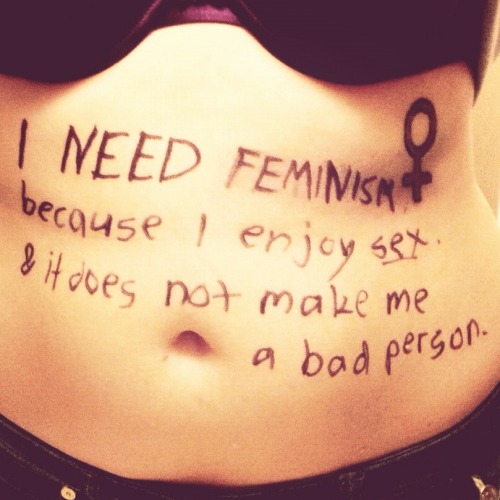
So, I am a feminist. I am a militant, Black, class-conscious-but-struggling-with-her-own-changing-class-perspective, outside-of-the-gay-straight-dichotomy, likely to drink a beer while wearing a dress, sex-positive, unwanted-children-negative, big-titties-embracing, revolution-demanding, self-loving, hegemonic-standards-of-beauty-rejecting, romantic-comedy-loving, stereotype-eviscerating, all-inclusive, no-kids-wanting-but-motherhood-respecting, checking-my-own-privilege-but-checking-yours-too, articulate-but-still-will-grab-a-n*gga-by-the-collar-quick, justice-fighting-for ready-to-fuck-up-some-traditional-gender-roles, academic-who-curses-too-much feminist. I am everything I am...I just didn't realize it could all fit under one word.
"For absolutely so many reasons. But mostly to stand in solidarity with
every man, woman, trans, gender-queer individual who has ever felt
degraded, ashamed, fear, sadness, rage or despair at the hands of the
patriarchy." -- Who Needs Feminism
"...because
apparently talking about my period out loud to a friend is vulgar. But
the guy three seats down made an announcement about his threesome last
night and is getting high fives." -- Who Needs Feminism
"I need
feminism because the fact that I’m an overweight, person of color, and a
female isn’t anything to be ashamed of, nor does it tell you what I’m
capable of. Three strikes against me my ass." -- Who Needs Feminism
And the tl;dr version of this post: "because a friend of mine said she doesn’t declare herself as a
‘feminist’ because she ‘doesn’t believe in everything they stand for’.
As if every feminist must hold the exact same opinion/criteria of
beliefs. The reality is we each have individual opinions, ones we agree
and disagree with but we are united with the common need for equal
rights." -- Who Needs Feminism
"Since the notion that we should all forsake attachment to race
and/or cultural identity and be “just humans” within the framework of
white supremacy has usually meant that subordinate groups must surrender
their identities, beliefs, values, and assimilate by adopting the
values and beliefs of privileged-class whites, rather than promoting
racial harmony, this thinking has created a fierce cultural
protectionism."
Specifically in the context of persons who usually are not close to me in any way who feel the need to ask me,
"Are you mixed?"
or are so audacious as to presume a mixed racial background and bust right out with,
"What are you mixed with?"
I'm sincerely unsure whether the sirs and madams who ask these questions understand how problematic they are.
First off, dogs are mixed. I am not mixed. Nor am I a mulatto, a mudblood, a mutt, a half-breed, a quadroon, or an octaroon. (Click here if you're confused by any of these names.) If you phrased the question as, "Do you come from a multiracial background?" I suppose that the truthful answer is yes. If you were to move backwards through my family tree, you would discover multiple people of non-African descent. At the very least, you would discover German, Portuguese, and American-Indian ancestry. There's a good chance you'd find some White guy from Canada in the not too distant past (my dad's dad's dad), though I don't know for a fact that this person was White or what his nationality was, and will never know because no one living knows. No matter which side you go up or what branches you go off exploring, all over my family tree you will run into question marks. Things no one knows and no one can know.
So, am I mixed? Technically, yes, I suppose. Historically speaking. Not recently. Not primarily through choice. I only know that the German (my dad's mom's mom) was an un-forced mixture. Thus I will claim that, if pressured, but I feel no obligation to recognize small percentages of my racial make-up formed through slavery, oppression, or other relations I am not sure were consensual. I feel especially unobligated to do so because the overwhelming majority of multigenerational African-Americans--Imani Perry's term for those of us who descended from slaves--share a similar history. Rather ironically, Blackness constitutes "otherness" to White America, while simultaneously containing Whiteness nearly definitionally. The question marks in my family tree are a trademark of life as a descendant of an enslaved population: if you wanted to say that the only Black persons allowed to identify as such are those with nary a White face on their family tree, the only Black people in America would be recent African immigrants. My mom's mom's mom was a dark-skinned woman with blonde hair and blue eyes. This is our history. So to those people who claim that I'm doing a disservice to American history and my ancestors' legacies by not identifying as multiracial, I say that you're doing the same disservice to American history and adding injury to current Black populations by not allowing us to incorporate our complicated racial histories into one story of preservation, rather than of domination and dissipation.
Am I mixed? Technically, yes, I suppose. Historically speaking. Not recently. Not primarily through choice. But I will never ever check that on a box. I will never say this of myself. I identify as a Black person. I interpret my Blackness as inherently containing elements that aren't Black, and I would appreciate it if you, people who question my monoracial identity, would accept my interpretation. How dare you seem incredulous when I respond that I'm "just Black"? How dare you try to say, "No you must be ________"? You don't know me like that, and I am allowed to identify however I please. If I screw up your schema of what a "just Black" person "should" look like (or act like or feel like or be like), then well, I'm not sorry.
Also, my friend @iribobiri came up with the best response ever to the second question. I promise this will play out in my life at least once:
Ignorant person I've recently met: What are you mixed with?
On the most recent survey I filled out, I picked Queer over Bisexual because queer has a broader meaning, but I still prefer "heteroflexible" as the best representation of my place along the sexuality spectrum at this particular point in time. I've talked about how checking sexual orientation boxes is difficult for me before (here), and I unsurprisingly really really can't stand it when people try to invalidate other people's sexual identities--or any other identity, because by the simple virtue of not being me, you (hypothetical rando trying to tell me about myself) cannot say who or what I am or am not. Fact of life. Get over it.
Anyway, evidently Cynthia Nixon, the woman who played Miranda on Sex in the City (which has become one of the shows I will watch whenever it is on television), told the New York Times that her identity as gay is a choice, and various factions of LGBTQQIA communities freaked the fuck out. She tried to explain later that she chooses to identify as gay because she doesn't like the way Bisexual sits, and they were like, 'Oh so you're bi and just denying.' Pause. People. Explain to me how persons of various sexual identities who have banded together in order to demand public visibility and acceptance can render her identity choices and preferences invalid? 1) you are perpetuating the very same things you're fighting against. 2) NO MATTER WHO YOU ARE, YOU CAN'T TELL HER WHO SHE IS. You just can't. It doesn't work like that. If she had implied that everyone's sexuality is a choice, which she expressly said she was not doing, you could raise the issue that that viewpoint is problematic for any of 2987904734 reasons. You can't say fuck your opinion of yourself, Cynthia Nixon, this is what you are because we said so. No.
"Simply slapping a label that says “bisexual” onto Nixon — or me, or
anyone else who falls outside a clearly delineated gay/ straight
dichotomy — and expecting that to be the end of the conversation is
reductive, simplistic, and insulting to everyone whose sexuality is
somewhere in the gray area." --Lindsay Miller, Thought Catalog
In fact, I think that trying to do this is absolutely antithetical to the recognition of sexuality as a spectrum. Anyone who is working towards that goal should celebrate sexual identity as an individual process of self-acceptance and definition, rather than a forced matching to societal standards (even as those standards become more "progressive"). Let her identify how she wants and me identify how I want and everyone identify however they want because they are who they are and that's just how it is.
"...the people of the African Diaspora are a biogenetically diverse category of people who have an identity derived from common experiences of exploitation and racism. It is far more accurate and more fruitful to scholarship, and possibly to the future of humankind, to define African American people by their sense of community, consciousness, and commitment than by some mystical 'racial' essence. It is the Community into which they were born and reared, a Consciousness of the historical realities and shared experiences of their ancestors, and a Commitment to the perspectives of their 'blackness' and to the diminishing of racism that is critical to the identities of the Thurgood Marshalls and Hazel O'Learys of our society."
--Audrey Smedley, "'Race' and the Construction of Human Identity"
I listened to/saw the video for the first half-ish of Nicki Minaj's "Stupid Hoe" last night. I say the first half because I actually couldn't bring myself to sit through the entire thing. It was like torture; I love myself too much to subject myself to such foolishness. Some things can't be unseen/heard. It's like, okay, from an academic perspective, I would really like to like Nicki Minaj. Or at the very least, to be able to appreciate her and what she's trying to do. I want to embrace her like I embrace Rihanna, for owning her sexuality and putting herself out there with an agency not often afforded to women, and particularly not to women of color, even in 2012. I want to applaud her for being the only female member of Young Money, and on an even greater scale for like, reintroducing the female rapper, whom we haven't really seen since Eve and Lil' Kim disappeared a while back. I want to commend her for being unashamedly and unabashedly herself in the face of an entertainment system that tries its damndest to mass produce creativity.
I want to have all this respect and maybe even some love for Nicki Minaj. I really do. But I just...find it hard to. I have three songs by the Black Barbie in my music library, "Fly," "Your Love," and "Super Bass". She is featured in three other songs in my library: Gyptian's "Hold Yuh," Sean Kingston's "Letting Go," and Trey Songz's "Bottoms Up." I have few major issues with any of these songs, but they're but a fraction of Minaj's work overall.
It's like, okay, first off she just kind of freaks me out, with her ridiculously colored wigs/makeup and her incessant tics in her music videos. But, as my blog description proclaims, I believe in the power of making audiences uncomfortable to inspire change, so I'm not going to knock her for freaking me out. And as a full-figured woman, I definitely appreciate a nice rack, but...she's just got too much artificiality going on there for me. But that's just a personal preference and I'm not gonna come out and say I'm like, against cosmetic surgery entirely, because it really does change some people's lives for the better. I just kind of wish she embraced her natural body, but hey, this isn't enough to write her off entirely.
It's songs like "A$$" and "Stupid Hoe" and "Did It On 'Em" that get me. It's not that "A$$" is "too sexual" or that any of these songs are "too aggressive" or "too aggressively _______," it's that they're just too damn vulgar for my tastes. (And the fact that "Stupid Hoe"'s entire chorus is "You're a stupid hoe, you're a, you're a stupid hoe" is just problematic on all sorts of levels.) It might not even matter what your message is if it's so buried in seemingly unnecessary vulgarity that people can't find it. I am dubious of the idea that intent matters more than consequence.
And then, okay, can we talk about this Barbie thing? Sure, people should be allowed to create their own identities and embrace them and yada yada. That's all well and good and I generally support it, but can we take a moment to analyze the identity she's putting forward? She's the "Black Barbie." Pause. Barbies, by definition, aren't real. They're toys, children's playthings to be used in whatever way the play-er wants and then tossed into some dark box, only to see the light of day again when the play-er decides. They have no will, no volition. They make no choices. They are only used and thrown away, used and left to collect dust. I wasn't really upset if Barbie's head came off because I combed her hair too hard or if my teething little brother chewed on her feet, because Barbie was a thing. By aligning herself with that image, Nicki's objectifying herself, and I can't really see any reason why doing it to herself should be any better than a man (or a patriarchal society) doing it for her. And to add another level, Barbie dolls represent anatomical impossibilities and are one of the first ways in which society indoctrinates young girls with standards of beauty they'll never be able to meet, which it could be argued that Nicki is also playing into by modifying her body with implants.
So many women have so much love for Nicki Minaj, but it's not really clear to me that she has love for us, or even for herself.
And rather than sharing any of Nicki's music here, because I'm not sure how comfortable I am with it on my page even in a critical sense, I'm going to share this poem by Jasmine Mans, whom Josh Bennet told me to check out way back when I met him at the Mellon Mays mixer in December:
Tuesday, January 24, 2012
"When you say to a person of color, 'When I see you, I don’t see you as
black! I just see everybody the same.' People, think about that. You
don’t have the right to say to a person, 'I do not see you as you are, I
want to see you as I would be more comfortable seeing you.'" - Jane Elliot on the absurdity and invalidation of claims of “Color Blindness” by white folk (via Choosing Pancakes)
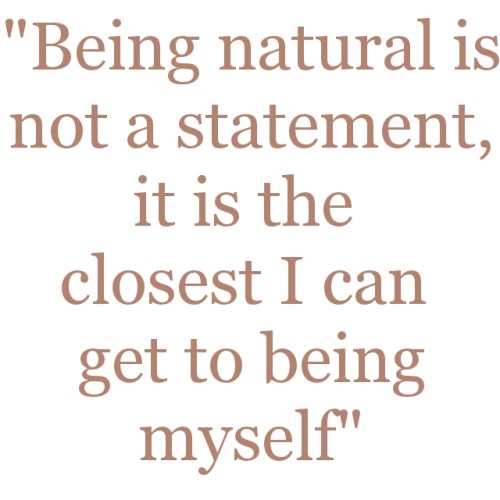
One of the questions I get asked most often about my hair (after how do I get it to curl like that, to which I always have to answer, sorry, honey, that's just my curl pattern) is whether I feel like I'm making some kind of statement by wearing my hair in its natural state. At first this question used to offend me. Like, damn, can't a sista do something for her damn self without everyone trying to attach some larger meaning to it? (Side note: I now understand why my friends with tattoos sometimes get mad when people ask what the tats "mean," which I myself am guilty of. Oops. #gottadobetter)
So once upon a time, I would have cosigned Lyrna's statement. I still appreciate the sentiment, but in the time between when I first embraced my natural texture and now, I've come to realize that every. little. fucking. thing. in our lives is political. Feminism said it first, but there's absolutely no separating the personal from the political. In my humble opinion, there is very little (if anything) I can do as a Black woman that isn't making some sort of statement in the face of a larger society that still actively tries to stereotype us in every imaginable way. No matter who we are, what social categories we fall in, or what exact boxes other people try to shove us in, choosing to be fully and openly ourselves rather than bending and squishing and silencing ourselves to fit whatever is "in" in the moment is making a statement. We pick our clothes, accessories, and hairstyles for a reason, even if that reason is just I like this/think I look good with this; as Facebook has taught us, "liking" something can be an incredibly powerful social tool.
But I like imagining a world in which we don't have to see our choices as political, a world where style is just style for everyone, regardless of race, gender, sexuality, etc. That would mean that we as members of the human race have come to see all social categories as capable of all the variation imaginable, and that choosing to do things that run counter to dominant society would no longer be stigmatized. Being free to understand our choices simply as choices would require the end of marginalization, fetishization, and the questioning of authenticity. And what a beautiful world that would be.
But until then, yes, my hair is a statement. So is my style, the music I like, the way I carry myself, my vocabulary, and basically every other stylized choice I make. The statement I'm making? Bitch, who gon check me?!Here I am fucking up your schemas. Deal with it.
I seem to be on the road to self-identifying as a feminist. Some of you might be looking at me like, well DUH, but let me explain: I've always had feminist tendencies. It's funny, but since birth I've had this nagging conceptualization of myself as a person that deserves recognition as such...but I digress. I've always had feminist tendencies. I just used to be wary of downright against calling myself "a feminist." And before you start thinking I'm some little punk, it wasn't because of all of the shit that gets talked about feminists. Who gon' check me, boo?!
My problems with feminism come from its longstanding history of ignoring the particular struggles affecting women who are anything other that White, middle-class, and heterosexual. And yeah, okay, I know the movement is officially for all women now, but honestly, I believe that like I believe Santorum was talking about "blah" people...like hell.
Get at me when you stop producing foolishness like this, feminism. It's like, damn, and I liked SlutWalk too...
I still see the experiences of women of color, queer women, and poor women being addressed primarily by in-group members. I still see personhood being portrayed as Whites-only when feminists report statistics about "Women," "Men," "Blacks," and "Hispanics." (Should I clap that you're trying when you're doing it so very wrong?) And it's just like, while I'm so glad the right to breastfeed at work has become protected by law, I'm just much more concerned with the fact that unemployment is rising for Blacks as it falls for everyone else.
And yeah, okay, I know that Black feminism is a thing. It's a really fucking awesome thing. And then there's the whole womanist movement, too. And when I discovered these, I got more open to the idea of maybe calling myself a feminist. And when I realized the error of my previously pro-life ways, I got even more open to the idea of maybe calling myself a feminist. And the above photograph says more than I ever can about how the movement as a whole isn't doing nearly enough to address race and racism, but at least part of that needs to be interpreted in a Gandhi "It's not your Christ I have a problem with; it's your Christians" kind of manner.
And there's another It's-not-your-Feminism-it's-your-feminists problem that I have: man-bashing. I really don't know what it's going to take for people to realize that the celebration of one thing does not necessitate the belittling of its opposite (not that I believe men and women are inherently opposites). It is possible to love one thing without hating its counterpart. I love being Black, but that doesn't mean I hate Whiteness. I'm pro-choice but not anti-children (for other people). I'm pretty sex-positive, but that doesn't mean I'm abstinence-negative. And I can't stand it when so-called "feminists" attack manhood and masculinity, rather than attacking patriarchy. I can't stand it when "feminism" doesn't realize that portraying women as "good" and men as "evil" not only belittles both genders by erases heterogeneity, but is creating the exact same issues that patriarchy creates by portraying men as significant and women as not. By talking about all the things that are "wrong" with "men," these people are just playing into the narrow stereotypes and archetypes patriarchy has carved out for men to exist in.
Men have emotions. They hurt. They think. They dwell. They worry. They love. They fear. They have stories to tell, too.
And with that, I give you this awesome short documentary I discovered thanks to Tunde (@BrazenlyVirile) today. It's called Men Ain't Shit, and it goes out to everyone who has ever said any version of that statement. (I'm guilty of "Boys are stupid.")
I stumbled across someone who had reblogged this, and it caught my attention:
"I am queer. say that intentionally.I am not a lesbian. Not bi. Not straight. Not pan. Not gay. I am queer. Intentionally. I intentionally use this term although others may apply. Because being queer is political. It is fucking shit up. It is reconstructing broken elements. It is loving multiple sexes…" -- Freedom Fighter
I've said before that "queer" as a term seems too...grown for me. Too firmly set on an alternative lifestyle, as contrasted with my willingness to experiment. I wonder how a queer identity on my part would be regarded when I'm in a heterosexual relationship; would people see it as legitimate? Anyway, this makes me feel like maybe my "heteroflexibility" is a cop-out in terms of the politics of sexual orientation and identity politics generally. Yes, it's great to personally identify yourself in whatever way you want, but I would like to fit into a larger politically charged sphere of social identification. I want to help fuck shit up. So from now on, I'm going to actively try to grow into queer-dom.
Sunday, October 16, 2011
"One way I combat racism is by claiming my blackness as positive and in no need of justification." -- Malcolm Shanks, student at Brown University
His article addressing White people in classes that discuss identity who are uncomfortable talking about race is pretty bad-ass.
So y'all know that my blackness relationship to the dominant cultural narrative about what blackness is is something I struggle with. And while the Black Princetonian community definitely makes me feel less jarringly out of place than do/did most of the other interactions I've ever had with peoples of African descent--let it be known that I LOVEmy fellow Black Princetonians, even when I don't feel like I mesh well with the group--I've never really totally been able to shake that puzzle-piece-that-got-wet-and-now-just-won't-fit-no-matter-how-hard-you-try feeling. (Something along the lines of I can stand strong with the group in a discussion forum like a BSU or PABW meeting, but Idgaf how popular the dance is, I will never portray any part of my body as "stanky". I can seek/give advice to fellow naturalistas on campus, but I don't believe in God. I feel like parts of me are both the thesis and the antithesis of the norms of our community, and so I've come to a happy medium with one foot in and one foot out.) So after getting internally frustrated trying to totally Black-ify my life for two years, I joined an eating club and Sustained Dialogue and have finally started to have the rainbow coalition of friends I'd always wanted. Again, nothing new here--I've talked about this before.
What I really really love discovering, though, as I brought up yesterday in my post about Awkward Black Girl, is that out there in the interwebz world exist lots of other people who feel just as torn between their true selves and what the world wants their "Black" selves to be, people who want to change the narrative, people who get the vibe from other people, both Black and non-Black, that their racial validity is being questioned. Part of me wants to call this the rise of those who get called "Oreo," but I'm positive it's broader than that. [Side note: it wasn't until Sustained Dialogue this year that I heard the terms Banana and Apple (see definition six). Blew my mind. Also part of the reason I really don't want to limit my thesis about racial identity on campus to Black students--there are all kinds of tensions and derogatory in-group names I was entirely unaware of.] Some call us "awkward". Some call us "nerds". Some call us "bougie". Maybe we're all of those things. Maybe we're none. What we definitely are, though, is Black. And here, in large numbers.
These two articles on the subject made me smile today:
Excerpt One (though I don't support other Black Americans trying to threaten my race card either--if anyone should recognize a broader interpretation of Blackness, it's us):
"It's one thing when other African-Americans try to threaten my race card, but when people outside of my ethnicity have the audacity to question how "down" I am because of the bleak, stereotypical picture pop culture has painted for me, as a Black woman? Unacceptable." -- Issa Rae (aka AWKWARD BLACK GIRL HERSELF), from The Huffington Post
Excerpt Two:
"My experience of surprising White folks has continued my whole life....the near-hostility from non-nerdy Black folks has been the most painful....So, I have tried to be Black in stereotypically recognizable ways....American people of all races have a hard time acknowledging the complicated ways that blackness exists...Some of us just want to be free to be our complicated Black selves and kick it however the wind blows." -- PhyllisRemastered
Another thing that made me smile: a black staff member here at Lewis, who I met at a Fields Center event and is leaving Princeton for Northwestern, called me "Sista" when he was saying his goodbyes. I love getting called Sista. Makes me feel like the person addressing me recognizes that I fit despite all the ways in which I am not normative.
From an article entitled "Reconceptualizing Personality: Producing Individuality by Defining the Personal Self," by John C. Turner and lots of other people:
"Personal identity is not a fixed product of past socialization, learning or maturation but a contemporary product of social, societal and psychological forces. It depends inter alia on current group identities, social contexts and the goals, motives, expectations, beliefs and knowledge which are shaped by social influence and social ideologies. An individual's past experience, individual and social, may certainly affect how he or she reacts to and cognizes the contemporary social world, but present social realities, norms, values and ideologies, and reference group memberships are decisive for producing personal identity. Personal change is made possible by social change which impinges on the factors influencing the creation of personal identities."
Be who you want to be. Who it feels best to be right now. Who you were doesn't matter nearly as much as who you can be right here and now.
Racialicious posted something today that brought up a topic I struggle with from time to time, mostly whenever I'm filling out some form that asks about my racial identity and asks me to select all that apply.
I am a black person. I prefer to identify myself as a Black American, though I can accept multigenerational African-American (Imani Perry term), and will respond to African-American more broadly. I don't like the term African-American because I don't have very strong ties with Africa culturally or otherwise. I am somewhat Afrocentric, with my style of jewelry and sometimes clothing, and my hair to a degree (but that wasn't the original intent), and how I try to celebrate Kwanzaa. I think I prefer to think of it as ethnocentric. But another part of my reasons for disliking the term African-American is the simple fact that some of my foremothers and forefathers [yo, why is forefathers a word as recognized by the internet and foremothers isn't? Sexist and rude.] were not of African descent; their inclusion in my family tree was done through a mixture of choice and domination. This means that technically, despite the fact that I and my parents and my mother's mother all identify as black people, I am an individual of mixed race. Is this an identity I should embrace? I am a black person [with bits of German, Portuguese, Native American, mysterious-probably-white-Canadian, AND NOBODY KNOWS OR CAN EVER KNOW WHAT ELSE]. It is an inherent part of the process of having descended from a people who were not regarded as people. Am I denying the other parts of my ancestry by claiming only my blackness? Is this doing my ancestors (moreso the ones in my family tree due to love) a disservice? Or does claiming a black identity automatically include all the various mixings that produced black people, because to be a multigenerational African-American means to have been mixed? I don't ever check anything but Black/African-American on forms that say to select all that apply, because I don't identify as anything else. Should I?
I know you meant well. Or at least, that you didn't mean me any harm by what you said. I must admit, it was slightly amusing watching you struggle to dig yourself out of this hole you realized you'd inadvertently dug. It led to an interesting discussion about the differences between "white culture" (after questioning what exactly white culture is and whether it can be separated from mainstream American culture more broadly) and Jewish culture--you tried to draw an analogy between my personality:blackness::Jewishness:whiteness, and really, I want to commend your effort. I guess majoring in Psychology, Philosophy, and Economics makes you more attuned to the reality of cultural sensitivities and how to handle them with finesse more than most of my non-ethnic-minority friends. And don't worry, you're far from the first person to say this (or something similarly-themed) to me. I just a) hoped I had embraced my blackness enough in college to dispel such observations, and b) can't help but feel as though I should be offended, either on my own behalf, on that of black people as an amorphous group, or both. I cannot blame you--and am not trying to--for your statement because, as I learned during the Black Solidarity Conference this year, even [at the very least some, a concentration of whom I interacted with at Yale in February] of my peers and current race scholars don't see me as fitting into the larger overall picture of blackness either. But don't think for a second I'm condoning this, because I'm not. The fact that lots of people, even insiders, do this, does not in any way make it any more acceptable, or any less racist. So, friend, peers, scholars, larger world, I must again beg you to reconsider the apparently negatively themed definition you give to blackness. Who are you excluding from that group, and why, and what do you presume gives you the authority to make those cuts? I ask you to remember that race itself is a social construct, an idea that our forefathers made up to promote white privilege and deny persons with whom they were uncomfortable (or did not even consider to be persons) the rights of citizenship or even simply the rights of man--sure, it's one made visible by the color of my skin, the texture of my hair, the breadth of my nose, but again, these are all things that human beings themselves defined as fitting the construct of blackness, not inherent distinctions.
We struggled to define white culture when trying to establish Jewish culture's distinctiveness. I would like to raise the challenge that black culture, and (though I know little about it, everything I know about the world as a sociologist or even as an observant member of society leads me to believe that) even Jewish culture cannot be limited to one narrow definition against which to pose some other narrowly defined cultural group. Every mainstream culture has a counter-culture, usually multiple counter-cultures. There is always an underground, a counter-movement, even the smallest of revolutions. There is always someone who is unafraid to open their eyes, see their surroundings for what they really are, and say, "Hey, wait, this isn't what I want. This isn't correct/right/fair/justified/appropriate/normal/what-I-should-be-striving-for." There is always someone pushing for change. So, I have more rock on my computer than hip-hop/rap. That doesn't mean I can't spit a T.I. verse back at you, and it doesn't mean I'm not black. I will never fight someone because they scuffed up my sneakers, most likely because I'm in a cute pair of flats. That doesn't mean I'm not black. I have owned exactly two pieces of clothing from a "black" clothing brand in my lifetime, and they were both from JCPenney on clearance. (I can't turn down a good deal.) That doesn't mean I'm not black. I'm not a great dancer--I learned how to two-step less than two months ago and I cannot (and may never be able to) pop or lock (though I can drop it). That doesn't mean I'm not black. Enunciation and complete complex sentences define my natural linguistic structure; while that might make my 6-year-old cousin interrupt Thanksgiving dinner to start the following exchange:
V: Maya, why do you talk like that?
Me: Talk like what?
V: All...proper.
it doesn't mean I'm not black. I am and will continue to become highly educated at very elite universities, where my study of blackness and black peoples should not separate me from them. That doesn't mean I'm not black. I disdain of the use of the word nigg- by any and all persons, much in the same manner that I disapprove of faggot and cunt and a lot of other entirely inappropriate derogatory terms. It doesn't mean I'm not black. I don't like collard greens, but I won't eat macaroni and cheese that hasn't been in an oven and trust me, your sweet tea isn't sweet enough for me. This doesn't mean I'm not black. I don't have fake gold hoop earrings with my name in them, but again...I think you're getting the picture here.
I guess the more significant way to approach this is to examine what means I am black, besides my aforementioned skin, hair, and nose. 1) My recognition of the history this country tries to hide and the havoc that history and its hidden status wreaks on the black population even in 2011. 1b) My disdain for the term post-racial, no matter how you're defining it. Like my homeboy Brother West says, Race Matters. 2) In my house, Santa and Baby Jesus were both black, and though I didn't grow up to believe in either of them, I learned to see the world from a black person's perspective. I learned about the black tax (which I still believe in), and I learned the importance of remembering where you came from, because no one else is going to. I learned Kwanzaa and sweet potato pie and the foods you have to eat on New Year's to bring good fortune. I learned everyone from the Temptations to India.Arie. So I would like to take this time, world at large, to throw your assumptions about my cultural background back in your face. 3) In line with your mainstream negatively-themed ideas of blackness, world at large, which I do not agree with but feel the need to address, I am no stranger to struggle. I know what it is to be on food stamps. I know what it is to have the electricity/water/cell phone cut off due to nonpayment of the bill. I know what it is to not have food in the house. But knowing all those things taught me to dream, taught me to work towards a goal, taught me dedication and resilience, and combined with a lot of luck, those things have made me successful. Fact: either success nor lack of it are definitive of status as a racial minority. 4) R&B/Neo-Soul is my favorite genre of music, which is just as rooted in the black community as hip-hop. 5) My ideal breakfast features grits. 6) AND MOST IMPORTANTLY, I am black because I SAID SO. Honestly, that's the only reason you should need. Because this is an identity I have adopted as belonging to me and people like me and lots of people who aren't like me in many ways EXCEPT for their adoption of this same identity. If the work I'm just beginning on racial identity and college students has taught me anything, it is that beyond being a social construct and a category that people will try to place you in no matter what, race and your identification with your race is a choice. Whether that choice is manifested through organizational involvement, circles of friends, or something as simple as being the little guy's advocate in a classroom debate, it is an active decision. It is a decision I have made, it is an identity that is important to me, and while I certainly don't want it to be the only thing you categorize me as, I do want you to stretch your notions of blackness to include me. In fact, today, tomorrow, and every day until you concede, world at large, I will do nothing short of demanding it.