Showing posts with label Issa Rae. Show all posts

Friday, March 2, 2012

On meeting Issa Rae and Angela Davis

She came to Princeton as part of her college tour, and Black folks came out of the woodwork to be in her presence. There was seriously this one chick I don't even think goes here, haha. She started talking and we all turned to each other like, the fuck is she? 

First awesome thing was they didn't have a mac adapter and needed to borrow a PC and since I showed up half an hour early to get a front row seat (I'm not even kidding), I had my computer with me and she used it to make her presentation! I got to help her set it up and everything. We watched the first 7 episodes--with my friend LC and I basically reciting the jokes from memory, oops--and then she talked a little and opened up the floor for questions. I knew a lot of the answers to the questions people asked because I read approximately 98745903703 interviews for the paper I wrote on Awkward Black Girl, but I was still cheesing ridiculously and just totally geeked out the whole time. I then got to take a picture with her 
I can't remember the last time I smiled that hard, lol
It was similar to when I could hardly contain myself the first time I was in the same room as Joshua Bennett. I don't think it's weird at all that I care more about meeting and talking with people like them than with most of the legitimately famous people I've gotten to meet due to the incredible resources of this institution (including but not limited to Cornel West, Toni Morrison, Joyce Carol Oates, CK Lewis, Forrest Whittaker, and Tavis Smiley). Those are the kinds of famous people I expect Princeton to bring to me, established successful have been around forever exude importantness with every step kind of famous people. Josh and Issa are like, famous within certain crowds only, and I never really expected to see them outside of YouTube; their works speak to me in ways that no work of scholarship can speak to me, and they're not so in another stratosphere that it's impossible for me to have legitimate interactions with them. I'm such a legitimate fan-girl of each of them.

Meeting Angela Davis was an entirely different experience. She's a multigenerational great. Being in her presence felt weighty and significant, like I was witnessing history unfolding in front of me. I just wanted to turn into a sponge and wordlessly soak up everything she had to offer. I didn't have any real desire to interact or converse with her--as much as I feel like she would hate to hear this, I didn't feel worthy. Even if her speech wasn't the most well-organized thing I've ever heard, her words were still profound and inspiring. I would have been fully comfortable to just sit and bask in her glory, but I got the opportunity to take a photo with her too:
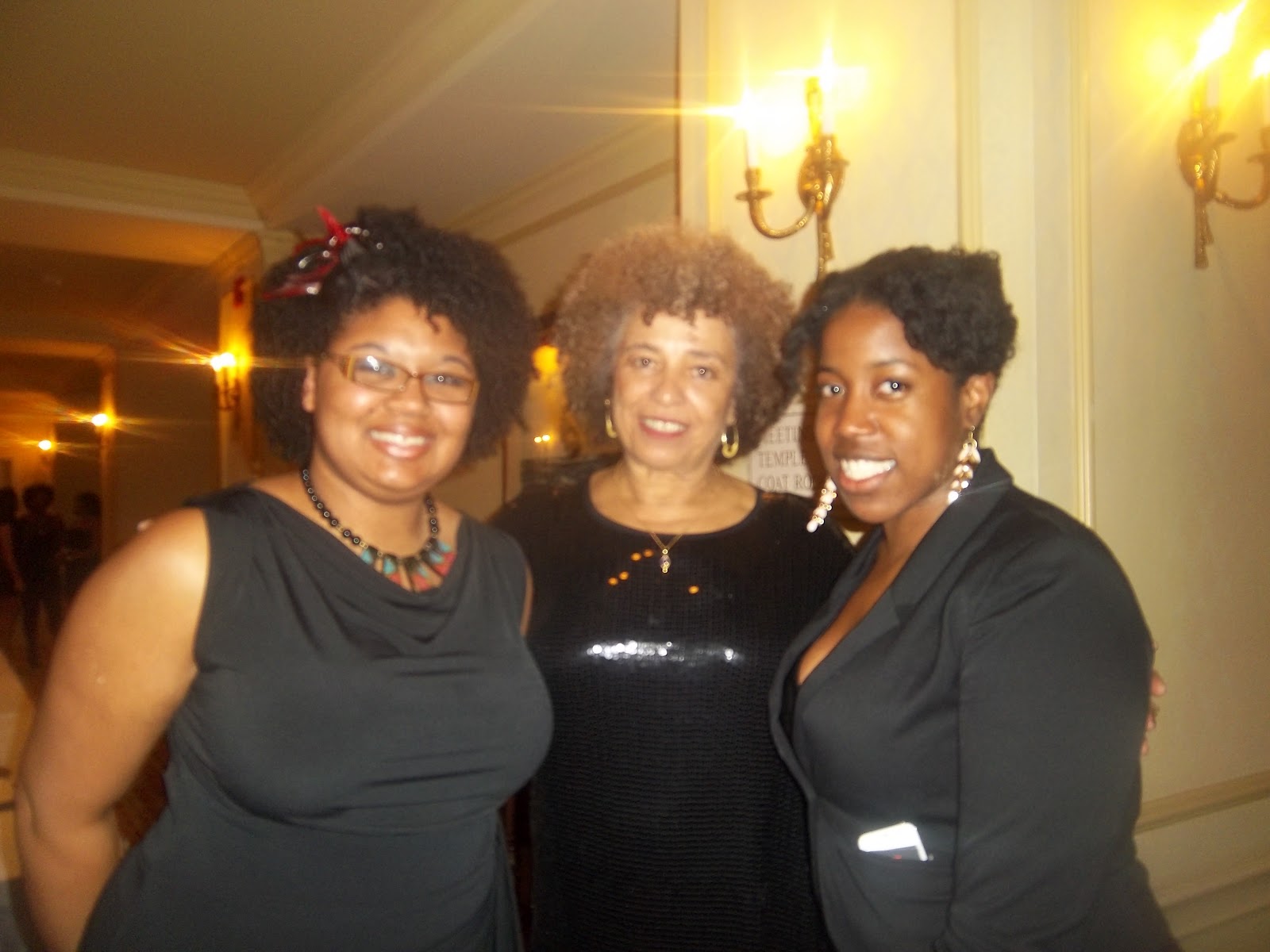
Some highlights from her speech (which I had typed into my phone and subsequently forgotten about):
"[It is time for us to] generate a new enthusiasm...that views us all as historical actors..."
"...a commitment to use knowledge in a transformative way and a refusal to attribute permanence to things that exist in the present simply because they exist."
"As apologies don't compensate for the deeply entrenched racism in this society, neither do they erase the homophobia that has caused so many young people to commit suicide recently."
"Racism is deeply structured by sexuality, especially in regard to expectations about practices of sexuality."
"[After slavery, sexuality was] the only means through which Black people could own their freedom."
Gertrude "Ma" Rainey's "Prove it on Me Blues" as accidental activism
prison as a gendering institution
"...just sending people to prison allows us to forget about the problem"
"The family is the site of the institutional reproduction of a flawed oppressive system."
"Binarism always shuts down thinking, because it has to be one thing or the other."
"How can we dwell inside contradictions in order to turn them into productive moments of greater freedom for us all?"

Tuesday, January 17, 2012

The first season of Akward Black Girl is over

and rather than lay in bed mourning, I decided to rewatch the entire season and write a paper about two of my favorite projects surrounding Black identity that exist right now: The Misadventures of Awkward Black Girl and Toure's Who's Afraid of Post-Blackness? What It Means to be Black Now. I feel so validated by the versatility of the fields of Sociology and African-American studies, both of which consistently remind me that that which is interesting to me personally is worthy of legitimate academic exploration and discussion. 

Anyway, I thought you all might be interested in my thoughts on combining the two works. But don't go stealin my shit, okay?


"Through directly addressing the themes of race, gender, sexuality, class, beauty, love, power, social acceptance, and of course, awkwardness, through the particular lens of one individual Black female’s experiences working at an average job and leading an average life, Awkward Black Girl shatters cultural expectations of Black femininity by honestly exploring the way individual Blackness is lived in contemporary society. Though the normative cultural gazes, stereotypes, tropes, and racist incidents that plague marginalized populations manifest themselves within every webisode and affect J’s daily life in small but not insignificant ways, viewers never lose the perception that they are witnessing J’s Blackness as a deeply individualized personal characteristic, rather than solely as an imposed social category. J’s character is thoroughly ordinary in a way that has not existed in television or film in years, since what some would call the death of the Black family sitcom in the late 90s and early 2000s, and thus Awkward Black Girl’s most profound points may lie simply in having re-carved a social space for such ordinary conceptualizations of Black American characters and presenting such characters as shared cultural objects, persons in whom everyone can be interested in, knowledgeable about, and can draw from in the future.[1] Drawing from many well-known images of Black femininity but fully representing no established trope, J demonstrates a deep cultural knowledge of many variations of Blackness in conjunction with a wealth of cross-cultural capital, and never seems to struggle with her racial identity. She does not view her awkwardness, her penchant for sushi, or her appreciation for both “hoodrat love songs” and 90s pop-rock as antithetical to Blackness, and the specific way in which J narrates her experiences, rather than simply letting viewers follow them, demands that the public share this viewpoint at least temporarily.
            Touré quotes the artist William Pope.L as saying that “Blackness is limited only by the courage to imagine it differently,”[2] and by engendering a fanbase dedicated enough to create an “Awkward Nation” hashtag on Twitter, Issa Rae has given social validity to a different understanding of Blackness. The series’ tagline, “I’m awkward…and Black” suggests that Blackness is not the primary lens through which J understands her life, which Hollywood again does not discuss often; like post-Black visual artists, her work is “‘steeped, in fact deeply interested, in redefining complex notions of Blackness’”[3] while it works very actively to not limit her to depicting Blackness and Blackness alone. Having come of age in an era where slices of Black culture have become mainstream, J’s character seems secure enough in her Black identity to experiment with it, to recognize as Roland Martin has recognized that “what is real and authentic Blackness is solely based on your experience. How you grew up, how you were raised, what you saw, and what you went through,”[4] and to not concern herself with bending to fit pre-made societal molds of Black femininity. But in disregarding the limitations society attempts to place on Black femininity as constricting her existence, she continues to have those limited understandings thrown her way throughout the course of her daily life, demonstrating the fact that ever-expanding definitions and understandings of Blackness do not negate the effects of racism and white supremacy. By letting viewers experience her world entirely from her point of view, the character of J demands that the rest of America grant her the same freedom of identity she gives herself and recognize the ways in which race and gender still profoundly shape daily existence for marginalized populations; one cannot watch Awkward Black Girl without being forced to dismiss the idea that race no longer matters in America, and experiencing Blackness as J demands a recognition of Blackness as multifaceted and enormously inclusive, placing ABG in the category of post-Black art."


[1] Touré, Who’s Afraid of Post-Blackness? What It Means to Be Black Now. 49.
[2] Touré, Who’s Afraid of Post-Blackness? What It Means to Be Black Now. 7.
[3] Thelma Golden. Cited in Touré, Who’s Afraid of Post-Blackness? What It Means to Be Black Now. 32.
[4] Roland Martin. Cited in Touré, Who’s Afraid of Post-Blackness? What It Means to Be Black Now. 154.