Showing posts with label Civil Rights Movement. Show all posts

Saturday, December 29, 2012

Photo

Reblogged from Lavender Labia
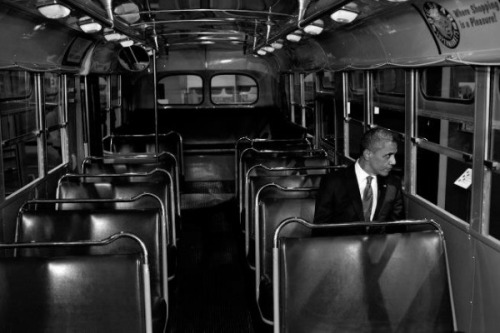
On the 57th anniversary of Rosa Parks's refusal to give up her seat on a Montgomery bus earlier this month, President Barack Obama visited this historic bus at the Charles H. Wright Museum of African-American History in Detroit, MI. He sat in the seat she, a revolutionary staunch political activist (not the feeble little lady most of us have been brainwashed into conceptualizing her as) wouldn't get out of. We went from it being against the law to sit at the front of the bus when there was a White person without a seat to re-electing a president of African descent in 57 years. 

That's within my father's lifetime. I hope he sees this photo and remembers taking me to sit in that seat when he lived in Detroit. That was 2005, and I was overwhelmed by our progress. Now it's 2012 and I'm so torn between wanting to cry in celebration of how far we've come and wanting to cry in desperation at how far we have left to go.

Saturday, August 13, 2011

So, true to my word, I saw "The Help"

K and I went to see it last night. I must say, right off the bat, that my expectations for this movie were greatly surpassed. I laughed, I cried, I was angry, I was sympathetic...this was, by most of the measures by which I usually judge movies, a very good movie. It was the kind of movie that makes me think I should be calling it a "film." It was incredibly well-acted. So much attention was paid to detail, from the clothing to the decorations in the homes to the cars to the clips of news footage from the Civil Rights Movement. It was just as sexist and racist and racistandsexist as it needed to be for the period. I looked at and listened to some of these characters and saw women I know. I shouldn't have just assumed that a White woman couldn't portray Black women with any sort of authenticity. I have been proven wrong on that account. Also, I think they did an excellent job of balancing the two stories here: one about Black women standing up for themselves and one about a brave White woman who fought against all the racists. I was led to believe that the story was more about the White woman helping the maids, but they had WAY more autonomy than I was expecting to be presented with, and I am surprised and grateful. 
Yes, this was a "let's-alleviate-a-little-bit-of-White-people's-guilt" movie, which The Oreo Experience [a blog I like when I think about it as an exercise in exaggeration and social criticism, but which saddens me whenever I think she might be serious] renames as the "White People to the Rescue" movie. You know this genre--The Blind Side, Driving Miss Daisy, most movies about education reform, almost any movie about a predominantly black sports team and a white coach--where there is a person of color or a group of people of color who obviously need help and have the power to be something [which implies that narratives that don't follow the American Nightmare Dream to the letter are "nothing"] or maybe even to help themselves, but don't realize this until some benevolent White [or, more recently, racially ambiguous] person steps in to show them how to achieve. It's a pretty popular unofficial genre. But this was a GOOD white guilt movie, if such a thing can exist.
I say that for two reasons. Reason 1: A lot of white guilt movies just have, you know, some privileged White people, well, feeling guilty and doing charitable things to quell that guilt. We also occasionally get the used-to-be-a-hardcore-racist-but-sees-the-error-of-his/her-ways White person in these movies. What we don't usually get, but this film gave us, is the hardcore-racist-White-person-who-despite-being-socially-criticized-and-exposed-to-the-other-side-of-the-story-DOES-NOT-STOP-BEING-A-HARDCORE-RACIST White person. But this film gave us those people. I said it to K last night, and I'll say it again now [warning, this is NOT P.C.]: This movie made me remember what it's like to hate White people. Like I would be in jail right now if it were possible to walk into a movie and choke a bitch, because I was DONE with those women quite a few times. The fact that our White protagonist was clearly the exception to the rule in Jackson, Mississippi, and could not convince the majority of the other people in her social circle to come over to the good side is unusual and daring for this genre. And I think this is productive, because while guilt isn't a pleasant feeling, I don't think anyone could sit through the beginning of this movie without feeling profoundly uncomfortable, regardless of race. And being uncomfortable is promising for those of us who advocate change. 
Reason 2: The White protagonist didn't don a red cape and put an S on her chest and swoop in to save these women. She didn't boldly go where no White woman had gone before and advocate for the plight of these women publicly. HER ASS WAS HIDING. She wasn't Freedom-Writers-what-the-fuck-are-you-doing-caring-about-these-[derogatory slur] until the very end after the book was published; before then, she interviewed women behind closed doors and drawn curtains, strategically avoided saying she was refusing to publish a racist proposition in the newspaper because she disagreed with it, and she watched the news of the Movement on TV rather than going to march. I'm not saying she wasn't brave or courageous, I'm just saying her bravery was undercover. She remained overtly only a little less than neutral in public, and even in the end no one could prove what she had done. I like that she didn't take all the credit here. I like that this movie is about the two maids who made her project possible just as much as it's about her. I like that they get more recognition from their community than she gets from her own. 
Bonus reason: I like that racism didn't blindly lessen in severity by generation. The oldest White character we see is fighting her daughter for her maid's rights a lot, though she can rarely do anything to stop her. 

But then the movie had to come to a neat little close, as movies must do, and then everything I hate about this genre and was hoping to avoid reared its ugly head. Our benevolent White protagonist spreads the wealth from the book's earnings, then high-tails it out of town, off to a fancy job in NYC after having managed to change very little for the Black women of Jackson except their mindsets. The Black women of Jackson are now getting even further demonized/taken advantage of by White women, to the point where the main maid loses her job and walks determinedly down the street, talking in a lofty manner about how much it mattered to her that someone wondered what it was like to be her, and about finding her voice and becoming a writer. That end scene reminded me a lot of Precious: she hasn't a damn thing going for her--no hope of getting a job in that town ever again, no money to move, few skills besides literacy and childcare/housekeeping, no family to rely on...I worry. But more than any of those practical things, I worry that this ending leaves a happy taste in audience's mouths about how far we've come or some shit about how empowerment is psychological. Fuck that shit, man. Yes, getting your mind right is a critical component of empowering oneself, but it doesn't mean SHIT if you're still living under a system of oppression. 

So there were points and deductions. Other deductions included propagating the happy Black mammy role when the White female protagonist remembered her own childhood maid/nanny (whom she didn't imagine having had any of the same struggles as the women she interviewed), an abusive Black husband, and a focus on Black women as "dirty". Violence is present without being addressed--wealthy white woman suggests her Black maid leave her abusive husband, despite the fact that she wouldn't be able to care for her children on her (and her daughter's) incomes alone. The White protagonist gets to walk away from everything leaving the people she endangered-by-helping with uncertain fates. Black women still just have to be strong and take White people's shit. The larger Civil Rights Movement is present--as a person who knows the intimate details of the Mississippi Burning era, watching the small news clip of Medgar Evers's death and hearing the characters talk about his family undid me--but the role played by regular women like our characters in the larger movement isn't really addressed either; they're all anonymous. They cannot be recognized for their contribution, as most of the people who fought this battle will never be recognized--that might actually be a point of non-romanticization that I approve of, actually. I like that happiness existed right alongside pain and disgust in this film--that felt real. And the sisterhood and standing up for what you believe in and having courage themes really did come through. Some of these deductions get a point or two back for raising issues that still need to be addressed, though.
All in all, it was a good film. Could have avoided a few potholes, but it surpassed my expectations greatly.

Tuesday, January 18, 2011

Does King Deserve to be King?

One of the biggest tangible changes being an African-American studies certificate pursuer has made in my life is my like, newfound...let's say "objection" to Martin Luther King Day as a holiday, as part of a larger...yeah, I think we can actually say "disgust" with the commonplace representations of the Civil Rights Movement in contemporary American classrooms and homes. I hate being lied to, particularly by authority figures. I hate the images of Christopher Columbus and Abraham Lincoln that are portrayed to young children everywhere. I hate when culture tries to rewrite history to make it more convenient. And similar to all these hatreds, I hate that America puts MLK up on a pedestal without addressing any of the flaws in his strategies and ideologies. 

Now don't get me wrong; Martin Luther King was an incredible man who did phenomenal things for black people in this country, and who tried to do similarly phenomenal things for poor people. There was a time when I would have said that I owe my very lifestyle to him; but that kind of statement, and the mindset it reflects, is exactly what pisses me off so much about this holiday. I owe my lifestyle to the Civil Rights Movement, fact, but while culture elected King as the Movement's face, there are so many other people who made contributions just as--if not more, in light of the fact that I am a black WOMAN--relevant and effective on my day-to-day being. With all of my knowledge of African-American history, I can think of NO reason King deserves to be elevated over Malcolm X or Ella Baker. I can think of NO reason for the American public--even the BLACK American public--to think of Rosa Parks as just some little old lady who wouldn't get up from her seat on the bus one day, as opposed to the die-hard political activist she really was.

Martin Luther King was many many wonderful things, but he was also a stickler for some pretty bad ideas: a) political sexism, and b) passive resistance. I think that to some degree, the black "community" as a whole is still struggling to recover from the lasting implications of the utter dominance of these ideologies, and the effective hero-worship and idolization of King in this country simply pushes conversations about the inherent badness of these ideologies further and further under the rug. If we can't address the faults of the persons we are told to view as having been great in the past, how will we ever recognize them in the future? Sexism in the black community is STILL un-talked-about by anyone but black feminists, and fact: no one really listens to them anyway. My mother STILL says she's oppressed as a black person but not as a woman, and black women's position in society will NEVER increase until we can eradicate the existence of such limited mindsets. But how can we if we continue to praise King as our savior? Political sexism is, in some aspects, even worse than in-everyday-life sexism, because it's like saying there are specific areas in which women can never be equal to men and certain arenas in which they should never be listened to, as opposed to just being generally ignorant. Passive resistance too often leads to just sitting there and taking the shit this country throws at us, and maybe I'm a radical but I will fight to the death for the things I deserve. We all should; it's the only way to get anyone to listen. The Movement has DIED; now we all practice passive resistance, and our men and boys rot in jail, and our children fail in failing schools, and our success stories are ostracized and remain single and childless for being strange exceptions to unwritten rules...it's not getting us anywhere. Blindly accepting King as the face of the Movement, as the King of race relations in America and as having the chief ideas that should be recognized and remembered just sets us back into the faults of his time, and I for one shall not regress.