Tuesday, January 17, 2012

The first season of Akward Black Girl is over

and rather than lay in bed mourning, I decided to rewatch the entire season and write a paper about two of my favorite projects surrounding Black identity that exist right now: The Misadventures of Awkward Black Girl and Toure's Who's Afraid of Post-Blackness? What It Means to be Black Now. I feel so validated by the versatility of the fields of Sociology and African-American studies, both of which consistently remind me that that which is interesting to me personally is worthy of legitimate academic exploration and discussion. 

Anyway, I thought you all might be interested in my thoughts on combining the two works. But don't go stealin my shit, okay?


"Through directly addressing the themes of race, gender, sexuality, class, beauty, love, power, social acceptance, and of course, awkwardness, through the particular lens of one individual Black female’s experiences working at an average job and leading an average life, Awkward Black Girl shatters cultural expectations of Black femininity by honestly exploring the way individual Blackness is lived in contemporary society. Though the normative cultural gazes, stereotypes, tropes, and racist incidents that plague marginalized populations manifest themselves within every webisode and affect J’s daily life in small but not insignificant ways, viewers never lose the perception that they are witnessing J’s Blackness as a deeply individualized personal characteristic, rather than solely as an imposed social category. J’s character is thoroughly ordinary in a way that has not existed in television or film in years, since what some would call the death of the Black family sitcom in the late 90s and early 2000s, and thus Awkward Black Girl’s most profound points may lie simply in having re-carved a social space for such ordinary conceptualizations of Black American characters and presenting such characters as shared cultural objects, persons in whom everyone can be interested in, knowledgeable about, and can draw from in the future.[1] Drawing from many well-known images of Black femininity but fully representing no established trope, J demonstrates a deep cultural knowledge of many variations of Blackness in conjunction with a wealth of cross-cultural capital, and never seems to struggle with her racial identity. She does not view her awkwardness, her penchant for sushi, or her appreciation for both “hoodrat love songs” and 90s pop-rock as antithetical to Blackness, and the specific way in which J narrates her experiences, rather than simply letting viewers follow them, demands that the public share this viewpoint at least temporarily.
            Touré quotes the artist William Pope.L as saying that “Blackness is limited only by the courage to imagine it differently,”[2] and by engendering a fanbase dedicated enough to create an “Awkward Nation” hashtag on Twitter, Issa Rae has given social validity to a different understanding of Blackness. The series’ tagline, “I’m awkward…and Black” suggests that Blackness is not the primary lens through which J understands her life, which Hollywood again does not discuss often; like post-Black visual artists, her work is “‘steeped, in fact deeply interested, in redefining complex notions of Blackness’”[3] while it works very actively to not limit her to depicting Blackness and Blackness alone. Having come of age in an era where slices of Black culture have become mainstream, J’s character seems secure enough in her Black identity to experiment with it, to recognize as Roland Martin has recognized that “what is real and authentic Blackness is solely based on your experience. How you grew up, how you were raised, what you saw, and what you went through,”[4] and to not concern herself with bending to fit pre-made societal molds of Black femininity. But in disregarding the limitations society attempts to place on Black femininity as constricting her existence, she continues to have those limited understandings thrown her way throughout the course of her daily life, demonstrating the fact that ever-expanding definitions and understandings of Blackness do not negate the effects of racism and white supremacy. By letting viewers experience her world entirely from her point of view, the character of J demands that the rest of America grant her the same freedom of identity she gives herself and recognize the ways in which race and gender still profoundly shape daily existence for marginalized populations; one cannot watch Awkward Black Girl without being forced to dismiss the idea that race no longer matters in America, and experiencing Blackness as J demands a recognition of Blackness as multifaceted and enormously inclusive, placing ABG in the category of post-Black art."


[1] Touré, Who’s Afraid of Post-Blackness? What It Means to Be Black Now. 49.
[2] Touré, Who’s Afraid of Post-Blackness? What It Means to Be Black Now. 7.
[3] Thelma Golden. Cited in Touré, Who’s Afraid of Post-Blackness? What It Means to Be Black Now. 32.
[4] Roland Martin. Cited in Touré, Who’s Afraid of Post-Blackness? What It Means to Be Black Now. 154.
"I am a feminist, and what that means to me is much the same as the meaning of the fact that I am Black: it means that I must undertake to love myself and to respect myself as though my very life depends upon self-love and self-respect." -- June Jordan
Our lives DO depend on self-love and self-respect, though. If we do not love ourselves, how do we take care of ourselves? How do we sacrifice and strive for ourselves without respecting ourselves? But the imperative nature of self-love and self-respect don't describe Blackness or a feminist identity to me...they describe the human condition. We need to love and respect ourselves like we need to breathe and eat and think. 

Sunday, January 15, 2012

(Life)Style Crush:

Reblogged from
See the city behind her? 6 months from now, I hope this will be me. And her outfit/hair are CUUUUTE!

Saturday, January 14, 2012

How I Feel About: Taking Your Husband's Last Name

I've decided that I often leave comments on various other sites on topics I don't really address on my blog, and that's the opposite of cute, so I'm going to start reposting my comments here! They'll be identifiable with the "How I Feel About" tag.

So I used to be entirely, firmly, totally, and completely against it. I thought it was an archaic patriarchal ritual (much like weddings themselves) and that I would slap my husband if he dared feel some kinda way about me keeping my own damn last name.
And as a righteous Princeton student, I accordingly flipped a shit when Professor Melissa Harris-Lacewell adopted Harris-Perry after her marriage. But when this somehow came up in a class, another professor of mine said that Melissa’s counterargument was simple: it’s not like she chose her original last name. It was just the name of another man, her father, and so anyone who tried to argue that taking her husband’s last name implied some form of ownership must have believed she first “belonged” to her father.
I wasn’t about to support that, and thus was thoroughly and completely shut up.
I think my plan for if and when I get married is to keep my name professionally, because it will hopefully be a brand by then, and to take my husband’s name personally IF AND ONLY IF I like the way it sounds after my first name.

Wednesday, January 11, 2012

I wish I could have been a part of this all the time.

We're fighting the same fight, but it seems so...diluted. My opponents are invisible, as is my army. My artillery is made of scholarship, of words, numbers, and history, whereas theirs was physical, involving bodies, marches, and when the occasion called for it, guns. I want the feeling that my militancy is part of something larger.

But I digress. 

Kathleen Cleaver of the Black Panter Party answers the ubiquitous question of "why" Black people wear their hair naturally:

Lies my Commercials Told Me:

Check out this lovely short satirical piece on impossible standards of beauty and the rampant use of Photoshop in the media/advertising industry:


Fotoshop by Adobé from Jesse Rosten on Vimeo.

I'm finally reading Toure's "Who's Afraid of Post-Blackness"

partially for pleasure and partially for a paper I'm writing about Awkward Black Girl, because let's be real, I don't have time to read for pleasure until April 14th.

And I'm following him on Twitter and have to fight myself hard not to tweet everything I find profound and tag him in every single tweet. I'm considering it an exercise in self-control.

But I have to share this, his writings on another Black student telling him he wasn't Black:
"Why was I working to reject being defined by the white gaze but not also working to reject definition by the Black gaze?...Who gave him the right to determine what is and is not Blackness for me? Who made him the judge of Blackness? To say I'm not Black is to accuse me of apostasy as if Blackness were a religion that could be escaped. But we cannot abandon Blackness even if we commit treason against it. It's permanent. Even an Uncle Tom must suffer beneath the boot of white supremacy. And I'm not a Tom just because you don't understand me. I may be a work in progress but I will always be Black. The only things in life that I am obligated to do are pay taxes, be Black, and die." 
--Toure, Who's Afraid of Post-Blackness? What It Means to Be Black Now, pg. 97

Tuesday, January 10, 2012

Two. Dos. Duex. Due. Mbili.

(I had to look that last one up. It's Swahili and seemed appropriate.)

 
That's how old my blog is today. I published my first post on January 10th of 2010, halfway through my sophomore year at Princeton. (Side note: oh my word, my hair has come such a long way since then.) For the vast majority of my life, January 10th has held no particular significance, but on that date in 2010, I decided that straightening my hair was no longer a lifestyle choice I was going to make. I was on a mission to get to know who I was underneath everything I'd been doing for other people, and to bare that self to the world in the process. "Crisis" is a strong word for where I was this, but this was definitely the beginning of my quarter-life identity struggle. 

And today, two years later, I'm pretty amazed at how far this weird little project I started has gone, and how much farther I expect it will go. When I hit the "publish" button, this will be my 809th post. I had 155 pageviews yesterday, which is a record for the blog. I have 21 followers through Google (shoutout to the 5 that have joined me within the last week! Glad to have you!), 8 people who subscribe to my RSS feed, and it has actually gotten to the point where it's not uncommon for me to be walking around campus and have someone mention my blog or one of my recent posts. Getting an email telling me someone has commented on a post can put a smile on my face for the rest of the day. Basically, I think that over the past year, I've really embraced my identity as a "blogger," rather than just being a person who happens to have this little blog thing. This blog and the people who read it are so important to me. 

This past year saw a name change (for those who don't know, I'm Such an Afroholic used to be AFROdisiAccordingtoMe), which was a pain in the butt to execute, but which I'm so happy I did. The new name feels more like me. It saw me learning how to find balance between talking about my life and talking about the lives of other people who are in my life; my own personal openness doesn't mean I have the right to put other people on blast. It saw an unplanned hiatus in the Spring, followed by more blogging than I'd ever done before through the summer and continuing into the present. It saw the introduction of various new page elements: The Hits, the Twitter log, updates from other websites I like, as well as of the "reblog," as I have started following almost 200 other blogs and want to share their awesomeness with you all. 

I really like the direction I've gone in with the blog, even if it is somewhat awkwardly half-Tumblr half blog at times, and I hope you guys are happy with it, too. I'm learning so much about myself and getting into such fabulous discussion with other people as a result of this project, and here's to another year of that and more! It wouldn't be the same without you guys, readers, so here's a round of applause to you. 

Much love,

Maya

Monday, January 9, 2012

I wanted to tweet this, but it's too long,

and editing it in any way would be doing VIOLENCE.

"I'm so SICK of being made invisible by people. Can't be black and queer. Can't be black and female. Can't be black and non-religious. Like, what the fuck? I need some of y'all to have a fucking seat." 
--A commenter on this post

Reblogged from  Quirky Black Girls  

I would like to find the person who wrote this and hug them. Repeatedly. (But only with their consent, of course.) 

Sunday, January 8, 2012

...Hence the name.

Reblogged from el odio por amor

I might have to start watching Saturday Night Live.

It's like All That! grew up and got a lot more controversial!

But, for the record, I do want to recognize that privileged people of all races experience problems like this, and even though white people are far more likely to be in that privileged category, saying that these are problems that affect only white people is problematic and contributes to the narrative of POC as invariably poor. 

That being said, this is still amusing:


For similar entertainment, check out WhiteWhine.

Things that make me feel old:

My little sister's boyfriend coming over to meet the family. I'm no longer the only one whose relationships are subject to my mother's scrutiny.

This morning, my little sister needing help filling out her FAFSA. Realizing that I don't need to file a FAFSA this year because I won't be in school next year. (Graduation is imminent.)

Things that make me feel poor: mentioning the above sentiment to a friend over dinner, and him not sympathizing because he's never had to apply for financial aid.

Things that make me feel privileged: Being able to take things like financial aid for granted.

It seems I have officially fallen for multilingual music of the African Diaspora.

Artist I swooned over today: Stevy Mahy. From Guadelopue, she's trilingual in English, French, and Creole, and I could legitimately listen to her for hours. Check it out.


"To love. To be loved. To never forget your own insignificance. To never get used to the unspeakable violence and the vulgar disparity of life around you. To seek joy in the saddest places. To pursue beauty to its lair. To never simplify what is complicated or complicate what is simple. To respect strength, never power. Above all, to watch. To try and understand. To never look away. And never, never, to forget."
 --Arundhati Roy

reblogged from Indie. Radiant.

"I got 99 problems, but a perm ain't one!"

I'm kind of in love with the "Shit __________ Say" videos, and this is definitely among my favorites. I'm familiar with SOOOOOO many of these struggles, haha.

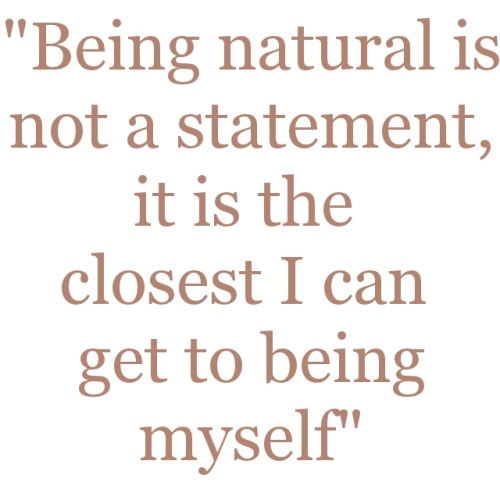
Natural Hair as a Statement

Lyrna, Vogue.It contributor and Editor of Lurve Magazine, in an interview with Natural Belle
One of the questions I get asked most often about my hair (after how do I get it to curl like that, to which I always have to answer, sorry, honey, that's just my curl pattern) is whether I feel like I'm making some kind of statement by wearing my hair in its natural state. At first this question used to offend me. Like, damn, can't a sista do something for her damn self without everyone trying to attach some larger meaning to it? (Side note: I now understand why my friends with tattoos sometimes get mad when people ask what the tats "mean," which I myself am guilty of. Oops. #gottadobetter) 


So once upon a time, I would have cosigned Lyrna's statement. I still appreciate the sentiment, but in the time between when I first embraced my natural texture and now, I've come to realize that every. little. fucking. thing. in our lives is political. Feminism said it first, but there's absolutely no separating the personal from the political. In my humble opinion, there is very little (if anything) I can do as a Black woman that isn't making some sort of statement in the face of a larger society that still actively tries to stereotype us in every imaginable way. No matter who we are, what social categories we fall in, or what exact boxes other people try to shove us in, choosing to be fully and openly ourselves rather than bending and squishing and silencing ourselves to fit whatever is "in" in the moment is making a statement. We pick our clothes, accessories, and hairstyles for a reason, even if that reason is just I like this/think I look good with this; as Facebook has taught us, "liking" something can be an incredibly powerful social tool. 

But I like imagining a world in which we don't have to see our choices as political, a world where style is just style for everyone, regardless of race, gender, sexuality, etc. That would mean that we as members of the human race have come to see all social categories as capable of all the variation imaginable, and that choosing to do things that run counter to dominant society would no longer be stigmatized. Being free to understand our choices simply as choices would require the end of marginalization, fetishization, and the questioning of authenticity. And what a beautiful world that would be. 

But until then, yes, my hair is a statement. So is my style, the music I like, the way I carry myself, my vocabulary, and basically every other stylized choice I make. The statement I'm making? Bitch, who gon check me?! Here I am fucking up your schemas. Deal with it.    

Saturday, January 7, 2012

That Friend...

At some point yesterday, one of the top ten Twitter trending topics in the world was #ThatFriend. I didn't actually click on it, so I don't know if it was mostly that terrible "friend" or that funny friend or that dope ass friend that people were talking about, but I know which friend instantly sprang to mind.

#Thatfriend you didn't think you were going to like when you first met him through a roommate you didn't care for. 
#Thatfriend you only started talking to because you were surrounded by strangers. 
#Thatfriend whose name you all of a sudden kept dropping to the bewilderment of your other friends. 
#Thatfriend you kicked yourself for wasting a year and a half not knowing. 
#Thatfriend you fell into best-friend-ship with so quickly you almost mistook it for something else. 
#Thatfriend you can shed every last pretense for. 
#Thatfriend who just GETS you, even when he hasn't been through something you're going through. 
#Thatfriend you can ACTUALLY talk to about ANYTHING. 
#Thatfriend who makes you make sense to yourself. 
#Thatfriend who will judge you (righfully) but stand by you. 
#Thatfriend you can accidentally talk to for hours about nothing and everything all at once. 
#Thatfriend who feels more like your brother than your actual brother.
#Thatfriend who knows every detail of your life. 
#Thatfriend you spend the majority of your free time with. 
#Thatfriend who can just sit in a chair at a desk with you and you guys will have a great time. 
#Thatfriend you wish you could put a piece of in your pocket and take with you wherever you go. 
#Thatfriend you feel kind of lost without when they're out of the country for a week.
#Thatfriend you're dependent on.
#Thatfriend you're afraid to try to live without after graduation.
#Thatfriend who sort of turned almost all of your other friends into afterthoughts.

What do you do when you're less than five months away from losing #thatfriend's daily presence in your life? Do you try to wean yourself off, reconnect with your other friends? Or should you go cold turkey, like it's a breakup, and cry about it for your first month of summer and then move on? Is there even moving on from #thatfriend? Is it possible he can stay #thatfriend from afar? 

A friend from high school asked me what my New Year's resolutions were. I only really had new year's visualizations: doing well on my thesis, getting a job, finding an apartment that made me happy, living as an independent professional woman in a major city. But now I think I have one: stop letting my relationship with #thatfriend eclipse all my other friendships. I love him, but being dependent on anyone scares the shit out of me. I will hang out with each of my five closest friends who aren't in my eating club at least once a month until graduation. That's my resolution. If I don't salvage those friendships now, they'll disintegrate in a few months' time. And if I don't remember that other people can satisfy me socially besides #thatfriend, I might.    

Friday, January 6, 2012

Men Ain't Shit.

I seem to be on the road to self-identifying as a feminist. Some of you might be looking at me like, well DUH, but let me explain: I've always had feminist tendencies. It's funny, but since birth I've had this nagging conceptualization of myself as a person that deserves recognition as such...but I digress. I've always had feminist tendencies. I just used to be wary of downright against calling myself "a feminist." And before you start thinking I'm some little punk, it wasn't because of all of the shit that gets talked about feminists. Who gon' check me, boo?!

My problems with feminism come from its longstanding history of ignoring the particular struggles affecting women who are anything other that White, middle-class, and heterosexual. And yeah, okay, I know the movement is officially for all women now, but honestly, I believe that like I believe Santorum was talking about "blah" people...like hell.

Get at me when you stop producing foolishness like this, feminism. It's like, damn, and I liked SlutWalk too...
I still see the experiences of women of color, queer women, and poor women being addressed primarily by in-group members. I still see personhood being portrayed as Whites-only when feminists report statistics about "Women," "Men," "Blacks," and "Hispanics." (Should I clap that you're trying when you're doing it so very wrong?) And it's just like, while I'm so glad the right to breastfeed at work has become protected by law, I'm just much more concerned with the fact that unemployment is rising for Blacks as it falls for everyone else. 

And yeah, okay, I know that Black feminism is a thing. It's a really fucking awesome thing. And then there's the whole womanist movement, too. And when I discovered these, I got more open to the idea of maybe calling myself a feminist. And when I realized the error of my previously pro-life ways, I got even more open to the idea of maybe calling myself a feminist. And the above photograph says more than I ever can about how the movement as a whole isn't doing nearly enough to address race and racism, but at least part of that needs to be interpreted in a Gandhi "It's not your Christ I have a problem with; it's your Christians" kind of manner. 

And there's another It's-not-your-Feminism-it's-your-feminists problem that I have: man-bashing. I really don't know what it's going to take for people to realize that the celebration of one thing does not necessitate the belittling of its opposite (not that I believe men and women are inherently opposites). It is possible to love one thing without hating its counterpart. I love being Black, but that doesn't mean I hate Whiteness. I'm pro-choice but not anti-children (for other people). I'm pretty sex-positive, but that doesn't mean I'm abstinence-negative. And I can't stand it when so-called "feminists" attack manhood and masculinity, rather than attacking patriarchy. I can't stand it when "feminism" doesn't realize that portraying women as "good" and men as "evil" not only belittles both genders by erases heterogeneity, but is creating the exact same issues that patriarchy creates by portraying men as significant and women as not. By talking about all the things that are "wrong" with "men," these people are just playing into the narrow stereotypes and archetypes patriarchy has carved out for men to exist in. 

Men have emotions. They hurt. They think. They dwell. They worry. They love. They fear. They have stories to tell, too.

And with that, I give you this awesome short documentary I discovered thanks to Tunde (@BrazenlyVirile) today. It's called Men Ain't Shit, and it goes out to everyone who has ever said any version of that statement. (I'm guilty of "Boys are stupid.")


Men Ain't Sh?t from Le Femme Flaneur on Vimeo.
 

Fact:

Reblogged from Paper Pensive

New Music Find: Tif B!

   (Love) Bound by TifB

Gorgeous:

Reblogged from 18° 15' N, 77° 30' W

Thursday, January 5, 2012

And while we're talking about things that make me angry...

I dislike commercials all the time. In fact, I think it's safe to say I dislike most of the commercials that are on television. Sometimes I even dislike them enough to talk with other people about disliking them. But I've never gone so far as to look up the video on YouTube so that I can 1) dislike it, and 2) rant about it here. 


But while weight loss commercials--well, really, weight-obsessive American culture, but that's a whole different ballgame--generally don't sit well with me, with all the implicit criticisms of people's "Before" selves and the tiny print at the bottom of the screen that reads "Results Not Typical". I have gotten used to be annoyed by these things. 

This new Jennifer Hudson and Weight Watchers commercial takes it a little too far, though.

I won't even start by mentioning that no one will ever win my favor by singing Whitney's song from The Preacher's Wife. That's beside the point. 

The ENTIRETY of the problem is that heavier Jennifer from the past sings "I was looooooost," and then thinner Jennifer sings, "and now I'm freeeeeeeee." That's it! That's all I'm taking issue with. But my issue with it is huge.

Now, let me come out and say that I am NOT by any means hating on Jennifer Hudson for losing weight. She looks GOOD. In fact, let me further say that I'm not hating on Jennifer Hudson for anything, because she didn't design the damn commercial.

But I want to be really articulate about what I'm upset about. This commercial isn't just your average run-of-the-mill hey, look, I lost a lot of weight and I'm happy about that; watch skinny me talk about how my whole life changed. Those commercials imply some negative emotions or understandings of having been overweight, but oftentimes shift the blame for that negativity to other people and in a small sense could be interpreted as advocating for the rights of heavy people by drawing attention to how others demean them. (Don't worry, I'm not foolish enough to believe that actually happens, but hey, a girl can dream.)

But this commercial takes it a step further. By heavy Jennifer singing her line, "I was lost," it's like Weight Watchers is trying to shame heavy people. They're suggesting that people who don't have flat abs or could stand to lose a little arm flab have "lost their way," have made bad decisions, are bad people. And then new skinny Jennifer is "free," having found the path to enlightenment in a size whatever. That's the message I'm supposed to be getting, right? There is an academic term for what they're doing: fat-shaming. And it's not okay, not even a little bit.

Depending on where I'm shopping, I'm sometimes a plus-sized woman (because society keeps trying to convince women that smaller and smaller sizes are the norm), and no matter what I'm a large-structured curvy woman. My skeleton probably weighs more than most fashion models whole bodies. And I'm fine with that. I am not lost, and I don't like Weight Watchers insinuating that I am just because I don't count calories and obsess about being toned and defined. I refuse to let them shame me into thinking there's something wrong with me, my body, or my mind.    

In the flesh

This one's from the random things that piss me off files:

"Nude" or "flesh" colored clothing. Also sometimes referred to as "Body Beige," at least by Maidenform bras. 

*takes a deep breath*

I have a radical concept for you, people who design such clothing. Are you sitting down? I think you should be sitting down, because this shit is really. fucking. out there. Okay, are you ready? 

SOME. PEOPLE'S. BODIES. AREN'T. FUCKING. BEIGE. 

That "nude/flesh" color doesn't actually even match the skin of the model its on, so how do you possibly have the audacity to claim it's the color of the flesh of every human being walking this green earth? WHERE DO IDIOTS COME UP WITH THESE IDEAS?! DO NO PEOPLE OF COLOR WORK FOR YOU, OR DO THEY JUST HAVE NO SAY IN ANYTHING?!? 

What in the FUCK, may I kindly ask you, is wrong with just calling the various shades of this color "beige" or "tan"? Or if you get some kind of a kick out of the tiny bit of kink involved in linking these shades with actual human bodies, why not have Nude #1, Nude #2, and Nude #3 in various shades that might vaguely correspond to the bodies of people of color? Why not also have Body Brown? 

Oh, hmm, maybe because that would be recognizing people of color as empowered consumers who'd like to see their needs met. Or recognizing that we exist at all. Because if you're claiming that those shades are the end all be all of nudes, fleshes, and bodies, you've effectively erased not only our voices, but our physical selves.

This post was inspired by this lovely image, which I've reblogged from  el odio por amor


Photo

Reblogged from learning my whole life

A conversation with my little brother:

who is 16, after he learned my Twitter handle:
 
W: Your Twitter name is @SuchanAFROholic?!?
Me: Yeah...so it matches my blog.
W: You have a BLOG?! My sister is a ...blogger?
Me: Yup! It'll be my two year blogging anniversary next week! 
W: *looks at me quizzically* You've changed a lot since you started wearing your hair like that. (By "like that" he means in its 3c/4a kinky-curly natural texture, rather than fighting losing battles with flat irons and humidity on the daily.)
Me: This is me. I just finally started letting it show. 

Wednesday, January 4, 2012

Reblogged from it'sme...SHANA

She. is. gorgeous.

Reblogged from 18° 15' N, 77° 30' W
PS Can people pull off opera gloves at formal events in the real world? Also, fuck fancy hairdos for formals; she makes me wanna rock nothing but a 2-second puff and confidence.
“We are all a little weird and life’s a little weird, and when we find someone whose weirdness compatible with ours, we join up with them and fall in mutual weirdness and call it love.” ~Dr. Seuss
*Reblogged from el odio por amor* 

In my next life

I want dreds. Everything about this woman is ON. POINT.

Reblogged from As far as i'm concerned...
 

Jilly from Philly reminding us all to live positively


Shoutout to DJDScott for sharing!

This is pretty dope.

Reblogged from As far as i'm concerned...
Class. of.

Yo, but actually


I have heard these things in real life, I swear. And not just from White girls, but people of various non-Black-woman race/gender combinations. "It's almost like you're not Black" is actually too close to home; I'm writing about times that has been said to me in my personal memoir on Blackness for my Comparative Literature class. Fuck other people feeling like they have some sort of authority to tell me what I'm supposed to be as a Black woman. Hell, even as a person. 

But to go along with the theme of the video, I shall reveal what I believe is the most ridiculous thing a white girl has ever said to me:
"It's like I'm a big Black woman trapped inside a skinny white girl's body!"
She later became a dear friend of mine, but saying this like the second time we'd ever met? The opposite of cool. 


Tuesday, January 3, 2012

Fun fact of the day:

"a 5 minute vigorous masturbation session" can burn up to "around 300 calories...according to Japanese scientist Dr. Shukan Tokuho." (Source)
Welp, I think I just figured out how to incorporate more exercise into my daily life, haha! I think I'm going to try this going to the gym a couple times a week thing again too, but we'll see how long that lasts. All the fit people there intimidate me. And the skinny old ladies who can put me to SHAME on the elliptical. (I wish I were kidding.)   

Sit alllllllll the way down

says this Iowan man, in response to all the people who are raising hell about the upcoming primaries. It's cute that you're concerned and all, but your worry basically just shows that you're a bunch of ignorant sons of bitches.


I'm going to DC!

Not sure exactly when yet, but I got an email from a woman I had a phone interview with before Christmas for this awesome-sounding Survey Associate position at one of the country's leading policy research centers asking my availability during the month of January to come to DC for an in-person interview! I'm trying to be as conveniently flexible as possible, so I basically gave her every day that I'm on campus in January besides Dean's Date, the day before Dean's Date, and the day before my last take-home is due. And I was sitting at my computer wondering how to get to DC (I'm thinking NJTransit to Trenton, Septa to Philly, Amtrak to DC--they'll reimburse me) when I realized that DC is a major city. So major a city, in fact, that Pariah might be playing there.

So I went to check the website and YES! It opens in exactly one theater in DC this Friday. So I'm basically buying a ticket as soon as my interviewer nails down a date. Maybe I'll even contact a few of my friends who live in DC and make an adventure out of it. 

I'm BEYOND excited for the chance to interview and the opportunity to see Pariah, because it will certainly never open in Mays Landing. I could potentially try to pull all sorts of Princetonian strings (the Women's Center, LGBT Center, Af-Am Studies program, Gender and Sexuality dept, Carl A. Fields Center for Diversity and Multicultural Understanding, etc.) to organize a trip to NYC to still it, but...hmm, actually, no buts. I might still try to do that, haha! 

And for those of you who don't know what I'm referring to, check out the trailer below. It's a feature film based on an independent Black film that won all kinds of awards at Sundance in 2007, about a young Black lesbian coming of age in Brooklyn, and I've been itching to see it since I first starting reading about the short film AGES ago.  These are the stories of Black America that I want to start hearing more and more about. These are the voices that have been silenced.

Trailer:


Obligatory 2012 post:

So I've been avoiding this post like a mothafucka, but there is no denying that my three-day graduation process begins in exactly six months, which means that it is officially 2012. 

This is probably going to be one of the biggest transition years of my life, and knowing that I'm in it now and basically the beginning of my life is over and I have to try to be an adult now is really. fucking. scary. But I suppose that if your life as a whole doesn't freak you out from time to time, you've probably settled into some routine that is, shall we say, less than stimulating. And maybe you should reconsider your decisions. 


So, without further adieu, here's a recap of what I learned in 2011:


The wonder of being reunited with a family member you've missed for 7 years. That I have the best friends in the world. The delicious joy of falling asleep in and waking up in someone's arms. That in the future I'll have to work on not letting my romantic relationships sort of overshadow the entire rest of my life. How it feels to be rejected from something academic. How to use STATA. How it feels to complete your first substantial piece of independent research. The importance of honest communication, of saying how you feel even if you're not sure how the person you're talking to will take it; silence and acquiescence lead to dangerous assumptions and general trouble. That I should not, in any arena of my life, base my actions primarily upon how I think I'm supposed to feel/think/be/act, but rather upon how I actually feel/think/am/do. To lock. my. shit. up. because Princeton is incredibly safe for people, but not so much for laptops. That I might be a little bit of a nympho. How to not be intimidated by my professors. The joys of shopping on Etsy. To do things with my hair!!! That night shifts at libraries are THE. BEST. JOBS. EVER. That, as I have assumed for years, I actually really can't handle long distance relationships. That Erykah Badu is a mind-blowingly phenomenal performer. That good intentions mean very little in the moment, but can be quite significant in the long run. That I have the best friends in the world (this is important enough to be said twice). That I can let my emotions run away with me. That I'm a pretty decent cook. That my alcohol tolerance is basically too high for drinking in the real world. How to be friends (or at the very least, quite friendly) with an ex. That I can sleep with people I'm not dating (or even interested in romantically) and still respect myself in the morning. How to be more fiscally responsible. How to make a graduation cap work with a fro. That indie Black music and world Black music are PHENOMENAL. That I like Earl Grey with honey. That my mother has cancer. To incorporate many more ways of thinking, acting, feeling, and being into my understanding of Blackness. That my generation is capable of mobilizing politically. That styling tutorials by YouTube vloggers can be fantastic. That things generally come to me frequently more when I put myself out there more actively. How to braid! How kissing a girl feels different than kissing a guy. That hair salons can do wonders for natural hair. How to eat with chopsticks. That I am capable of having real conversations with all of my siblings. How to paint my nails. That my friends from elementary/middle/high school will always be my friends, regardless of how rarely we talk/see each other.

I'm sure I could think harder and come up with more things I learned in 2011, but that list seems exhaustive enough. There were some really tough times and I will freely admit that there were days I spent in tears, but all in all, I'd say it was a good year. I feel as though I spent a lot of this year coming into myself (perhaps as a direct result of having to take myself out of the "we mentality" I'd developed), and I'm delighted with the results.

In 2012, I'm going to have to learn: how to write a thesis. How to leave Princeton, which has played a huge role in creating so much of who and what I am, and the friends I have been realer with than I have been with many people who have known me since childhood, without losing myself. How to not be sobbing in all of my graduation pictures. How to negotiate the fine details of employment in a real person full-time salaried position. How to find an apartment. How to furnish an apartment. How to get around in a new city. How to be a grown woman working in the professional world in a major city. How to keep myself busy without homework. How to make friends out of anything other than proximity.

And who knows what else I'll pick up along the way? As always, I want to continue learning from past lessons and embrace growth and not be afraid of change. I'm going to keep making it work in 2012. After all, this is going to be a big transition year for me. I refuse to stop blossoming.

Reblogged from Indie. Radiant.
 And before I go, I realize that I'm a little late, but I wish all of you joyous new years! May your strategies be effective, your plans go accordingly, and your goals/desires be realized in 2012 (and beyond)! 


Monday, January 2, 2012

I don't know how I feel about the turban fad

but she rocks it so well. Major style-crushing:

Reblogged from Treasured Tresses

All I need in life:

Bookshelves that are built into the wall. This must exist in a future home and/or office of mine. I demand it.

Reblogged from Street Etiquette

Style Blogger Crush: Tanesha Awasthi

I would like to introduce you guys to Tanesha. She blogs over at Girl with Curves, a style blog for (you guessed it) curvy women, and I oftentimes absolutely love her style. This outfit she put together for New Year's Eve, however, actually needs to get on my body immediately. I can totally see myself wearing this to some sort of holiday party in the future and eagerly await the day I can sport something similar. 

Isn't she lovely?
 Her site is pretty awesome, so any other curvy girls who read my blog should check her out!

Earrrings. Want.

Reblogged from As far as i'm concerned...

I have no shame.

By which I mean, I adamantly refuse to feel ashamed of desires or actions that sit well with me just because they may not jive with what other people think is right for them. And since becoming a blogger I've gotten used to just putting all my business out there (while trying to maintain some level of privacy for the people in my life whose business could be spread in the spreading of my own business), and my sexual business is far from excluded on this list. 2011 was the year I finally threw that door wide open and took care of business, if you know what I mean, and I am so much happier for it. I am not ashamed to say that coming into my nature as a sexual being has enhanced my overall identity and partially reshaped my relationship to myself as an entity. I feel free from frustration and restriction I hadn't really even been acknowledging.

But still, sometimes people judge me and I have this fleeting moment where I wonder if I should be judging myself.

And that's why this passage from a  Clutch Magazine article by Arielle Loran resonated with me SO HARD:
"Shame is your enemy, and silence will stifle your growth. There’s no reason to feel guilty about natural desires, and if you haven’t already, this is the year to throw shame out of your life. Refuse to ignore your curiosities, urges, and intuition. Talk to your lovers, friends, and family about sex, sensuality, and sexuality. Use these relationships as a classroom for your growth. The more you open up, the more people will respond with wisdom, guidance, and affirmation. You need community to grow. You cannot become your best sexual and sensual self without the support of others."

On excellence:

Reblogged from maneandchic

Something I need to not do:

Project the emotions raised by a situation I went through into the past onto situations that are developing in the present.

See:

And okay, I don't think I'm walking around with a particularly large amount of baggage. I don't actively drag every situation I've ever been in around with me all day; I don't avoid relationships because I've been hurt in them in the past or not apply to competitive research programs just because last year I got rejected from everywhere I applied. I don't even have to pretend to be friendly with my ex--I am fully capable of moving on, I promise. 

But that doesn't mean I don't get a gut reaction when something happens that reminds me of something that caused me pain in the past. I won't necessarily plan my next steps entirely around that reaction, but I can't bring myself totally ignore it either. There has to be a comfortable middle ground where I can recognize a potential warning sign without losing my shit or feeling weighed down. If I totally ignore it, the chances that I'll end up right back where I was last time seem fairly high. But preparing myself for an apocalypse that might never come just seems silly and overly defensive.

So I think I'll compromise by highlighting all of the ways the situation that may or may not be currently unfolding differs greatly from the somewhat similar situation I went through in high school. The players, the scene, the maturity levels, the strength of the involved relationships. Why do we jump to compare situations based on one or two similarities when so many other variables differ? Why is what things have in common more valuable than what sets things apart? 

I am not convinced that I have anything to worry about. And yet a familiar tightness is wreaking havoc on my stomach right now; I think its name is dread. I want to hide from it under the covers. 

Sunday, January 1, 2012

What do I believe in?


I had to go there. There can be no talking about beliefs without it. 

The principle for the seventh and last day of Kwanzaa, which always falls on the first day of the new year, is Imani, or Faith. And before you groan anticipating a rant about how infuriating I find the presumption that all Black peoples are Christian (or at the very least, religious), remember that Kwanzaa is entirely 100% a non-religious holiday. The principle of Imani, rather than calling upon us to be faithful in the religious sense, calls instead for us "to believe with all our heart in our people, our parents, our teachers, our leaders, and the righteousness and victory of our struggle." Today calls for us to do more than keep hope alive; it calls for us to keep fighting the good fight. It calls for the absolution erasure of internalized -isms (racism, sexism, colorism, classism, heteronormativism, etc.) from our communities, a task which may be impossible, but for which we should still strive. Remember what the homeboy Nas said (but take it with a grain of salt because it buys into the myth of American meritocracy): If you believe, you can achieve, so say it like this--I know I can (I know I can) be what I wanna be (be what I wanna be) if I work hard at it (if I work hard at it) I'll be where I wanna be (I'll be where I wanna be). Imani calls for the recognition of our beauty, our worth, and our accomplishments, but at the same time it demands we do not shy away from our shortcomings, that we do not abandon sections of our communities in their times of need.

I believe in myself and the goals I have for myself; the vision I have of my own future is what keeps me motivated. I believe in the power of true friendship. I believe that words are a double-edged sword of hurt and healing. I believe in love. I believe in luck. I believe in strength in numbers, and in the ability of a community (or even a community of communities) to demand and implement change. I believe that we shall overcome. I believe that every child can succeed if given the right tools. And I just love the way "the righteousness and victory of our struggle" rolls off my tongue.

A creative understanding of creativity

As a sociologist, and a somewhat radical/liberal one at that, I spend a lot of time defining the proverbial "box," the set of cultural norms, values, and opinions that dominate American social life, and then doing as much work as I possibly can to fuck that box up to the point where it's no longer even recognizable. I consider it my JOB to tear people's assumptions asunder and make them question things they've always taken for granted. Maybe I don't live my life coloring outside of the lines in every way imaginable, but I refuse to let myself feel confined by any of them, and more importantly, I refuse to sit back while people try to force those lines upon others' lives and conduct (with the notable exception of immoral conduct, though who has the authority to determine morality is something I'm still wrestling with...). 

I'm sure some of you are scratching your heads right now in an attempt to figure out how the title of this post and that first paragraph have anything to do with each other. Yesterday was my best friend's 22nd birthday and New Year's Eve, so I didn't quite find the time to write a post for Kuumba, the sixth day of Kwanzaa. Kuumba translates to creativity, but not in as restrictive a sense as most of us are used to thinking about creativity (as oxymoronic as that sounds). Officially, the sixth day of Kwanzaa calls for us "to do always as much as we can, in the way we can, in order to leave our community more beautiful and beneficial than we inherited it." This is active creativity, putting creativity to WORK.
This can be done in the typically creative way, via some artistic form like visual art, music, poetry, theater, film, *cough*blogging*cough*, especially when the content of that art challenges expectations and assumptions, but to the best of my understanding, Kuumba demands that we explore broader ways to interpret creativity. We must never forget that artists are FAR from the only people capable of creating. Entrepreneurs create economic opportunity where there was none. Community leaders and organizers create political action and social camaraderie where none existed previously; they are creative. Teachers, professors, and scholars are creative, putting forth new ideas and queries that stimulate discussion and action around previously ignored topics/issues. Students are creative, taking the ideas teachers, professors, and scholars raise and running in incredibly interesting and varied directions with them. The man who gives a few dollars to a homeless person creates hope. The couple giving themselves to one another honestly and working on their relationship thoughtfully creates love. The protestor, the person who speaks up in the silence, creates a counter-narrative, creates the possibility of change.

I took a class last Spring for which we read and wrote a paper exploring Richard Florida's The Rise of the Creative Class...and how it's transforming work, leisure, community, and everyday life, in which the author argues that today's young professionals are demanding the ability to lead creative lifestyles, lifestyles that turn a lot of the things our parents and grandparents took for granted on their heads, and productively fucking shit up in the process. Florida argues that by “apply[ing] or combin[ing] standard approaches in unique ways to fit the situation, exercis[ing] a great deal of judgment, [and] perhaps try[ing] something radically new from time to time” (Florida, 68-9), today's professionals are introducing creativity into the workplace and American culture overall; we're on a road to ALL being identifiable as "creatives". And with that, I say go fuck some shit up. Ask questions. Raise issues. Be heard. Hear others, and help others hear them too. What you make is up to you, but create.