Sunday, January 1, 2012

A creative understanding of creativity

As a sociologist, and a somewhat radical/liberal one at that, I spend a lot of time defining the proverbial "box," the set of cultural norms, values, and opinions that dominate American social life, and then doing as much work as I possibly can to fuck that box up to the point where it's no longer even recognizable. I consider it my JOB to tear people's assumptions asunder and make them question things they've always taken for granted. Maybe I don't live my life coloring outside of the lines in every way imaginable, but I refuse to let myself feel confined by any of them, and more importantly, I refuse to sit back while people try to force those lines upon others' lives and conduct (with the notable exception of immoral conduct, though who has the authority to determine morality is something I'm still wrestling with...). 

I'm sure some of you are scratching your heads right now in an attempt to figure out how the title of this post and that first paragraph have anything to do with each other. Yesterday was my best friend's 22nd birthday and New Year's Eve, so I didn't quite find the time to write a post for Kuumba, the sixth day of Kwanzaa. Kuumba translates to creativity, but not in as restrictive a sense as most of us are used to thinking about creativity (as oxymoronic as that sounds). Officially, the sixth day of Kwanzaa calls for us "to do always as much as we can, in the way we can, in order to leave our community more beautiful and beneficial than we inherited it." This is active creativity, putting creativity to WORK.
This can be done in the typically creative way, via some artistic form like visual art, music, poetry, theater, film, *cough*blogging*cough*, especially when the content of that art challenges expectations and assumptions, but to the best of my understanding, Kuumba demands that we explore broader ways to interpret creativity. We must never forget that artists are FAR from the only people capable of creating. Entrepreneurs create economic opportunity where there was none. Community leaders and organizers create political action and social camaraderie where none existed previously; they are creative. Teachers, professors, and scholars are creative, putting forth new ideas and queries that stimulate discussion and action around previously ignored topics/issues. Students are creative, taking the ideas teachers, professors, and scholars raise and running in incredibly interesting and varied directions with them. The man who gives a few dollars to a homeless person creates hope. The couple giving themselves to one another honestly and working on their relationship thoughtfully creates love. The protestor, the person who speaks up in the silence, creates a counter-narrative, creates the possibility of change.

I took a class last Spring for which we read and wrote a paper exploring Richard Florida's The Rise of the Creative Class...and how it's transforming work, leisure, community, and everyday life, in which the author argues that today's young professionals are demanding the ability to lead creative lifestyles, lifestyles that turn a lot of the things our parents and grandparents took for granted on their heads, and productively fucking shit up in the process. Florida argues that by “apply[ing] or combin[ing] standard approaches in unique ways to fit the situation, exercis[ing] a great deal of judgment, [and] perhaps try[ing] something radically new from time to time” (Florida, 68-9), today's professionals are introducing creativity into the workplace and American culture overall; we're on a road to ALL being identifiable as "creatives". And with that, I say go fuck some shit up. Ask questions. Raise issues. Be heard. Hear others, and help others hear them too. What you make is up to you, but create.      

Friday, December 30, 2011

Living Intentionally

Today is the fifth day of Kwanzaa, and it's principle is Nia, or Purpose. I'm not going to pretend I have wise things to say about our overall purpose(s) in this life, or even my own purpose, because I'm not the type to think we necessarily have reasons for existing. I'm going to talk about purpose in a much smaller way, purpose in the everyday kind of way we often take for granted. As 2011 winds down, it's a good time to reflect on all the things I did without meaning to, accidentally, or absent-mindedly over the course of the past year. My carelessness sometimes meant forgetting about a meeting or commitment I'd made, and sometimes my looseness of lip or hand got me in hot water with a friend. Sometimes I got drunker than I'd meant to, or procrastinated more than I'd meant to, or absent-mindedly starting biting my nails again when I'd been trying to grow them out. I made a lot of mistakes in the relationship that came and went during first half-ish of the year, often because of things I didn't want to do or couldn't figure out a way to do properly or just found myself doing because I thought I was supposed to be doing them. 

And that list could probably go on and on, but the point is a lot of the things I do on a daily basis aren't intentional. I am not always acting purposefully, and I want to work towards rectifying that. And acting purposefully/living intentionally doesn't mean I can't be spontaneous or have fun. It doesn't mean I have to become a workaholic or analyze how every single second of my day is working towards advancing some larger goal. It just means that I should take more time to question whether what I'm doing, how I'm acting, or how I'm living is what/how I want to be, rather than just how I happen to be in the moment due to some circumstance or other. It means working when it's work-time and playing when it's play-time and appreciating the beauty of the things in my life (because it'll be 2012 in 24 hours and a few minutes and in six months everything is changing). It means taking ownership of everything I do and say and think and feel, actively carrying each of these things as a reflection of myself and giving them the significance they deserve. Most of all, I think living intentionally or with purpose just means living actively, rather than letting other things take the wheel. I like being on top in charge. I want to do more to remember that/stay there. 

"I have nothing to wear."

I can understand how this statement might be viewed as a convenient excuse or a cop-out in some situations. Like, if you have your entire wardrobe at your fingertips to choose from at your convenience and are actually overwhelmed by options and really mean, "I can't figure out what to wear." Or if there is no specific dress code for whatever you've been invited/asked to go to and you could legitimately spray some Febreze on something in the laundry hamper and call it a day. Or if you have the time and extra spending money to go shopping and buy something for the occasion. In any of these cases, you legitimately have no room to be making excuses.

But if you're, say, on vacation with a finite amount of clothing, and didn't pack, say, short dresses or miniskirts or high heels because it is December and your friends have never wanted to go clubbing before and you don't own a miniskirt anyway, then when your bestie invites you to her sorority sister's birthday party at this fancy club she doesn't think you can wear jeans to and all you brought home was jeans and the party is in three days, which includes NYE and appropriate getting-over-your-hangover time, I think it's a legitimate rationale behind which to at least think about declining the invitation. 

My friend seemed to disagree, and so I ask you, friends and people of the internet: Do you think not having anything to wear is ever an acceptable reason to not go somewhere/do something?

Style crush

Reblogged from 18° 15' N, 77° 30' W

Thursday, December 29, 2011

Major cosign-age:


We, not just as black women, but as women, and as human beings, should have BEEN DONE with this narrative quite some time ago. But by discussing it, even when we're talking about how stupid/inaccurate/detrimental it is, we're giving it credibility and encouraging the media to keep bringing it up. We need to let this DIE and come up with better, more productive narratives to talk about.

And my shout out to someone who is telling the truth about us will go to The Crunk Feminists, with honorable mentions to playwright Lydia Diamond, who wrote Stick Fly, and Issa Rae and her whole team over at The Misadventures of Awkward Black Girl.


Uhm, I want HIM!

#OccupyKwanzaa

Ujamaa is the fourth day of Kwanzaa, and it's probably the day I'm the least enthused about every year. Ujamaa means "cooperative economics," and this day was originally dedicated to "building and maintaining our own stores, shops, and other businesses, and to profit from them together." And...I can see how that was a great strategy in 1966, but in modern times, that's just a little too separatist for me to really rally behind. I do like to support small (and often black-owned) businesses, usually just because their products are unique or more holistic than those of large chains, and I love shopping at farmer's markets and craft fairs when I'm in cities that support awesomeness like that, so I guess I could play that up to celebrate Ujamaa. 

But that doesn't make for much of a blog post, so I thought about it some more. I even did a little bit of research on contemporary understandings of the term "cooperative economics," and was delighted with what I found:
"Cooperative economics offers everyone a fair and equal chance to work and enjoy life through relationships and the goods of this world. It is recommended to stop governmental and private corruption, unnecessary plunder, community pollution and resource depletion." (Source)
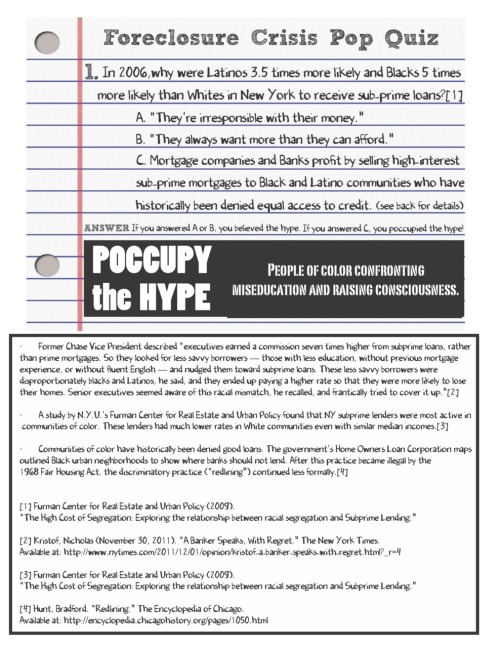
I can't believe I didn't realize this earlier. Ujamaa has #OCCUPY written all over it. "The 99%" as a concept is about as "cooperative" as you can get, and people from all walks of life coming together to fight for the "little guy," trying to make this country's economic system work for the masses, rather than against us, protesting corporate personhood and other evils of capitalism...this is OUR economic fight. It's about demanding fair wages, fair lending practices, corporate responsibility, fair tax policies, balancing the budget without screwing over the people on the bottom rungs of the economic ladder, and most importantly, EQUALITY OF OPPORTUNITY. It's about not letting ourselves be stepped on/over on other people's way to the top. And it's a worldwide movement, just like the Diaspora has made us worldwide peoples. 

And people of color ARE involved in the Occupy movement, even if the mainstream media isn't really perpetuating that idea:


Source
Source
Source
Source
Source
 

Am I too old to want a bedroom that looks like this?

Reblogged from Paper Pensive
...Do people get laid in bedrooms that look like this? One could argue that it's perfect mood lighting. I've always wanted a canopy-like structure and lots of interesting lights; in middle school, I had rope lights, a lava lamp, and glow in the dark stars on my ceiling, but I always wished it all worked together in a more cohesive fashion like this.

Anyway, *want* 

Wednesday, December 28, 2011

Am I My Brothers' (And Sisters') Keeper?

The principle for the third day of Kwanzaa is Ujima, or "collective work and responsibility". 

The metaphorical jury in my head is still out on whether any random Black person has some larger responsibility to Black peoples everywhere, to "give back" to communities s/he may or may not have been raised by, to represent "the race" in a "positive" light, or (and I struggle with this last bit) even to associate with the larger "community". A year ago, I would have unequivocally said yes to all of those statements, but since then my understandings of personal freedom, choice, and statements about what anyone "should" or "should not" be/do have grown immensely, and I'm no longer comfortable putting restrictions or regulations on anyone's sense of self and personal responsibility. Who am I to say what anyone else should do or be? I claim no authority over others.

So how can I talk about doing things collectively as a principle? How does this principle even sit with me? Well, firstly, doing work for and of Black peoples is important to me. Though I don't know if I HAVE to, I do feel a responsibility for talking about Blackness as a personal and a collective experience, which broadens into a feeling of responsibility for tackling issues pertaining to experiences of Blackness, person-of-color-ness, womanness, non-dominant-sexual-orientation-ness, and other minority experiences in this country. It would make me happy if everyone felt this need to tell their own stories and the stories of those who are often left out. To me, it seems that would be our collective responsibility as human beings, that all our brethren and all their struggles might be recognized as legitimate and significant. I'm not demanding selflessness, and maybe this is just a product of having been raised in a Judeo-Christian society, but I just can't see excessive greed as a productive means of life in modern society. I can't say that people of any certain race have a responsibility to other members of that same race, but I think it's pretty obvious that we as humans are responsible to humanity. Let's work on that.

I might have just stumbled upon a new theme song:

Hairspiration

Reblogged from 18° 15' N, 77° 30' W
Reblogged from Fuck Yeah Curls Curls Curls

Talk to me...

Reblogged from 18° 15' N, 77° 30' W
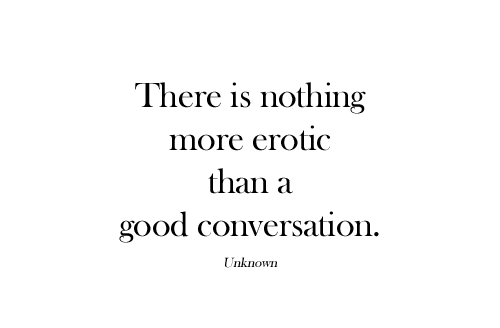
...except maybe a good dance, but these things are erotic in different ways, I guess. A good conversation makes me want to keep you around for a while, whereas a good dance makes me want you right now and then I don't really care if I see you again. A good conversation is enticing.

Tuesday, December 27, 2011

I absolutely love this piece.

Reblogged from On the Bright Side

This makes me smile :)

Reblogged from Treasured Tresses

In further recognition of Kujichagulia,

I give you the song that is both my ringtone and my life motto:

This little girl.

I WISH I had been as aware of social injustice and product manipulation when I was a kid. I loved playing with my brother's Rock 'Em Sock 'Em Robots, and he would deign to play Ken when I was playing with my Barbies, and we both happily played with androgynous toys like Legos and K'NEX, but to actually ASK FOR products targeted at the other gender was beyond me in my youth. But this child sees through the lies and blasphemy to question gendered socialization, and I want to applaud both her and her parents. 


Continuing goal: to be in harmony with my true self

A woman in harmony with her spirit is like a river flowing. She goes where she will without pretense and arrives at her destination, prepared to be herself and only herself. ~Maya Angelou

This is in the spirit of the second day of Kwanzaa, Kujichagulia, which means "self-determination." Which, when you think about it, is really the entire point of this blog and this period of my life in general. I am on a mission to create and define myself, and then live according to that definition, making revisions and adding things when needed. I have no problem with code-switching contextually--in fact, I think it's a necessary life skill when your life involves interacting with peoples of various backgrounds and social locations--but I am determined to never lose myself in a web of shoulds, shouldn'ts, supposed tos, woulds, or what's "proper" again. Being myself and living according to my own standards seems like the most proper thing imaginable. I'm not hiding from who I am anymore; rather, I'm actively exploring and excavating to get to know myself better and better, to know the limits of who I am and what I believe. This means I am free to change my opinion things as I learn and change and grow, and free to engage in practices I once would have frowned upon, or to frown upon things I once would have engaged in. I'm free to do whatever the fuck I want, as long as it resonates within me and I don't get caught breaking too many laws. I feel freer than I've felt in many years, and I'm pretty sure this journey I've embarked on will be life-long.

This is my favorite day of Kwanzaa. :) 


Monday, December 26, 2011

Today is the first day of Kwanzaa

and while I don't officially celebrate Kwanzaa, I respect it as an entity, and feel the need to defend it from haters like my bestie K. Hence, this post. 

A little background: Kwanzaa is a week-long holiday created by Dr. Maulana Karenga, a major figure in the Black Power Movement of the 60s and 70s, to "give Blacks an alternative to the existing holiday and give Blacks an opportunity to celebrate themselves and history, rather than simply imitate the practice of the dominant society." There are seven principles, each with a day devoted to it and represented by a red, green, or black candle that goes into a specific place in the kinara, a special candleholder. You're supposed to spend each day reflecting and talking about the principle with your family and friends, and each night feasting and exchanging gifts (which may or may not be supposed to be handmade as a rebellion against American consumer culture.) And that's a little much even for a self-righteous Black woman like myself, because I have no problems with Santa (who was Black in my house anyway, but that's another story for another time), and I hit up the after-Christmas sales LIKE A BOSS today, but I like the spirit of the celebration nonetheless. I like that it's something created by and for our peoples as a way of celebrating whatever it is that connects all of us Diasporic individuals.
Growing up, my family usually lit the candles, and my dad usually mailed me a Kwanzaa card, but I wouldn’t go so far as to say we legitimately celebrated Kwanzaa. As I’ve gotten older and have to start thinking about which traditions from my childhood to keep and which to let go of, I’ve decided that I want to start taking Kwanzaa more seriously. I don’t know if I’ll go so far as to make and exchange gifts for each of the days, but I want to get a kinara, light the candles on each day, and spend some time at the very least seriously reflecting on each of the principles, hopefully engaging in discussion with friends and family about them.
I don’t understand people who criticize it for being “made up;” how is it any more made up than the secular version of Christmas or Easter or any other (even non-religious) holiday? All holidays are social constructions, and I like the principles and values this particular holiday tries to construct us around. Maybe people who dress in “traditional African clothing” or go around speaking languages that originated in Africa or cooking foods from various African countries for this week ONLY every year might be “faking it” or “making it up,” but I think that just by being a socially conscious person of African descent in this world, I am living my culture every single day–on these particular days, I’m just reflecting on specific principles that may add strength and depth to my own understanding of that very culture. And I see no problems with that.


That being said, today's principle is Umoja, which means "unity" in Swahili. It is a day for reuniting with friends and family, and more broadly, for thinking about ties that bind. I spent this whole semester taking "Diversity in Black America," and after 12 weeks I say "Black peoples" and "Black cultures" and "Black identities," yet I don't believe it's possible to walk away from this concept of "out of many, one." Sure we may come from as many different backgrounds as you can possibly imagine and go through quite a range of experiences and have diverse interests and have been raised in cultures that are nothing like one another's and have different languages, vocabularies, styles, and tastes...but there is something that keeps "the Black head nod" and the either gravitation towards or strict avoidance of the other Black person in the room when you're few and far between in some social setting. Maybe that something is nothing more than the legacy of racism in this country, which has molded us all within a racialized understanding of the world, and maybe it's something more, but whatever it is, it is, and that is fine as long as we can still come together in our difference.
Unity is not casting out members of our communities for being different. It's accepting those who are Black and Women, who are Black and LGBTQQIA, who are Black and nerdy/awkward, and even who are Black and Republican. It's recognizing the "Black card" and terms like "oreo" and "sell-out" as ridiculous entities that no one has the authority to project onto anyone else. I think the truest form of solidarity to which we can strive as Black peoples, or even as human beings on this great green earth, is just to accept each other for that which we are without trying to quantify the authenticity or validity of anyone's sense of self. Recognizing that I am what I am, you are what you are, and we are what we are...that is being united.