 |
| Reblogged from Tudo Bom(b) |
Saturday, December 29, 2012

I don't understand why Bill Clinton is a political figure I'm supposed to like as a Black person.
I'm not even going to touch on the RAGE that overtakes me whenever anyone refers to him as the first Black president (or when someone refers to Obama as the first LGBT president). I'm just going to put a few paragraphs from Michelle Alexander's The New Jim Crow: Mass Incarceration in the Age of Colorblindness (pg. 57-58) here for you to ponder.
"...in 1992, presidential candidate Bill Clinton vowed that he would never permit any Republican to be perceived as tougher on crime than he. True to his word, just weeks before the critical New Hampshire primary, Clinton chose to fly home to Arkansas to oversee the execution of Ricky Ray Rector, a mentally impaired Black man who had so little conception of what was about to happen to him that he asked for the dessert from his last meal to be saved for him until the morning. After the execution, Clinton remarked, 'I can be nicked a lot, but no one can say I'm soft on crime.
"Once elected, Clinton endorsed the idea of a federal 'three strikes and you're out' law, which he advocated in his 1994 State of the Union address to enthusiastic applause on both sides of the aisle. The $30 billion crime bill sent to President Clinton in August 1994 was hailed as a victory for the Democrats, who 'were able to wrest the crime issue from the Republicans and make it their own.' The bill created dozens of new federal capital crimes, mandated life sentences for some three-time offenders, and authorized for than $16 billion for state prison grants and expansion of state and local police forces. Far from resisting the emergence of the new caste system, Clinton escalated the drug war beyond what conservatives had imagined possible a decade earlier. As the Justice Policy Institute has observed, 'the Clinton Administration's 'tough on crime' policies resulted in the largest increases in federal and state prison inmates of any president in American history.
"Clinton eventually moved beyond crime and capitulated to the conservative racial agenda on welfare. This move, like his 'get touch' rhetoric and policies, were part of a grand strategy articulated by the 'new Democrats' to appeal to the elusive White swing voters. In so doing, Clinton--more than any other president--created the current racial undercaste. He signed the Personal Responsibility and Work Opportunity Reconciliation Act, which 'ended welfare as we know it,' replacing Aid to Families with Dependent Children (AFDC) with a block grant to states called Temporary Assistance for Needy Families (TANF). TANF imposed a five-year lifetime limit on welfare assistance, as well as a permanent, lifetime ban on eligibility for welfare and food stamps for anyone convicted of a felony drug offense--including simple possession of marijuana.
"Despite claims that these radical policy changes were driven by fiscal conservatism--i.e., the desire to end big government and slash budget deficits--the reality is that government was not reducing the amount of money devoted to the management of the urban poor. It was radically altering what the funds would be used for. The dramatic shift toward punitiveness resulted in a massive reallocation of public resources. By 1996, the penal budget doubled the amount that had been allocated to AFDC or food stamps. Similarly, funding that had once been used for public housing was being redirected to prison construction. During Clinton's tenure, Washington slashed funding for public housing by $17 billion (a reduction of 61 percent) and boosted corrections by $19 billion (an increase of 171 percent), 'effectively making the construction of prisons the nation's main housing program for the poor.'
"Clinton did not stop there. Determined to prove how 'tough' he could be on 'them,' Clinton also made it easier for federally assisted public housing projects to exclude anyone with a criminal history--an extraordinarily harsh step in the midst of a drug war aimed at racial and ethnic minorities. In his announcement of the 'One Strike and You're Out' Initiative, Clinton explained: 'From now on, the rules for residents who commit crime and peddle drugs should be one strike and you're out.' The new rule promised to be 'the toughest admission and eviction policy that HUD has implemented.' Thus, for countless poor people, particularly racial minorities targeted by the drug war, public housing was no longer available, leaving many of them homeless--locked out not only of mainstream society, but their own homes."

"Some problems we share as women, some we do not. You [white women] fear your children will grow up to join the patriarchy and testify against you; we fear our children will be dragged from a car and shot down in the street, and you will turn your backs on the reasons they are dying."
--Audre Lorde, “Age, Race, Class, and Sex: Women Redefining Difference”
(via WYSIWYG)
(via WYSIWYG)
Friday, December 28, 2012
Always relevant.
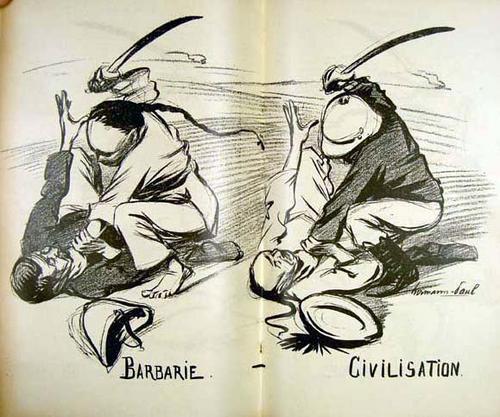 |
| Hermann-Paul, « Barbarie. Civilisation », Le Cri de Paris, n° 1900, 7/10/1899, via WYSIWYG |
"To be in good moral condition requires at least as much training as to be in good physical condition."
--Jawaharlal Nehru
(via WYSIWYG)
Thursday, December 27, 2012

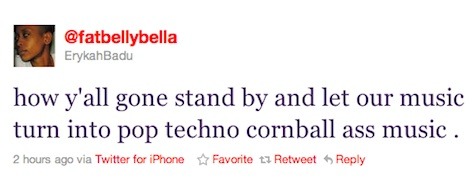
THIS.
"The thing that sucks about Girls and Seinfeld and Sex and the City and every other TV show like them isn’t that they don’t include strong characters focusing on the problems facing blacks and Latinos in America today. The thing that sucks about those shows is that millions of black people look at them and can relate on so many levels to Hannah Horvath and Charlotte York and George Costanza, and yet those characters never look like us. The guys begging for money look like us. The mad black chicks telling white ladies to stay away from their families look like us. Always a gangster, never a rich kid whose parents are both college professors. After a while, the disparity between our affinity for these shows and their lack of affinity towards us puts reality into stark relief: When we look at Lena Dunham and Jerry Seinfeld, we see people with whom we have a lot in common. When they look at us, they see strangers."
--Cord Jefferson, Hipster Racism Runoff And The Search for The Black Costanza
(via Racialicious)
...This might actually sum up most of my problem with pop culture. Wow.



I fundamentally don't understand people who don't enjoy reading.
"That is part of the beauty of all literature. You discover that your longings are universal longings, that you’re not lonely and isolated from anyone. You belong."
--F. Scott Fitzgerald
The best moment of my Christmas vacation
was not opening my presents.
It was not seeing my family eat the cookies and pie that I so lovingly made.
It was not baking said cookies with TN, or surprising TJ and DH with them.
It wasn't watching The Preacher's Wife with my mom.
It wasn't my little brother actually helping us decorate the tree.
It wasn't snuggling with FO on his couch.
It wasn't breakfast with SH.
It wasn't dinner, though that was delicious.
For a while, I thought it was going to be the moment my mother's look of confusion blossomed into a look of joyful recognition as she recognized what Garmin is a brand of.
But something tiny beat all of that. After dinner and present-opening at my grandmother's house, my little 9 year old cousin was sitting in the living room as we were talking about my little sister's first semester of college.
Cousin: I already know what college I want to go to.
Me: Oh really? What college do you want to go to?
Cousin: Princeton! ...Or Old Miss because it was in The Blind Side.(later)
Me: Why hasn't anyone tried my pie yet? No one appreciates me.
Cousin: I appreciate you, Maya. You inspire me to do lots of things.
"People of color have to learn White culture for survival. White people learn Brown and Black culture for 'ghetto' jokes."
--Sara David
(via Free Bird)
It may surprise much of my readership, but I actually pretty vehemently disagree with this quote as a blanket statement.
First, I would like to henceforth officially dismiss the term "[race/ethnicity] culture" from any and all popular discourse. Every group of people, no matter how specific you get to narrow them down, has cultures, plural. Urban Northern Black culture is very different from rural Southern Black culture, which is very different from Afro-Caribbean culture, which is very different from the cultures of recent African immigrants. The same goes for the cultures of various places in Latin America--Mexican culture is not Cuban culture is not Dominican culture is not Brazilian culture, etc. Even White culture is not a monolith--think about Midwestern US culture v. Californian surfer culture v. preppy New England culture. This is just an improper standpoint from which to discuss anything.
Secondly, I feel like this quote assumes that people of color grow up in environments mainly or entirely composed of other people of color, and have to venture out into the White world and fight and learn on their feet to make it because everything is so different. Bitch, please. My first best friend was White (as were the overwhelming majority of my closest friends until college), the first boy I couples skated with at our local skating rink was White, my first kiss was with a White boy, all of my teachers were White until high school. I could go on. Things typically described as "Black culture" involved much more active trying to learn on my part, as they were not part of my everyday lived experiences. What are you calling White culture here, anyway? Are you equating it with mainstream culture? Like, pop music and sitcoms? Because NSYNC was the first concert I had tickets to and Boy Meets World and Sabrina the Teenage Witch were as much a part of my childhood as The Cosby Show and Sister, Sister. You're arrogant as fuck if you assume that all Black and Brown people grew up outside of the mainstream.
Thirdly, and this is related to my first point, I don't think that every time a White person, or a person of any race, for that matter, adopts things that are generally associated with persons of another race, they do so with malice in their hearts. Also, I don't agree with the idea that people of a certain race somehow have a more authentic claim to certain elements generally assumed under "[that race]'s culture"--for example, during a conversation with WYSIWYG a few weeks ago, I shocked her by saying
"I don't really see why teen white boy asshat who thinks he's legit because he listens to rap is really that much different than teen black boy asshat who thinks he's legit because he listens to rap. Sure, we started it, but why does that give us some universal claim of authentically owning [rap music] or something? It's a culture you can play into or not play into."And that's a viewpoint I stand by. If you try to tell me there are no Black and Brown people in the world making ghetto jokes, you're a damned liar. I don't see why the offensiveness of a 'ghetto' joke should vary depending upon the color of the skin of the person who makes the joke, just like I don't see why we assume that Black and Brown people are somehow more significantly linked to "the ghetto" than are White people. You're either of that kind of a background/situation or you're not. End of story.
Sincerely,
A Black Girl who Grew Up in Suburbia
Monday, December 24, 2012
"I don't know if I continue, even today, always liking myself. But what I learned to do many years ago was to forgive myself. It is very important for every human being to forgive herself or himself because if you live, you will make mistakes--it is inevitable. But once you do and you see the mistake, then you forgive yourself and say, 'Well if I'd known better, I'd have done better,' that's all. So you say to people you think you may have injured, 'I'm sorry,' and then you say to yourself, 'I'm sorry.' If we all hold on to the mistake, we can't see our own glory in the mirror because we have the mistake between our faces and the mirror; we can't see what we're capable of being. You can ask forgiveness of others, but in the end the real forgiveness is in one's own self. I think that young men and women are so caught by the way they see themselves. Now mind you, when a larger society see them as unattractive, as threats, as too Black, or too White, or too poor, or too fat, or too thin, or too sexual, or too asexual, that's rough. But you can overcome that. The real difficulty is to overcome how you think about yourself. If we don't have that, we never grow, we never learn, and sure as hell we should never teach."
--Maya Angelou
(via Free Bird)
Thursday, December 20, 2012
Mini-doc on being Afro-Latino
You should watch it. It's a gem. Intersectionality for the muthafuckin win.
Going to this guy's book talk at Busboys was awesome.
Because none of you, dearest readers, were there, I bring you this tidbit from deep in the realms of YouTube:
Wednesday, December 19, 2012
On Phantom Negro Weapons
Phantom Negro Weapons are those weapons which White Americans report black people having but which are never found for some strange reason.
Examples:
1999: Amadou Diallo - shot 41 times, hit 19 times, died. His gun shapeshifted into a wallet.
2006: Sean Bell - shot 51 times and died after one of his friends reached for his gun. The gun cloaked itself and was never found.
2009: Oscar Grant - shot dead when he reached for his gun. Since it was a Phantom Negro Weapon, police failed to find it when they searched him before putting him face down on the ground.
2011: Kenneth Chamberlain - shot dead when he threatened armed policemen with a butcher’s knife. The knife, of course, being a Phantom Negro Weapon, did not appear on the video recording.
2012: Ramarley Graham - the gun in his waistband cloaked itself after police shot him dead in front of his grandmother.
2012: Trayvon Martin – no weapon was reported, but the way his killer acted you would think his Arizona iced tea and bag of Skittles had shapeshifted from something far more deadly.
2012: Rekia Boyd - was killed when police shot at Antonio Cross, whose gun shapeshifted into a mobile phone.
2012: Jordan Davis - killed after threatening Michael Dunn with a shotgun rather than turning down his music. The police were unable to find the shotgun. Maybe it will still turn up, but more likely it was Phantom Negro Weapon which has cloaked itself.
(via Sister Outsider)
Subscribe to:
Posts (Atom)