Reblogged from WYSIWYG
"White American children in this country who become victims of gun violence are a sign of shattered innocence, an anomaly that must be analyzed and dissected to ensure that it doesn’t happen again. Black and Brown American children who become victims serve as an indictment of our communities, our homes and our parenting."
"With you, intimacy colours my voice. Even 'hello' sounds like 'come here.'"
"Somebody told a real life woman that her skin was too brown to play an imaginary creature. That basically in the whole fictional world of Lord of the Rings and The Hobbit, where you have dragons and trolls and talking trees, where you draw the line, where imagination is capped out, no more room, is for a brown hobbit.
"Like, fiery eyeball thing, no problem, but don't even try to imagine a Samoan elf. That shit will blow your mind."
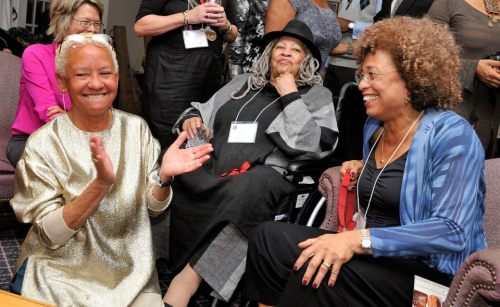 | |
| Nikki Giovanni, Toni Morrison, and Angela Davis talking and laughing about something. Reblogged from Racialicious |
"You are not responsible for the programming you picked up in childhood. However, as an adult, you are one hundred percent responsible for fixing it."
"Twenty-two children injured [by a knife attack in China]. Versus, at current count, 18 little children and nine other people shot dead. That’s the difference between a knife and a gun. Guns don’t attack children; psychopaths and sadists do. But guns uniquely allow a psychopath to wreak death and devastation on such a large scale so quickly and easily. America is the only country in which this happens again — and again and again. You can look it up."
"Imagine you are Emma Faye Stewart, a thirty-year-old, single African-American mother of two who was arrested as part of a drug sweep in Hearne, Texas. All but one of those people arrested were African-American. You are innocent. After a week in jail, you have no one to care for your two small children and are eager to get home. Your court-appointed attorney urges you to plead guilty to a drug distribution charge, saying the prosecutor has offered probation. You refuse, steadfastly proclaiming your innocence. Finally, after almost a month in jail, you decide to plead guilty so you can return home to your children. Unwilling to risk a trial and years of imprisonment, you are sentenced to ten years probation and ordered to pay $1,000 in fines, as well as court and probation costs. You are also now branded a drug felon. You are no longer eligible for food stamps; you may be discriminated against in employment; you cannot vote for at least twelve years; and you are about to be evicted from public housing. Once homeless, your children will be taken away from you and put in foster care.
"A judge eventually dismisses all cases against the defendants who did not plead guilty. At trial, the judge finds that the entire sweep was based on the testimony of a single informant who lied to the prosecution. You, however, are still a drug felon, homeless, and desperate to regain custody of your children.
"Now place yourself in the shoes of Clifford Runoalds, another African-American victim of the Hearne drug bust. You returned home to Bryan, Texas, to attend the funeral of your eighteen-month-old daughter. Before the funeral services begin, the police show up and handcuff you. You beg the officers to let you take one last look at your daughter before she is buried. The police refuse. You are told by prosecutors that you are needed to testify against one of the defendants in a recent drug bust. You deny witnessing any drug transaction; you don't know what they are talking about. Because of your refusal to cooperate, you are indicted on felony charges. After a month of being held in jail, the charges against you are dropped. You are technically free, but as a result of your arrest and period of incarceration, you lose your job, your apartment, your furniture, and your car. Not to mention the chance to say good-bye to your baby girl.
"This is the War on Drugs."
"We all have a blind spot around our privileges shaped exactly like us.
And I’m telling you guys, we’re never fucking going to get anywhere as long as our economies of attraction continue to resemble more or less the economies of attraction of white supremacy. Finding people who practice decolonial love is as hard inside of a vast movement as it is outside. The actual standard of decolonial love, how little discussed, how little understood, and yet in many ways is the great test of who we are and of our praxis and of our communal praxis."
"The important thing is that we cease treating sex as something shameful, and an aspect of life separate from all the rest. We need to make decisions about sex and evaluate them in the same framework which we use to judge worth of our other capacities, be they our intelligence, intuitions, physical stamina or prowess, or other special talents."
"...harsh mandatory minimum sentences for drug offenders have been consistently upheld by the U.S. Supreme Court. In 1982, the Supreme Court upheld forty years of imprisonment for possession and an attempt to sell 9 ounces of marijuana. Several years later, in Harmelin v. Michigan, the Court upheld a sentence of life imprisonment for a defendant with no prior convictions who attempted to sell 672 grams (approximately 23 ounces) of crack cocaine. The Court found the sentences imposed in those cases 'reasonably proportionate' to the offenses committed--and not 'cruel and unusual' in violation of the Eighth Amendment. This ruling was remarkable given that, prior to the Drug Reform Act of 1986, the longest sentence Congress had ever imposed for possession of any drug in any amount was one year. A life sentence for a first-time drug offense is unheard of in the rest of the developed world. Even for high-end drug crimes, most countries impose sentences that are measured in months, rather than years. For example, a conviction for selling a kilogram of heroin yields a mandatory ten-year sentence in U.S. federal court, compared with six months in prison in England. Remarkably, in the United States, a life sentence is deemed perfectly appropriate for a first-time drug offender."
"I will have an undergraduate class, let’s say a young white male student, politically-correct, who will say: “I am only a bourgeois white male, I can’t speak.” … I say to them: “Why not develop a certain degree of rage against the history that has written such an abject script for you that you are silenced?” Then you begin to investigate what it is that silences you, rather than take this very determinist position-since my skin colour is this, since my sex is this, I cannot speak… From this position, then, I say you will of course not speak in the same way about the Third World material, but if you make it your task not only to learn what is going on there through language, through specific programmes of study, but also at the same time through a historical critique of your position as the investigating person, then you will have earned the right to criticize, you be heard. When you take the position of not doing your homework- “I will not criticize because of my accident of birth, the historical accident” - that is the much more pernicious position."
"The 'drug-courier profiles' utilized by the DEA and other law enforcement agencies for drug sweeps on highways, as well as in airports and train stations, are notoriously unreliable. In theory, a drug-courier profile reflects the collective wisdom and judgment of a law enforcement agency's officials. Instead of allowing each officer to rely on his or her own limited experience and biases in detecting suspicious behavior, a drug-courier profile affords every officer the advantage of the agency's collective experience and expertise. However, as legal scholar David Cole has observed, 'in practice, the drug-courier profile is a scattershot hodgepodge of traits and characteristics so expansive that it potentially justifies stopping anybody and everybody.' The profile can include traveling with luggage, traveling without luggage, driving an expensive car, driving a car that needs repairs, driving with out-of-state license plates, driving a rental car, driving with 'mismatched occupants,' acting too calm, acting too nervous, dressing casually, wearing expensive clothing or jewelry, being one of the first to deplane, being one of the last to deplane, deplaning in the middle, paying for a ticket in cash, using large-denomination currency, using small-denomination currency, traveling alone, traveling with a companion, and so on. Even striving to obey the law fits the profile! The Florida Highway Patrol Drug Courier Profile cautioned troopers to be suspicious of 'scrupulous obedience to traffic laws.' As Cole points out, 'such profiles do not so much focus an investigation as provide law enforcement officials a ready-made excuse for stopping whomever they please.'"